
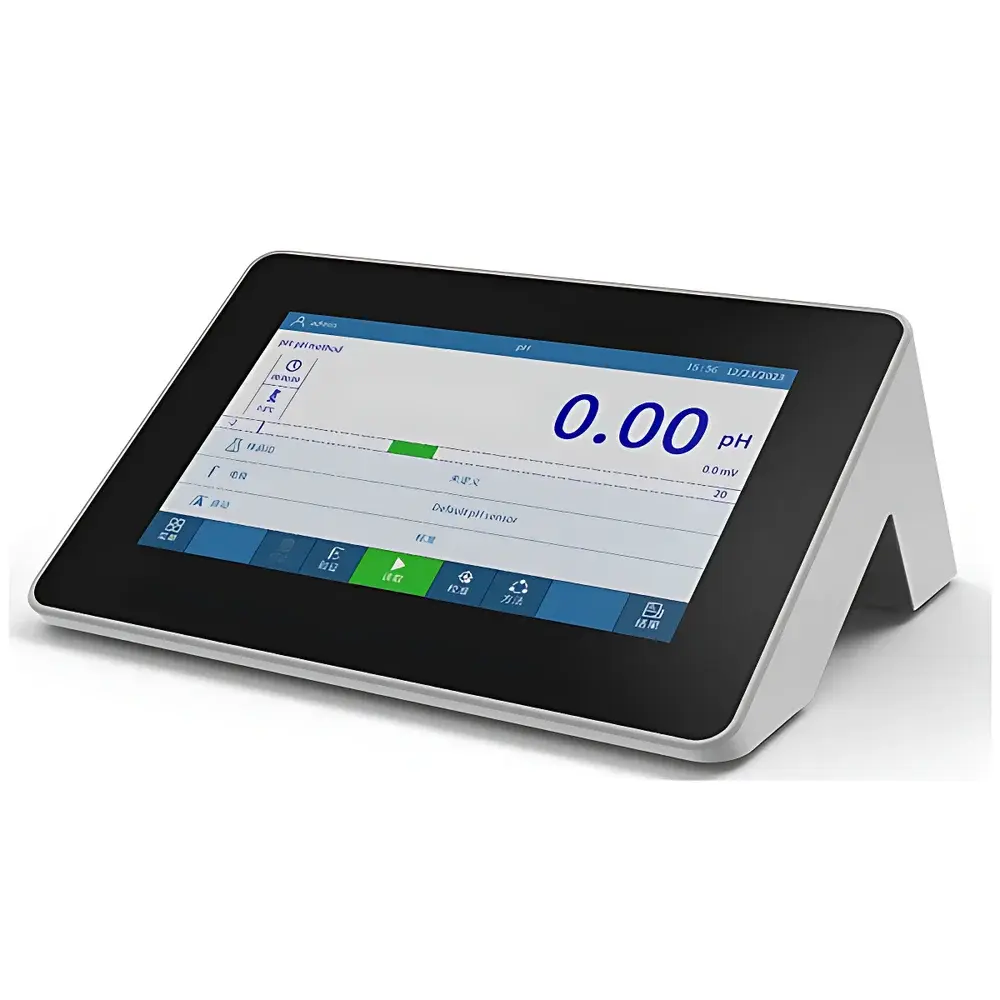
Yoke M901 High-Precision Benchtop pH Meter
| Brand | Yoke |
|---|---|
| Origin | Shanghai, China |
| Manufacturer Type | Direct Manufacturer |
| Instrument Type | Benchtop |
| Parameter Type | Single-Parameter (pH/mV) |
| pH Measurement Range | −2.00 to 20.00 |
| pH Resolution | 0.001 |
| mV Resolution | 0.1 mV |
| Display | 7-inch Color Touchscreen |
| Temperature Compensation | Integrated High-Stability Temperature Electrode (Auto/Manual Input) |
| Calibration | Auto-Recognition of Standard Buffers, 1–3 Point Calibration |
| Data Compliance | GLP-Compliant Logging with Audit Trail |
| Enclosure Rating | IP54 |
| Stirring | Built-in Magnetic Stirrer |
| User Management | Multi-Level Access Control |
| Method Storage | Programmable Test Methods with Recall Function |
| Connectivity | USB Host (U-disk), RS232 (Printer/PC), Optional Ethernet |
Overview
The Yoke M901 is a high-precision benchtop pH meter engineered for laboratories requiring rigorous electrochemical measurement integrity in routine quality control, research, and regulatory-compliant environments. It operates on the fundamental principle of potentiometric measurement—detecting the potential difference between a glass pH electrode and a reference electrode immersed in an aqueous sample, converting it into a pH value via the Nernst equation. Designed for trace-level accuracy, the M901 delivers a resolution of 0.001 pH units across its full range of −2.00 to 20.00 pH, enabling reliable characterization of highly acidic, neutral, and strongly alkaline solutions—including non-aqueous or low-ionic-strength matrices where electrode response stability is critical. Its integrated temperature-sensing electrode supports automatic temperature compensation (ATC) using either Pt1000 or thermistor-based input, minimizing thermal drift and ensuring thermodynamic consistency per ISO 3696 and ASTM E70.
Key Features
- 7-inch high-resolution color touchscreen interface with intuitive icon-driven workflow navigation—guiding users through calibration, verification, and measurement without reliance on external manuals.
- Built-in magnetic stirrer with adjustable speed control, eliminating manual agitation and enhancing reproducibility during endpoint stabilization.
- Real-time electrode health monitoring: automatic logging of calibration history, slope, offset, and asymmetry potential; configurable expiration alerts based on usage cycles or elapsed time.
- Multi-level user authentication (administrator, supervisor, operator) with role-based permissions—ensuring data integrity, preventing unauthorized configuration changes, and supporting 21 CFR Part 11 readiness when paired with validated software.
- IP54-rated enclosure provides protection against dust ingress and incidental liquid splashes—suitable for shared lab environments with variable ambient conditions.
- Flexible connectivity suite: dual USB host ports (for U-disk data export and peripheral control), RS232 serial interface (for legacy printers or PC integration), and optional Ethernet module for networked data transfer and remote diagnostics.
Sample Compatibility & Compliance
The M901 accommodates standard combination pH electrodes (BNC or DIN connectors) and supports both aqueous and semi-aqueous samples, including buffers, pharmaceutical formulations, food extracts, wastewater effluents, and electroplating baths. Its extended pH range (−2.00–20.00) enables valid measurements in concentrated NaOH/KOH solutions and aggressive acid digestions. All calibration and measurement records comply with Good Laboratory Practice (GLP) requirements: timestamps, operator ID, electrode ID, environmental temperature, calibration buffer lot numbers, and raw mV values are stored with immutable audit trails. The system meets ISO/IEC 17025 documentation expectations for accredited testing labs and supports validation protocols aligned with USP , EP 2.2.3, and CLSI C3-A4.
Software & Data Management
Internal firmware implements hierarchical data architecture: each measurement is tagged with customizable Sample ID, Batch ID, and Location metadata. Up to 2,000 full measurement records—including calibration reports, stability logs, and method parameters—are retained onboard. Data export formats include CSV (for Excel/LIMS import) and PDF (for signed reports). Method templates—preconfigured with calibration schedules, endpoint criteria (e.g., ±0.002 pH/10 s), temperature compensation models, and report headers—can be saved, versioned, and recalled instantly. Optional Yoke LabLink software extends functionality with trend analysis, statistical process control (SPC) charts, and automated backup to network drives or cloud repositories under IT-administered security policies.
Applications
- Pharmaceutical QC: pH verification of injectables, ophthalmic solutions, and buffer preparation per USP monographs.
- Food & Beverage: titratable acidity assessment, fermentation monitoring, and shelf-life stability testing.
- Environmental Labs: EPA Method 9040C-compliant pH analysis of soil leachates and surface waters.
- Academic Research: Kinetic studies involving proton-coupled electron transfer, where sub-millipH resolution impacts reaction modeling fidelity.
- Chemical Manufacturing: In-process control of caustic scrubbers, catalyst slurries, and polymerization media.
FAQ
Does the M901 support automatic calibration verification (ACV) with certified reference materials?
Yes—the instrument recognizes common NIST-traceable pH standards (4.01, 7.00, 10.01 at 25 °C) and calculates calibration uncertainty based on measured slope and zero-point deviation.
Can historical calibration data be exported for internal audit review?
Absolutely—all calibration events—including date/time, operator ID, buffer IDs, measured mV, calculated slope (%), and offset (mV)—are exportable as timestamped CSV files with no post-hoc editing capability.
Is the built-in stirrer compatible with all standard lab beakers and sample containers?
The stir bar coupling is optimized for vessels 50–500 mL in volume; maximum recommended viscosity is 500 mPa·s to maintain consistent mixing kinetics without motor stall.
How does the system handle electrode drift during prolonged measurements?
The M901 applies dynamic endpoint detection: users define stability thresholds (e.g., ΔpH ≤ 0.001 over 15 seconds); the system pauses acquisition until criteria are met, reducing operator bias and improving inter-day repeatability.
What cybersecurity measures are implemented for network-connected units?
When equipped with Ethernet, the device supports TLS 1.2 encrypted data transmission, configurable firewall rules, and certificate-based authentication—aligned with IEC 62443-3-3 SL2 requirements for industrial lab instrumentation.




