
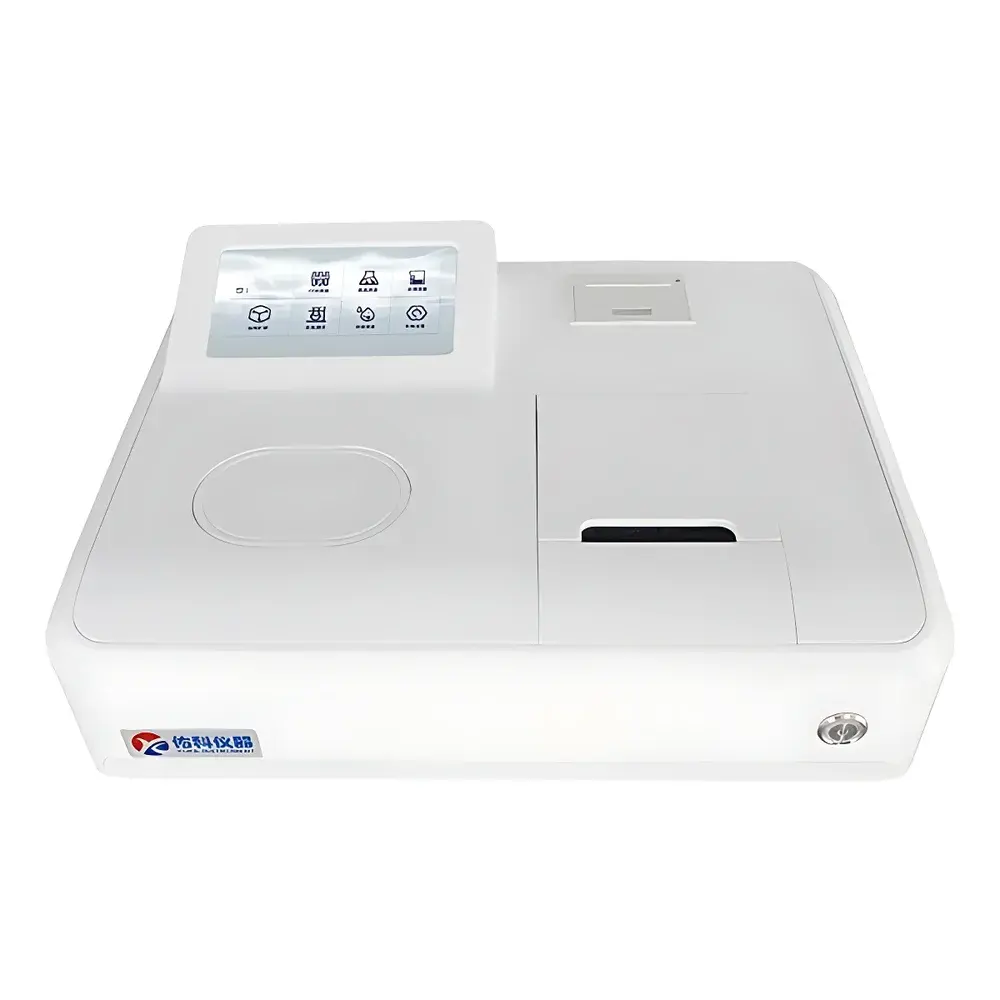
Yoke ITS2003 Multi-Parameter Water Quality Analyzer
| Brand | Yoke |
|---|---|
| Origin | Shanghai, China |
| Manufacturer Type | Direct Manufacturer |
| Product Category | Domestic Lab-Based Water Quality Analyzer |
| Model | ITS2003 |
| Price Range | USD 1,400 – 4,200 (FOB Shanghai) |
| Instrument Type | Benchtop Laboratory Water Quality Analyzer |
| Measurable Parameters | COD, Ammonia-N, Total Phosphorus, Total Nitrogen (any three simultaneously configurable) |
| Wavelength Accuracy | ±0.5 nm |
| Display | 5.6-inch TFT Color Touchscreen GUI |
| Data Storage | ≥5,000 test records |
| Preloaded Calibration Curves | 5 factory curves + 195 expandable user-defined curves |
| Light Source | Cold LED with Narrow-Band Interference Filters (Lifespan: ≥100,000 hours) |
| Processor | ARM9 core |
| Internal Memory | 512 MB |
| Connectivity | USB 2.0 port + RS-232 serial interface |
| Integrated Printer | Thermal printer (direct print of real-time & stored data) |
| Reagent Compatibility | Lab-YY pre-formulated reagent kits |
| Regulatory Alignment | Compliant with Chinese national standards HJ/T 399–2007 (COD), HJ 535–2009 (Ammonia-N), GB 11893–1989 (Total Phosphorus), HJ 636–2012 (Total Nitrogen) |
Overview
The Yoke ITS2003 Multi-Parameter Water Quality Analyzer is a benchtop spectrophotometric analyzer engineered for precise, standardized quantification of key water quality parameters in municipal, industrial, and environmental laboratory settings. It operates on the principle of narrow-band interference filter-based absorption photometry, utilizing cold LED light sources across defined spectral bands to detect analyte-specific chromophore formation following standardized colorimetric reactions. Each measurement module—COD, ammonia-nitrogen (NH₃-N), total phosphorus (TP), and total nitrogen (TN)—is implemented per nationally validated methods: COD via rapid dichromate digestion (HJ/T 399–2007), NH₃-N via Nesslerization (HJ 535–2009), TP via molybdate blue reaction (GB 11893–1989), and TN via alkaline persulfate digestion followed by UV absorbance at 220/275 nm (HJ 636–2012). The instrument’s optical architecture features high-stability interference filters with ±0.5 nm wavelength accuracy, minimizing spectral crosstalk and ensuring reproducible absorbance readings under variable ambient conditions.
Key Features
- 5.6-inch capacitive touchscreen interface with intuitive graphical navigation—designed for rapid method selection, parameter configuration, and real-time result visualization without external PC dependency.
- Dual-range measurement capability for each parameter (e.g., COD: 10–100 mg/L and 100–1000 mg/L; NH₃-N: 0.05–100 mg/L in segmented calibration), enabling broad dynamic coverage without manual dilution steps.
- Onboard calibration management supporting up to 195 user-expandable calibration curves, including slope-intercept and multi-point non-linear models; K-factor segmentation allows fine-tuned sensitivity adjustment per concentration range.
- Integrated thermal printer with direct output of current measurements, historical records, and calibration logs—eliminating post-analysis transcription errors and supporting GLP-compliant documentation.
- ARM9-based embedded processing platform with 512 MB internal memory, enabling fast spectral acquisition, background correction, and real-time baseline drift compensation during extended batch runs.
- Cold LED illumination system with >100,000-hour operational lifetime and minimal thermal drift—ensuring long-term photometric stability without lamp replacement or warm-up delays.
- USB 2.0 and RS-232 interfaces for bidirectional data exchange with LIMS, Excel export, and firmware updates; supports FAT32-formatted USB drives for bulk data archival.
Sample Compatibility & Compliance
The ITS2003 accepts standard 16-mm round glass or quartz cuvettes (10 mm pathlength) and is compatible with commercially available Lab-YY pre-dosed reagent kits—reducing preparation time, minimizing analyst error, and enhancing inter-laboratory comparability. Sample matrix tolerance has been verified for municipal wastewater, surface water, groundwater, and treated effluent within specified turbidity (<50 NTU) and chloride (<2000 mg/L) limits per method protocols. All analytical procedures align with China’s Ministry of Ecology and Environment (MEE) and Standardization Administration of China (SAC) regulatory frameworks. While not certified to ISO/IEC 17025 or EPA methods out-of-the-box, its traceable calibration architecture, audit-ready data logging, and method-specific validation support full compliance when integrated into accredited lab quality systems.
Software & Data Management
The embedded firmware implements role-based access control (administrator/user modes), automatic timestamping, and immutable record generation with embedded metadata (operator ID, sample ID, date/time, method version, cuvette ID). Data storage includes full absorbance spectra (320–900 nm), raw transmittance values, and processed concentration outputs. Export formats include CSV and PDF reports with embedded digital signatures. Audit trail functionality logs all critical events—including curve edits, calibration resets, and parameter changes—with operator attribution and timestamps. For regulated environments, optional software modules provide 21 CFR Part 11–compliant electronic signatures and secure user authentication via encrypted credentials.
Applications
The ITS2003 serves as a primary analytical tool in environmental monitoring laboratories conducting routine compliance testing for discharge permits (e.g., GB 8978–1996), drinking water source assessment (GB 3838–2002), and wastewater treatment plant process control. It is routinely deployed for QA/QC in municipal utilities, third-party testing labs, university research facilities, and industrial EHS departments managing cooling tower, boiler feed, or process rinse water. Its modular parameter selection (three of four) enables cost-optimized deployment where TN analysis is infrequent, while retaining full method fidelity and regulatory defensibility.
FAQ
Does the ITS2003 support method validation per ISO 8466 or US EPA guidelines?
It provides the foundational hardware and software capabilities required for method verification (linearity, LOD/LOQ, precision, recovery); however, full validation must be performed in-house per applicable regulatory requirements.
Can custom calibration curves be exported/imported between instruments?
Yes—via USB drive using standardized XML schema; curve metadata (date, operator, reference standard lot) is preserved during transfer.
Is the thermal printer compatible with continuous label stock?
No—it accepts only standard 57-mm thermal paper rolls (max 30 mm diameter); ribbon-free operation ensures low-maintenance field use.
What is the recommended maintenance interval for optical alignment?
None—interference filter assembly is factory-aligned and sealed; periodic verification using NIST-traceable neutral density filters is advised annually.
How does the ITS2003 handle high-chloride interference in COD measurement?
The rapid dichromate method includes mercury sulfate masking; users must select appropriate reagent kits rated for chloride concentrations up to 2000 mg/L per HJ/T 399–2007 Annex B.







