
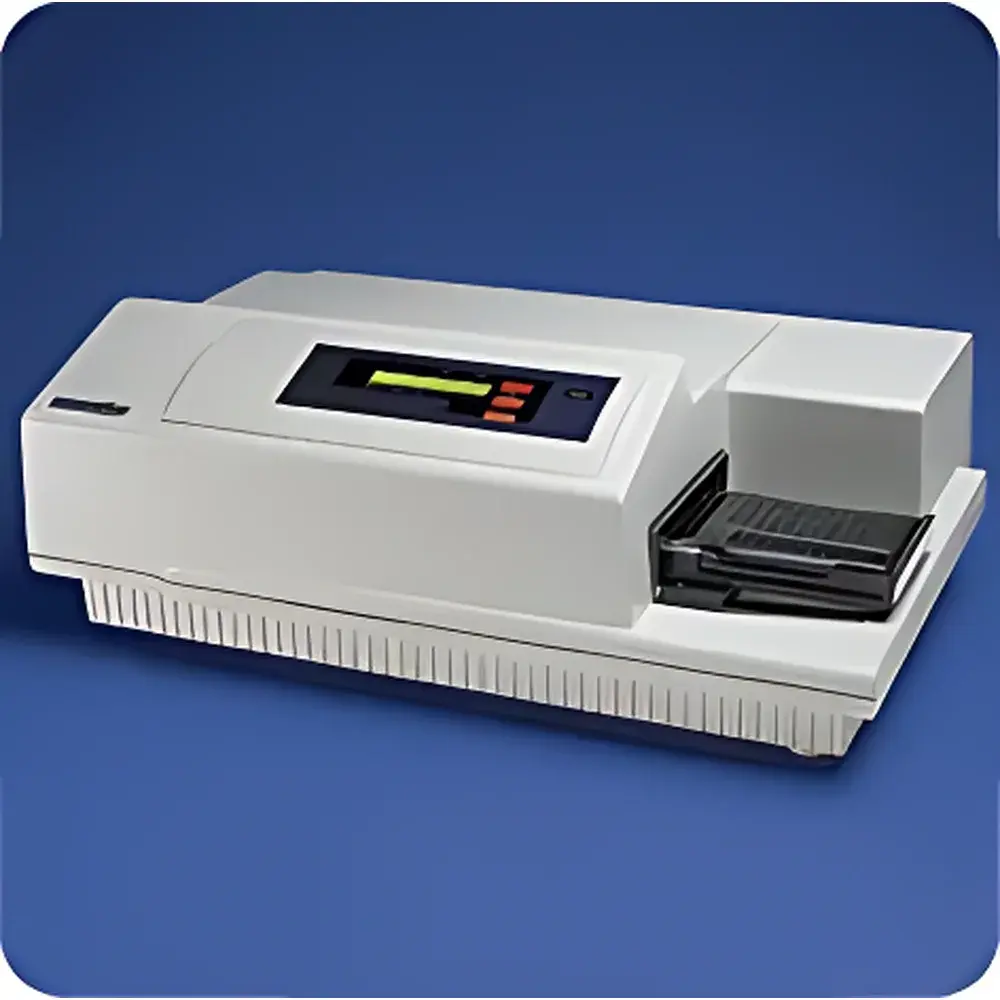
SpectraMax Gemini XPS Fluorescence Microplate Reader
| Brand | Molecular Devices |
|---|---|
| Origin | USA |
| Manufacturer Type | Original Equipment Manufacturer (OEM) |
| Import Category | Imported Instrument |
| Model | SpectraMax Gemini XPS |
| Functionality | Dedicated Fluorescence Detection |
| Automation Level | Fully Automated Microplate Reader |
| Assay Modes | Endpoint, Kinetic, Spectrum Scan, Well Scan |
| Curve Fitting | SoftMax Pro Software with 11 Built-in Models |
| Detector Type | Red-Sensitive Photomultiplier Tube (PMT) |
| Excitation/Emission Wavelength Range | 250–850 nm (dual-grating monochromator) |
| Wavelength Accuracy | < ±2.0 nm |
| Wavelength Scanning Speed | < 15 sec per scan |
| Linear Dynamic Range | Optimized across 360–850 nm for fluorescence intensity quantification |
| Plate Formats Supported | 6-, 12-, 24-, 48-, 96-, 384-well microplates |
| Multi-Point Well Scan | Up to 9 points per well |
| Robotic Integration | Yes, via SoftMax Pro API and standard communication protocols |
| Regulatory Compliance Support | FDA 21 CFR Part 11, IQ/OQ/PQ Documentation Packages, SpectraTest™ FL1 Performance Verification Kit, Software Validation Package |
Overview
The SpectraMax Gemini XPS Fluorescence Microplate Reader is a dual-monochromator-based benchtop instrument engineered for high-fidelity fluorescence intensity measurements in life science research and quality control laboratories. Unlike filter-based readers, it employs two independent grating monochromators—one for excitation and one for emission—enabling continuous, software-controlled selection of optimal excitation and emission wavelengths between 250 nm and 850 nm. This architecture eliminates dependency on fixed-wavelength filters, allowing seamless adaptation to novel fluorophores, multiplexed assays, and evolving experimental conditions such as pH- or temperature-dependent spectral shifts. The system is calibrated to deliver wavelength accuracy better than ±2.0 nm and supports rapid spectral scanning (<15 seconds per full scan), making it suitable for method development, spectral characterization of probes, and validation of assay robustness under variable optical conditions.
Key Features
- Dual-grating monochromator design enabling precise, filter-free excitation and emission wavelength selection across 250–850 nm.
- Red-sensitive photomultiplier tube (PMT) detector optimized for low-light fluorescence detection with extended quantum efficiency in the red/NIR region.
- Multi-point well scanning capability (up to 9 positions per well) to enhance signal reproducibility in heterogeneous samples—particularly valuable for adherent cell-based assays and tissue culture plates.
- Full compatibility with 6- to 384-well microplate formats, including standard flat-bottom, round-bottom, and tissue-culture-treated plates.
- Fully automated operation with integrated plate handling, temperature control (optional), and kinetic read intervals configurable down to 5-second intervals.
- Native robotic integration via SoftMax Pro’s open API and industry-standard communication protocols (e.g., RS-232, Ethernet, USB), supporting direct interfacing with liquid handlers, stackers, and LIMS platforms.
Sample Compatibility & Compliance
The SpectraMax Gemini XPS accommodates a broad spectrum of biological and biochemical sample types—including live/dead-stained cells, nucleic acid complexes, recombinant fluorescent proteins (e.g., GFP, mCherry), enzymatic reaction products (e.g., Caspase-3 cleavage substrates), and small-molecule probes (e.g., NanoOrange, PicoGreen). Its optical path and detector sensitivity are validated per ASTM E275 and ISO 15195 standards for spectrophotometric performance. For regulated environments, the instrument supports full traceability through optional IQ/OQ/PQ documentation packages, SpectraTest™ FL1 performance verification kit, and FDA 21 CFR Part 11-compliant audit trails when used with validated SoftMax Pro configurations. All firmware and software updates undergo version-controlled release cycles aligned with GLP/GMP documentation requirements.
Software & Data Management
SoftMax Pro software serves as the unified platform for instrument control, protocol definition, real-time data acquisition, and advanced statistical analysis. It includes eleven built-in curve-fitting algorithms (including linear, quadratic, sigmoidal, and four-parameter logistic models), customizable data reduction workflows, and user-defined formula editors for derived parameter calculation (e.g., fold-change, EC50, Z′-factor). Data from multiple plates—acquired across different days or instruments—can be batch-processed and normalized using internal controls or reference standards. Export options include CSV, Excel (.xlsx), PDF reports, and XML-compatible formats compatible with enterprise LIMS and ELN systems. The software supports role-based access control, electronic signatures, and full audit trail logging for compliance-driven labs.
Applications
- Cell viability and cytotoxicity assessment using dual-stain fluorescence (e.g., Calcein AM / EthD-1).
- Quantitative nucleic acid analysis via PicoGreen dsDNA or RiboGreen RNA assays.
- Reporter gene expression profiling using GFP, YFP, or luciferase-based constructs.
- Enzyme activity kinetics, including caspase-3, protease, and kinase assays with fluorogenic substrates.
- cAMP second messenger quantification using CatchPoint cAMP assay kits.
- Protein quantification in complex lysates using NanoOrange or similar dye-binding methods.
- Spectral fingerprinting of novel fluorophores and optimization of excitation/emission pairs for multiplexed detection.
FAQ
Does the Gemini XPS support both fluorescence intensity and luminescence modes?
No—the SpectraMax Gemini XPS is a dedicated fluorescence intensity reader and does not incorporate luminescence detection hardware (e.g., no photon-counting PMT mode or dark-current suppression circuitry required for luminescence). For combined fluorescence/luminescence applications, consider the SpectraMax M5 or M6 series.
Can I perform ratiometric measurements with this instrument?
Yes—up to four excitation/emission wavelength pairs can be programmed per assay, enabling ratio calculations (e.g., FRET, pH-sensitive dyes) directly within SoftMax Pro using user-defined formulas.
Is temperature control available as a built-in feature?
Temperature regulation is optional and implemented via an external incubation accessory (e.g., Stacker with Temperature Control Module), not integrated into the base unit.
What validation documentation is included out-of-the-box?
The system ships with factory calibration certificates and basic operational qualification (OQ) templates; full IQ/OQ/PQ packages, SpectraTest™ FL1 verification, and 21 CFR Part 11 configuration guides are available as optional add-ons.
How does the dual-monochromator design improve assay development efficiency?
It enables empirical determination of optimal λex/λem without physical filter swaps—reducing setup time, minimizing cross-contamination risk, and supporting iterative optimization under varying buffer or cellular conditions.




