
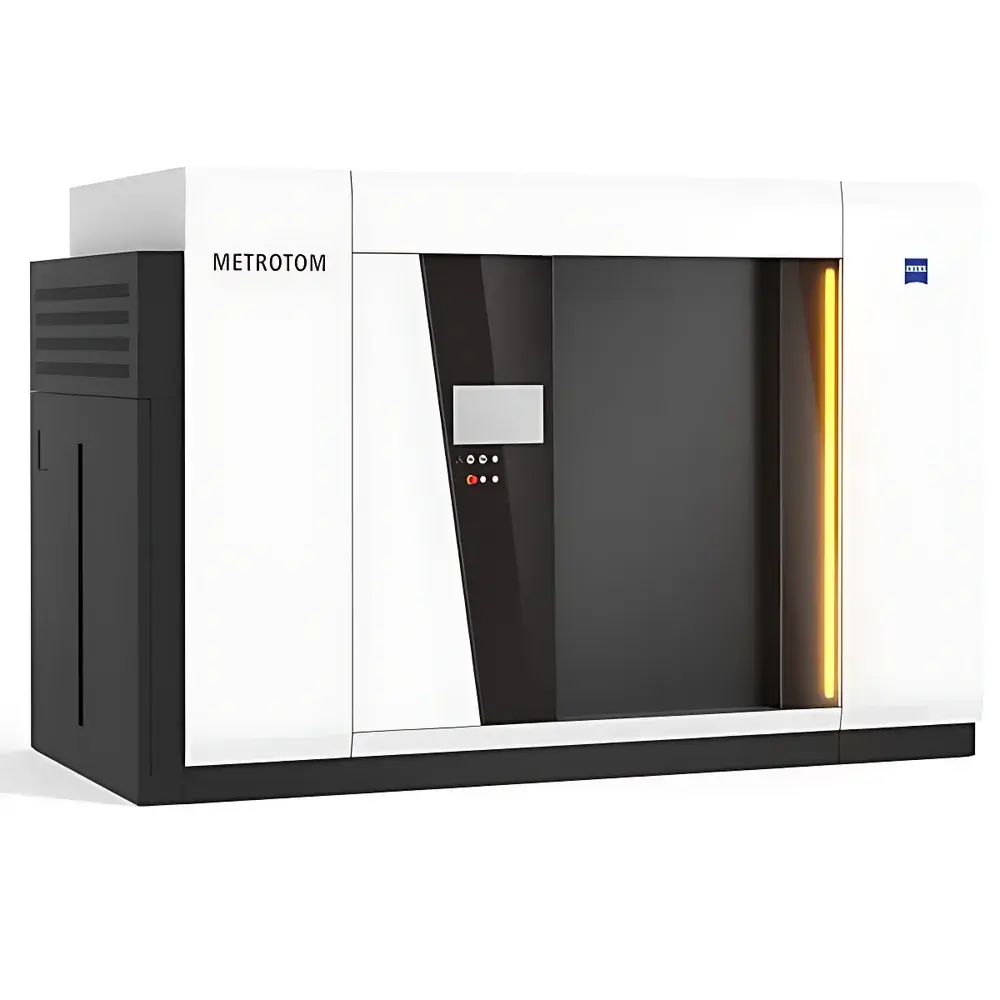
ZEISS METROTOM 1500 Industrial Micro-CT System
| Brand | ZEISS |
|---|---|
| Origin | Shanghai, China |
| Manufacturer Type | Original Equipment Manufacturer (OEM) |
| Regional Classification | Domestic Production |
| Model | METROTOM 1500 |
| Quotation | Upon Request |
| Detector Type | Flat-Panel Detector |
| Scanning Mode | Translation-Rotation (TR) |
| Accuracy | Micron-Level |
| Maximum Inspection Volume | Ø1500 mm × H870 mm |
| Sample Weight Capacity | 50 kg |
Overview
The ZEISS METROTOM 1500 is a high-precision industrial micro-computed tomography (micro-CT) system engineered for non-destructive dimensional metrology and internal defect analysis of complex, multi-material components. Based on X-ray absorption contrast principles, the system reconstructs volumetric 3D density maps from hundreds of 2D projection images acquired during controlled TR (translation-rotation) scanning. Its metrological-grade architecture integrates a microfocus X-ray tube with a focal spot size in the sub-5 µm range and up to 500 W maximum power output—enabling simultaneous high-resolution imaging of small features and rapid volumetric acquisition of large parts up to Ø1500 mm in diameter and 870 mm in height. Designed and validated in accordance with VDI/VDE 2630 Part 1.3 for CT-based dimensional measurement, the METROTOM 1500 delivers traceable, uncertainty-quantified results suitable for first-article inspection, GD&T verification, porosity quantification, and assembly integrity assessment across regulated industries.
Key Features
- Micron-level geometric accuracy certified per VDI/VDE 2630–1.3, supported by DAkkS-accredited calibration services for audit-ready traceability.
- Translation-rotation (TR) scanning geometry optimized for metrological stability—minimizing mechanical drift and enabling repeatable positioning across multi-day measurement campaigns.
- Flat-panel detector with high dynamic range and low electronic noise, ensuring optimal signal-to-noise ratio (SNR) for both low-Z (polymers, composites) and high-Z (aluminum, copper, steel) materials.
- Compact footprint (3.7 m × 1.8 m) with dual-purpose hinged access door—designed for integration into constrained metrology labs without compromising maximum measurable volume.
- ZEISS scatterControl hardware module integrated at source level to suppress beam hardening and scatter-induced artifacts, directly improving CT number linearity and dimensional fidelity.
- Modular X-ray tube configuration: selectable focal spot sizes (≤5 µm for high-res micro-imaging; larger spots for throughput-optimized macro-scans) and adjustable kV/mA settings for application-specific contrast optimization.
Sample Compatibility & Compliance
The METROTOM 1500 accommodates heterogeneous assemblies—including injection-molded plastics, sintered metal parts, cast aluminum housings, medical-grade polymer implants, and hybrid PCB-encapsulated modules—without disassembly or sectioning. Its 50 kg load capacity and vertical sample chamber allow upright orientation of tall, gravity-sensitive components. All measurement workflows comply with ISO 15530-3 (coordinate metrology using calibrated artifacts), ASTM E1441 (standard guide for computed tomography), and USP (for pharmaceutical container-closure integrity testing). For regulated environments, the system supports GLP/GMP-aligned operation through optional 21 CFR Part 11–compliant software modules—including electronic signatures, audit trails, and role-based access control.
Software & Data Management
Acquisition and reconstruction are managed via ZEISS INSPECT CT software, which provides real-time dose monitoring, automatic beam-hardening correction, and iterative reconstruction algorithms (e.g., SART, OS-SART) for artifact suppression. Metrological evaluation is performed using ZEISS CALYPSO, fully integrated with CT-derived point clouds and polygonal meshes. CALYPSO implements GD&T evaluation per ISO 1101 and ASME Y14.5, including true position, profile, concentricity, and wall thickness analysis. All measurement data—including raw projections, reconstructed volumes, evaluation reports, and calibration certificates—are stored in a vendor-neutral format (DICOM-CT, STL, ASCII point clouds) and can be exported to third-party CAE platforms (e.g., ANSYS, HyperMesh) for simulation-driven validation. Full version control, metadata tagging, and encrypted database archiving ensure long-term data integrity and regulatory readiness.
Applications
- Aerospace: Wall thickness mapping of turbine blades, porosity analysis in additively manufactured Inconel components, and internal channel verification in heat exchangers.
- Automotive: Dimensional validation of EV battery modules, electrode alignment inspection in pouch cells, and weld seam integrity assessment in structural aluminum castings.
- Medical Devices: Non-destructive verification of microporous structures in orthopedic implants, seal integrity of hermetically sealed drug delivery devices, and fiber orientation analysis in bioresorbable scaffolds.
- Electronics: Void detection in BGA solder joints, delamination assessment in multilayer PCBs, and encapsulant fill-level verification in power semiconductor packages.
- Research & Development: Time-resolved in situ CT (with optional environmental stages) for deformation mechanics, phase-change tracking in thermal interface materials, and pore-network modeling for filtration media.
FAQ
What standards does the METROTOM 1500 meet for metrological CT applications?
It conforms to VDI/VDE 2630 Part 1.3 for CT-based dimensional measurement and supports DAkkS-accredited calibration protocols aligned with ISO/IEC 17025.
Can the system perform quantitative porosity or void analysis?
Yes—via ZEISS INSPECT CT’s segmentation tools, users can isolate internal defects, compute volume fractions, and generate ISO 23802–compliant porosity reports with statistical confidence intervals.
Is the system compatible with automated production-line integration?
With optional ZEISS Automation Interface (ZAI), the METROTOM 1500 supports PLC-triggered scanning, pass/fail reporting via OPC UA, and seamless integration into MES/QMS platforms.
Does ZEISS provide training and technical support for metrological CT workflows?
Yes—ZEISS offers certified operator training programs covering VDI/VDE 2630 methodology, uncertainty budgeting, and FDA/ISO audit preparation, delivered by accredited metrology engineers.
How is measurement uncertainty determined for a given part geometry?
Uncertainty budgets are calculated per GUM (JCGM 100:2008) using part-specific factors—including voxel size, reconstruction algorithm, surface extraction method, and reference standard traceability—documented in each inspection report.



