
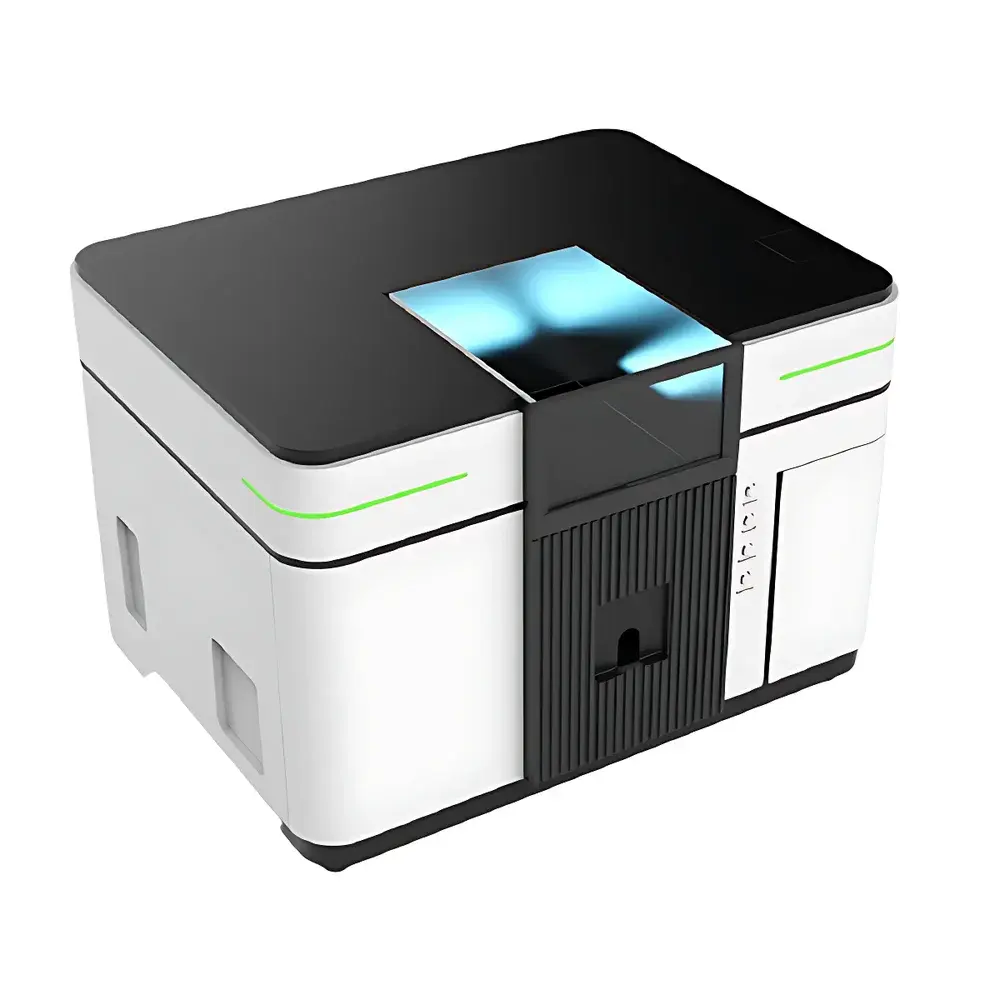
Luban Instruments LAS-400A Graphite Furnace Atomic Absorption Spectrometer
| Brand | Yoke |
|---|---|
| Origin | Shanghai, China |
| Manufacturer Type | Direct Manufacturer |
| Instrument Type | Graphite Furnace AAS |
| Monochromator | Plane Grating (1800 lines/mm, blazed at 250 nm) |
| Optical System | Single-beam Czerny-Turner |
| Detector | Photomultiplier Tube (PMT) |
| Background Correction | D₂ Lamp + Self-Absorption Dual-Mode |
| Spectral Bandwidths | 0.1, 0.2, 0.4, 0.7, 1.4, 2.0 nm (6-step automatic switching) |
| Wavelength Range | 185–900 nm |
| Lamp Positions | 8-slot automatic turret |
| Atomizer Control | Motorized graphite furnace vertical positioning |
| Automation | Fully automated wavelength scanning, peak search, HV optimization, energy balancing, and method recall |
Overview
The Luban Instruments LAS-400A is a high-performance graphite furnace atomic absorption spectrometer (GFAAS) engineered for trace elemental analysis in demanding laboratory environments. It operates on the fundamental principle of atomic absorption spectroscopy: ground-state free atoms in the graphite furnace absorb characteristic radiation emitted by a hollow cathode lamp (HCL) or electrodeless discharge lamp (EDL), with absorbance quantified according to the Beer–Lambert law. The instrument employs a single-beam Czerny-Turner optical architecture with an 1800-line/mm plane diffraction grating (blazed at 250 nm), delivering high spectral resolution across the full operational range of 185–900 nm. Designed for regulatory-compliant workflows, the LAS-400A supports both D₂ lamp and self-absorption background correction modes—enabling accurate compensation for structured molecular absorption and scattering effects commonly encountered in complex matrices such as biological fluids, environmental digests, and geological samples.
Key Features
- Intelligent gas control system with real-time pressure monitoring and fail-safe interlocks for argon and auxiliary gases—ensuring reproducible atomization and minimizing graphite tube degradation.
- Motorized, precision-controlled graphite furnace vertical positioning mechanism for repeatable sample introduction and optimized temperature gradient alignment.
- Eight-lamp auto-turret with non-volatile memory for lamp-specific parameters—including current, warm-up time, and spectral line selection—enabling rapid method switching without manual recalibration.
- Full automation suite: automatic wavelength scanning, peak centering, high-voltage optimization for the photomultiplier tube, and dynamic energy balancing across lamp intensities and slit widths.
- Six-step programmable spectral bandwidth selection (0.1–2.0 nm), allowing users to balance signal-to-noise ratio and spectral selectivity based on elemental line profiles and matrix interference potential.
- Dual-mode background correction: simultaneous D₂ continuum source correction for broad-band absorption and self-absorption correction for narrow-band, high-intensity lines—validated per ASTM E1553 and ISO 11170 protocols.
Sample Compatibility & Compliance
The LAS-400A accommodates standard 10–30 µL liquid microsamples via programmable autosampler integration (optional). Its graphite furnace platform supports temperature programming up to 3000 °C with ramp rates exceeding 2000 °C/s, enabling robust thermal stabilization for volatile (e.g., As, Se, Cd) and refractory (e.g., V, Mo, Ti) elements. Sample introduction is compatible with acid-digested aqueous solutions, diluted organic extracts (post-oxidation), and slurry suspensions meeting ISO 11047 requirements. The system complies with key international standards including ISO/IEC 17025:2017 (for testing laboratories), USP , and EPA Method 7000B. Audit-trail functionality—including user login logs, parameter change timestamps, and raw data file integrity hashing—supports GLP and GMP-aligned validation under FDA 21 CFR Part 11 when paired with compliant LIMS or instrument control software.
Software & Data Management
Control and data acquisition are managed via Windows-based analytical software featuring IEC 62443-aligned secure authentication, role-based access control, and electronic signature support. All measurement sequences—including furnace temperature programs, lamp settings, and background correction mode—are stored as encrypted method files (.mth) with embedded metadata (operator ID, date/time, instrument serial). Raw absorbance-time profiles and integrated peak areas are exported in ASTM E1382-compliant ASCII format or .csv for third-party statistical analysis. Software includes built-in calibration curve fitting (linear, quadratic, weighted least-squares), QC flagging (drift alerts, blank exceedance), and automated report generation conforming to ISO/IEC 17025 clause 7.8.2.
Applications
The LAS-400A is routinely deployed in environmental testing labs for Pb, Cd, Ni, and Cr quantification in wastewater per ISO 17294-2; in clinical research for serum Zn, Cu, and Mn analysis aligned with CLIA guidelines; and in food safety QA/QC for As speciation screening following AOAC 993.14 sample preparation protocols. Its low detection limits (sub-pg absolute sensitivity for Cd, Pb) and high matrix tolerance make it suitable for certified reference material (CRM) verification, catalyst metal leaching studies, and semiconductor-grade reagent purity assessment per SEMI C1 specifications.
FAQ
What background correction methods does the LAS-400A support?
The instrument provides dual-mode background correction: deuterium (D₂) lamp correction for broadband absorption and self-absorption correction for high-intensity spectral lines—both selectable per method.
Is the LAS-400A compatible with third-party autosamplers?
Yes—standard RS-232 and USB device interfaces enable seamless integration with industry-standard XYZ autosamplers supporting 12×72 or 16×100 rack formats.
Does the software support 21 CFR Part 11 compliance?
When deployed with validated configuration, audit-trail logging, and electronic signature modules, the software meets core technical requirements for Part 11 adherence in regulated environments.
What maintenance routines are recommended for long-term stability?
Monthly graphite tube resistance checks, quarterly monochromator alignment verification using Hg/Ne spectral lines, and biannual PMT dark-current calibration are advised per manufacturer’s maintenance schedule.
Can the LAS-400A be used for hydride generation applications?
No—the LAS-400A is configured exclusively for graphite furnace atomization; hydride generation requires dedicated vapor-generation accessories not supported by this model.



