
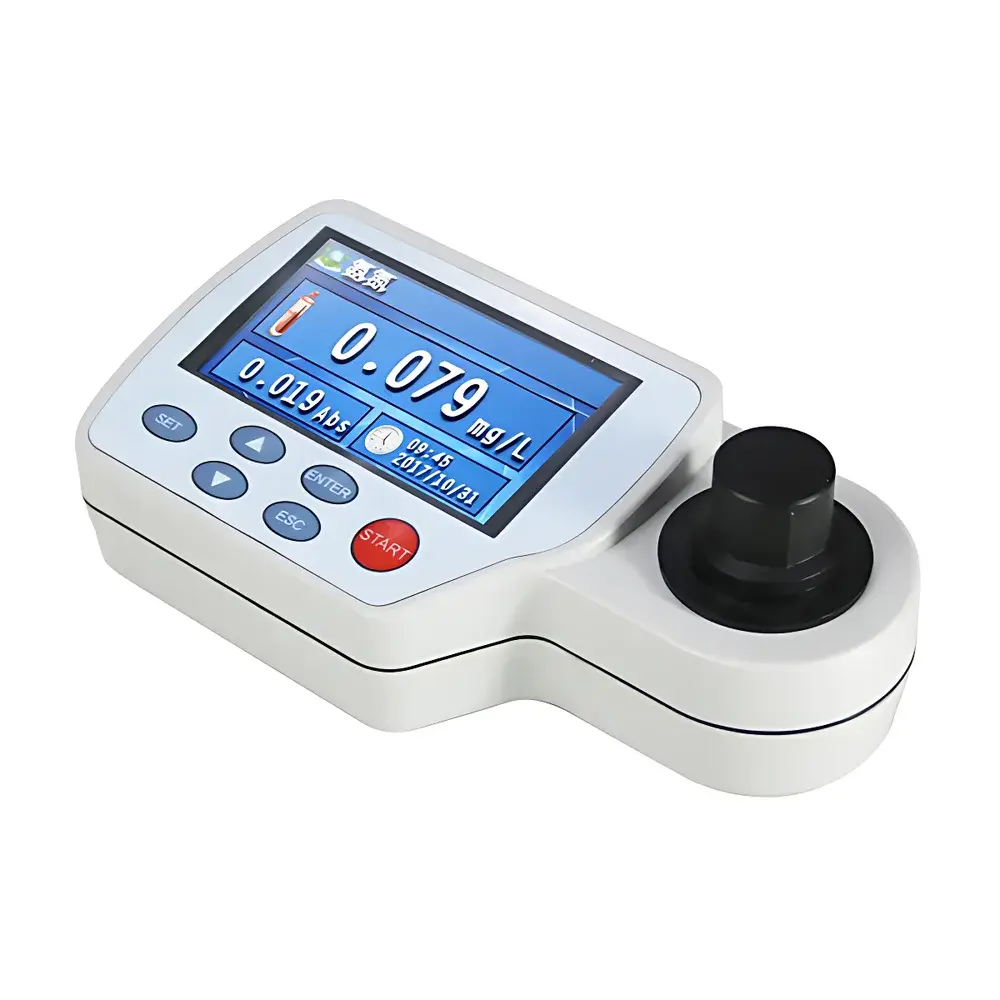
Yoke Portable Smart Ammonia Nitrogen Analyzer YKM-BAD
| Brand | Yoke |
|---|---|
| Origin | Shanghai, China |
| Manufacturer Type | Manufacturer |
| Model | YKM-BAD |
| Instrument Type | Portable |
| Measurement Principle | Colorimetric Method (Nesslerization or Salicylate-based) |
| Measurement Range | 0.02–30 mg/L NH₃-N |
| Accuracy | ≤ ±5% |
| Detection Limit | 0.02 mg/L |
| Measurement Time | 10–15 minutes |
| Batch Capacity | 20 samples |
| Optical Stability | ≤ 0.001 A/10 min |
| Light Source | Cold LED with Narrow-band Interference Filter, Lifetime ≥ 100,000 hours |
| Data Storage | 5,000 measurement records |
| Calibration Curves | 200 total (5 factory-default + 195 user-expandable) |
| Display | 4.3-inch TFT color touchscreen |
| Power Supply | Rechargeable Li-ion battery + USB-powered operation |
| Interface Language | English/Chinese switchable |
| Communication | USB data transfer |
Overview
The Yoke Portable Smart Ammonia Nitrogen Analyzer YKM-BAD is a field-deployable, laboratory-grade instrument engineered for rapid, on-site quantification of ammonia nitrogen (NH₃-N) in aqueous environmental samples—including surface water, groundwater, wastewater effluent, and municipal influent. It operates on the well-established colorimetric principle—specifically, either Nesslerization or salicylate reaction—where ammonia reacts with reagents to form a stable colored complex proportional to concentration. Absorbance is measured at a precisely defined wavelength using a cold LED light source coupled with a narrow-band interference optical filter, ensuring minimal spectral drift and high photometric fidelity. Designed for compliance with standard methods such as ISO 7150-1, APHA 4500-NH₃ B/C, and EPA Method 350.1, the YKM-BAD delivers trace-level sensitivity (LOD = 0.02 mg/L) and analytical repeatability ≤ ±5%, meeting routine monitoring requirements under national and international water quality frameworks.
Key Features
- 4.3-inch high-resolution TFT color touchscreen with intuitive graphical interface and dual-language support (English/Chinese), enabling efficient operation by field technicians and lab personnel alike.
- ARM9-based embedded architecture ensures responsive navigation, fast data processing, and robust firmware stability—even during extended field deployments.
- Advanced optical system featuring a 100,000-hour cold LED source and precision narrow-band interference filters, delivering exceptional photometric stability (≤ 0.001 A/10 min) and long-term calibration integrity.
- Comprehensive curve management: preloaded with 5 factory-validated calibration curves and expandable up to 200 total curves—including segmented multi-point calibrations where slope (K) varies across concentration ranges to optimize accuracy across the full 0.02–30 mg/L span.
- Integrated power management system with real-time battery level indication, USB-rechargeable lithium-ion battery (compatible with PC, power banks, and automotive USB ports), and low-power standby mode for extended operational autonomy.
- Dual sample presentation compatibility: accepts both standard 10-mm square cuvettes and 16-mm round test tubes, supporting flexibility in reagent kit integration and field protocol alignment.
- Onboard storage capacity for 5,000 measurement records—including date/time stamps, operator ID (if configured), sample ID, method used, raw absorbance, and final NH₃-N concentration—fully traceable and exportable via USB.
Sample Compatibility & Compliance
The YKM-BAD is validated for use with clarified, non-turbid aqueous matrices typical of environmental monitoring programs. It accommodates samples with moderate suspended solids when pretreated by filtration (e.g., 0.45 µm membrane) or centrifugation. Interference from common ions (e.g., Ca²⁺, Mg²⁺, Cl⁻) remains within acceptable limits per ISO 7150-1 specifications when recommended reagent kits and masking agents are applied. The instrument supports Good Laboratory Practice (GLP) workflows through timestamped, immutable data logging and optional user authentication. While not inherently 21 CFR Part 11 compliant out-of-the-box, its audit-ready data structure—retaining original measurements, curve metadata, and modification history—facilitates integration into regulated QA/QC environments requiring documented traceability.
Software & Data Management
Data export occurs exclusively via USB mass-storage mode—no proprietary drivers required. Measurement files are saved in CSV format, containing all relevant metadata for seamless import into LIMS, Excel, or statistical analysis platforms. Curve editing, calibration validation, and batch report generation are performed directly on-device; no external software installation is necessary. Firmware updates are delivered as signed binary packages via USB, preserving system integrity. Internal memory retains full calibration history—including date, operator, standard concentrations, and residual errors—for internal audit readiness and method verification.
Applications
- Routine surveillance of municipal wastewater treatment plant influent and effluent streams.
- Field assessment of agricultural runoff and aquaculture discharge compliance with local nutrient discharge limits.
- Emergency response testing following suspected ammonia spills or industrial discharges.
- Educational laboratories requiring portable, hands-on instruction in water chemistry fundamentals and spectrophotometric analysis.
- Regulatory sampling programs aligned with national standards (e.g., China’s GB 3838-2002, US EPA Clean Water Act reporting tiers).
FAQ
What reagent kits are compatible with the YKM-BAD?
The analyzer is optimized for use with Yoke-branded ammonia nitrogen reagent kits based on either Nessler or salicylate chemistry. Third-party kits may be used if they conform to ISO 7150-1 spectral and stoichiometric specifications—but validation against certified reference materials is strongly recommended prior to deployment.
Does the YKM-BAD support automatic blank correction?
Yes—each measurement cycle includes an integrated zero-reference step using a matched blank solution, eliminating manual offset adjustment and reducing operator-induced variability.
Can calibration curves be transferred between instruments?
Calibration curve parameters (wavelength, coefficients, segment definitions) can be exported/imported via USB as encrypted .CUR files, enabling method harmonization across multiple YKM-BAD units in a networked monitoring program.
Is the device suitable for drinking water analysis?
While capable of measuring down to 0.02 mg/L, the YKM-BAD is primarily designed for environmental and wastewater applications. For potable water compliance (e.g., WHO or EPA MCL of 0.5 mg/L), users must verify matrix-specific recovery and interference profiles using certified reference waters and follow applicable method validation protocols.
How often does the optical system require maintenance?
No routine optical alignment or lamp replacement is required due to the solid-state LED design. Annual verification of photometric performance using NIST-traceable neutral density filters is advised for ISO/IEC 17025-accredited operations.







