
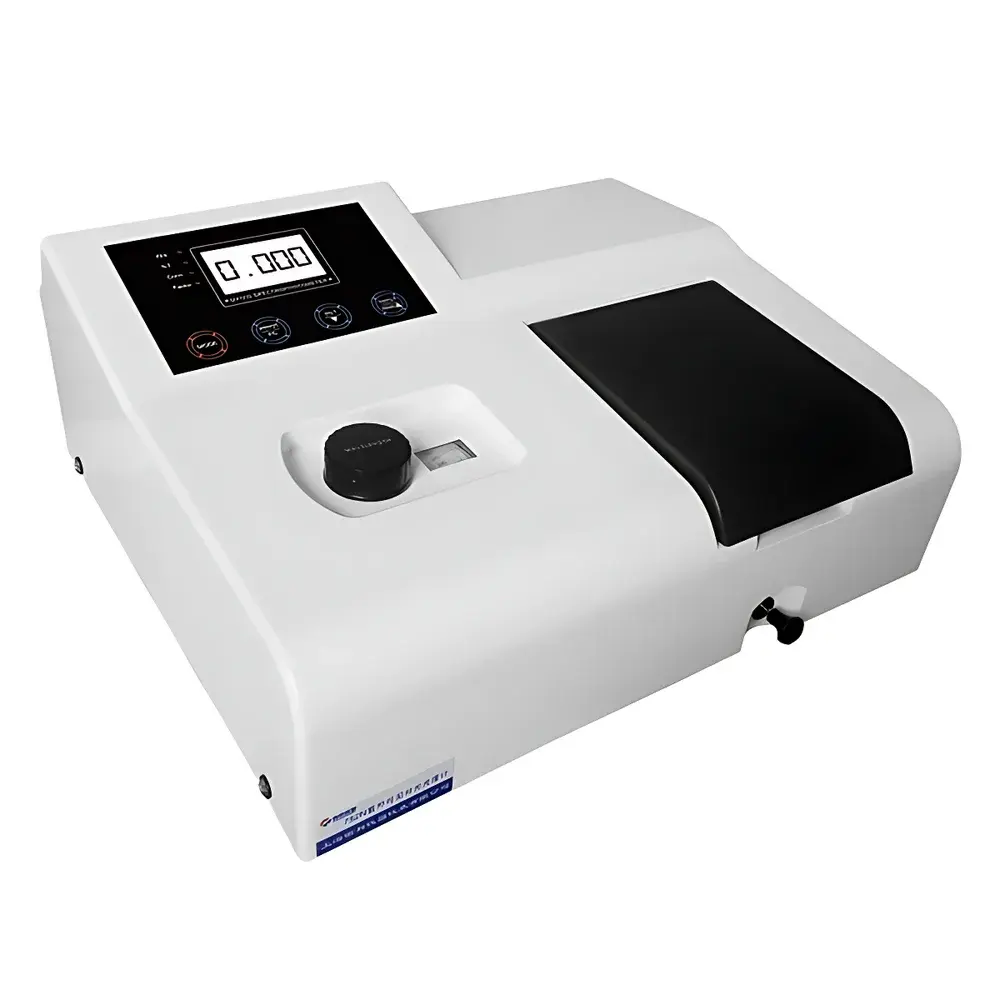
Yoke VIS 721 Single-Beam Visible Spectrophotometer
| Brand | Yoke |
|---|---|
| Origin | Shanghai, China |
| Manufacturer Type | Direct Manufacturer |
| Instrument Type | Domestic |
| Model | VIS 721 |
| Optical System | Achromatic Czerny-Turner (1200 L/mm grating) |
| Wavelength Range | 350–1020 nm |
| Wavelength Accuracy | ±2.0 nm |
| Wavelength Repeatability | ≤1 nm |
| Spectral Bandwidth | 6 nm |
| Photometric Accuracy (Transmittance) | ±1% T |
| Photometric Stability | ±0.004 A/h @ 500 nm |
| Drift | ≤0.2% T |
| Noise | ≤0.3% T |
| Stray Light | ≤0.3% T @ 360 nm |
| Detector Type | Silicon Photocell |
| Wavelength Adjustment | Manual |
| Sample Compartment | Accommodates up to 10 cm pathlength cuvettes |
| Display | Digital LED |
| Zero & 100% T Calibration | Automatic |
| Optional Interface | RS232 for printer or PC connectivity |
Overview
The Yoke VIS 721 is a precision-engineered single-beam visible spectrophotometer designed for routine quantitative and qualitative analysis in educational laboratories, quality control environments, and industrial R&D settings where reliable absorbance and transmittance measurements between 350 nm and 1020 nm are required. Based on the Czerny-Turner optical configuration with a 1200 lines/mm holographic grating, the instrument delivers consistent spectral dispersion and stable baseline performance. Its fixed 6 nm spectral bandwidth ensures adequate resolution for standard colorimetric assays—such as those following ASTM D1209 (platinum-cobalt scale), ISO 6271 (water clarity), or USP UV-Vis spectroscopy guidelines—while maintaining high photometric throughput. The system employs a calibrated tungsten-halogen lamp as its broadband visible light source, selected for long-term radiometric stability and low thermal drift, supporting reproducible measurements over extended operational cycles.
Key Features
- Single-beam optical architecture with manual wavelength selection, optimized for cost-effective, high-reliability operation in non-dynamic applications
- Achromatic Czerny-Turner monochromator incorporating a 1200 L/mm grating for minimized chromatic aberration and improved wavelength fidelity
- Digital LED display providing real-time readout of transmittance (%T) and absorbance (A) values with 0.1% T / 0.001 A resolution
- Integrated automatic zero-adjustment (100% T baseline) and full-scale calibration (0% T reference), reducing operator-induced error
- Spacious sample compartment engineered to accept standard square cuvettes up to 10 cm pathlength—enabling low-concentration measurements and compliance with EPA Method 365.1 (phosphate determination)
- RS232 serial interface (optional) supporting data export to external printers or legacy laboratory PCs running terminal-emulation software
- Robust mechanical design with thermally stabilized lamp housing and vibration-damped base plate, minimizing measurement drift during ambient temperature fluctuations
Sample Compatibility & Compliance
The VIS 721 accepts standard 10 mm, 20 mm, 50 mm, and 100 mm optical pathlength cuvettes made from glass or quartz (for extended near-UV use down to 350 nm). It supports common analytical protocols including iron (1,10-phenanthroline), nitrate (cadmium reduction), and protein (Lowry or Bradford) assays per AOAC International and ISO/IEC 17025 method validation frameworks. While not equipped with automated wavelength scanning or spectral storage, the instrument meets essential functional requirements for GLP-compliant environments when operated under documented SOPs—including daily photometric verification using NIST-traceable neutral density filters and annual wavelength calibration with holmium oxide reference standards (ISO 6957).
Software & Data Management
The VIS 721 operates as a standalone instrument with no embedded operating system or proprietary software dependency. When configured with the optional RS232 interface, it outputs ASCII-formatted measurement strings (e.g., “T=87.3 A=0.060”) at 9600 baud, compatible with generic terminal emulators (e.g., PuTTY, Tera Term) or custom LabVIEW/VB.NET acquisition scripts. No FDA 21 CFR Part 11 compliance features (e.g., electronic signatures, audit trails) are implemented; users requiring regulated data handling must integrate the device into validated third-party LIMS or ELN platforms via standardized serial protocols. All calibration parameters—including dark current offset and gain coefficients—are stored in non-volatile memory and retained after power cycling.
Applications
- Routine concentration determination of dyes, pigments, and transition metal complexes in textile, paint, and ink manufacturing
- Water and wastewater analysis for COD, ammonia, and total phosphorus using APHA Standard Methods (e.g., 4500-P E, 4500-NH3 G)
- Educational instruction in Beer-Lambert law validation, calibration curve construction, and method detection limit estimation
- Pharmaceutical excipient testing per Ph. Eur. 2.2.25 (visible absorption spectrophotometry)
- Food industry applications including carotenoid quantification in oils and anthocyanin profiling in fruit extracts
- Environmental monitoring of chlorophyll-a in freshwater samples using acetone extraction (EPA Method 445.0)
FAQ
Is the VIS 721 compliant with ISO/IEC 17025 for accredited testing laboratories?
Yes—when operated within a documented quality management system that includes periodic verification using certified reference materials, environmental monitoring, and staff competency assessment, the VIS 721 satisfies clause 6.4.10 (equipment verification) and 6.5.2 (measurement traceability) requirements.
Can the instrument measure absorbance below 350 nm?
No—the tungsten-halogen lamp output and optical coating specifications limit effective operation to ≥350 nm. For UV-range measurements, a dedicated UV-Vis spectrophotometer with deuterium lamp source is required.
What is the recommended maintenance interval for the lamp and grating?
Lamp replacement is advised every 1,000–1,500 hours of cumulative use; grating cleaning (if necessary) should be performed only by qualified service personnel using lint-free swabs and spectroscopic-grade methanol.
Does the VIS 721 support kinetic or multi-wavelength scanning modes?
No—it is a fixed-wavelength, single-point measurement device. Kinetic studies require manual time-point sampling and external data logging.
Is NIST-traceable calibration documentation available for purchase?
Yes—Yoke provides optional factory calibration certificates traceable to NIST SRM 2031 (neutral density filters) and SRM 2034 (wavelength standards), issued with uncertainty budgets per ISO/IEC Guide 98-3.
Related Products







