
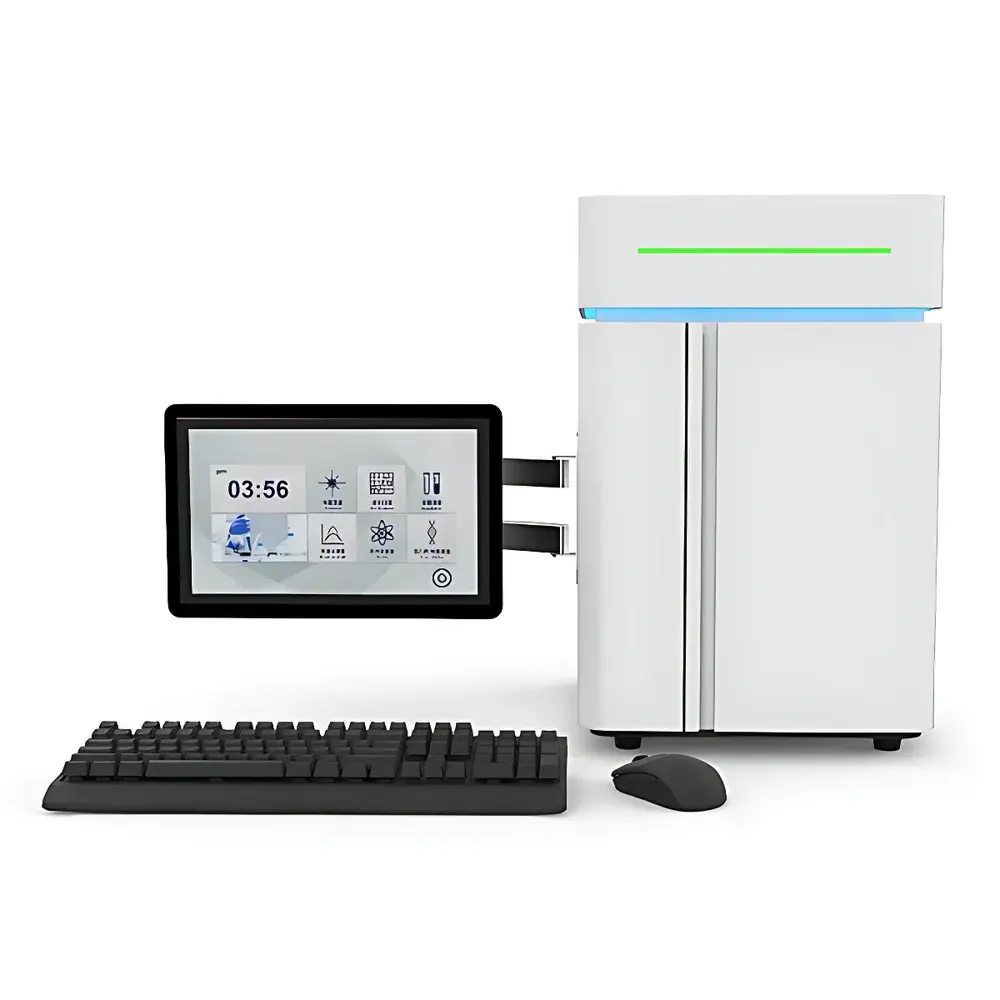
Luban Instruments LIM-001 Fully Automated Spectrophotometer
| Brand | Yoke |
|---|---|
| Origin | Shanghai, China |
| Manufacturer Type | Direct Manufacturer |
| Model | LIM-001 |
| Price | Upon Request |
| Wavelength Range | 190–1100 nm |
| Detector | Imported Silicon Photodiode |
| Monochromator | Czerny-Turner Mount with Holographic Blazed Grating |
| Cuvette Material | Quartz |
| Lamp Switching | Automatic at 340 nm (adjustable) |
Overview
The Luban Instruments LIM-001 Fully Automated Spectrophotometer is an integrated UV-Vis-NIR analytical platform engineered for high-throughput, operator-independent quantitative analysis in regulated and research-intensive laboratory environments. Based on dual-beam optical architecture with automatic wavelength selection across a continuous 190–1100 nm spectral range, the instrument employs standard absorption photometry principles—measuring either absorbance (A) or transmittance (%T) according to the Beer-Lambert law. Its fully automated fluidic handling system enables end-to-end sample processing: precise syringe-driven quantitative dispensing, in-line reaction incubation (where applicable), optical measurement, waste aspiration, and multi-stage rinsing with deionized water or solvent. This eliminates manual pipetting, minimizes analyst exposure to hazardous reagents, and ensures consistent pathlength and cell positioning—critical for inter-day reproducibility in compliance-driven workflows.
Key Features
- Fully automated assay execution: programmable method sequences support auto-sampling, reagent addition (if configured with optional reagent module), measurement, waste evacuation, and post-run cleaning—all without user intervention.
- Dual-lamp system with intelligent lamp life monitoring: independently tracked operational hours for deuterium (UV) and tungsten-halogen (Vis-NIR) sources; automatic switching at user-defined threshold (default 340 nm, adjustable).
- Czerny-Turner monochromator incorporating a holographic blazed grating delivers high spectral resolution and stray light suppression (<0.05% at 220 nm), essential for trace-level quantitation in complex matrices.
- Quartz cuvette compatibility ensures stable performance from deep UV (190 nm) through near-infrared (1100 nm); optional flow-cell or micro-volume adapters available for specialized applications.
- Corrosion-resistant fluidic pathway: all wetted components—including tubing, valves, pump heads, and sample loop—are constructed from chemically inert materials (e.g., PTFE, ETFE, sapphire, and 316L SS) compatible with acidic, alkaline, and organic solvent-based protocols.
- Real-time system diagnostics: embedded sensors monitor lamp intensity, detector response stability, temperature drift, and fluidic pressure—logging anomalies for preventive maintenance scheduling.
Sample Compatibility & Compliance
The LIM-001 accommodates liquid samples in standard 10-mm pathlength quartz cuvettes or via direct injection into flow cells. It supports aqueous solutions, buffered media, diluted organic extracts, and clarified biological supernatants. Sample volume requirements range from 0.5 mL (cuvette mode) to 50 µL (micro-flow configuration). The instrument meets core design requirements of ISO/IEC 17025:2017 for testing laboratories and aligns with functional expectations of USP , ASTM E275, and EPA Method 450.0 for spectrophotometric analysis. While not pre-certified for FDA 21 CFR Part 11, its software architecture supports audit-trail-enabling configurations—including user access levels, electronic signatures, and immutable method/data logs—facilitating GxP validation under internal QA oversight.
Software & Data Management
Controlled via Windows-based LIM-Workstation software, the system features a single-pane interface with modular toolbars for method building, real-time spectrum visualization, kinetic plot generation, and calibration curve management. All methods are saved as encrypted XML files with full metadata (operator ID, timestamp, instrument serial, lamp usage, environmental conditions). Raw absorbance/time data export is supported in CSV, TXT, and JCAMP-DX formats; integration with LIMS via HL7 or ASTM E1384 is achievable through optional API modules. Software updates follow documented change control procedures, and version history is retained within the audit trail.
Applications
- Environmental monitoring: nitrate, phosphate, COD, heavy metal speciation (e.g., Cr(VI), As(III)) in wastewater and surface water per EPA and ISO standards.
- Pharmaceutical QC: assay of active pharmaceutical ingredients (APIs), excipient purity screening, dissolution profile analysis.
- Academic research: enzyme kinetics (NADH/NADPH assays), protein quantification (Bradford/Lowry), nucleic acid integrity assessment.
- Industrial process control: dye concentration in textile effluents, lignin content in pulp streams, chlorophyll-a in aquaculture systems.
- Food & beverage safety: sulfite detection, antioxidant capacity (FRAP/DPPH), adulterant screening in oils and juices.
FAQ
Does the LIM-001 support multi-wavelength simultaneous acquisition?
Yes—the instrument performs sequential multi-point scanning at up to 10 user-defined wavelengths per sample, with dwell time configurable from 0.1 to 5 seconds per point.
Can it be validated for GLP or GMP environments?
The hardware and software architecture support IQ/OQ/PQ protocol development; full validation documentation packages—including URS, FRS, and test scripts—are available upon request.
Is remote operation possible?
Local network access is enabled via TCP/IP; secure remote desktop or VNC connections are permitted, though regulatory policies may restrict unattended remote use in audited labs.
What maintenance intervals are recommended?
Lamp replacement every 1,000–1,500 hours; quartz cuvette inspection before each batch; fluidic system cleaning with 10% nitric acid monthly if handling high-salt or precipitating matrices.
Are third-party calibration standards supported?
Yes—NIST-traceable neutral density filters and holmium oxide reference solutions can be loaded into the calibration workflow for wavelength and photometric accuracy verification.






