
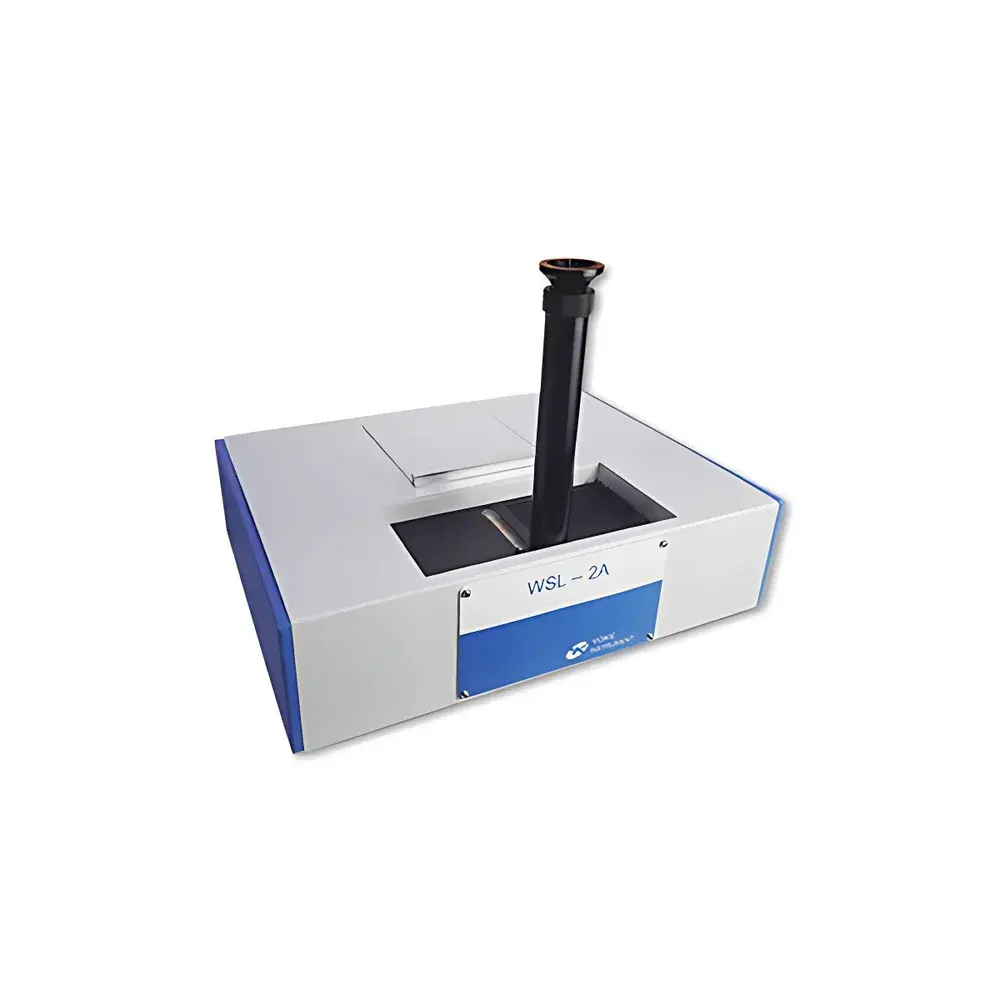
Yoke Lovibond Tintometer WSL-2A
| Brand | Yoke |
|---|---|
| Origin | Shanghai, China |
| Manufacturer Type | Direct Manufacturer |
| Country of Origin | China |
| Model | WSL-2A |
| Price Range | USD 1–699 (FOB Shanghai) |
| Measurement Scale | Red (R) 0.1–79.9 |
| Minimum Scale Division | 0.1 Lovibond Unit |
| White Reference Tile Reflectance | >80% |
| Viewing Tube Diameter × Length | Φ30 mm × 215 mm |
| Magnifier Lens | 1.9× |
| Cuvette Dimensions | 10×20×40 mm |
| Power Supply | 220 V ±22 V, 50 Hz ±1 Hz, 50 W |
| Instrument Dimensions (L×W×H) | 500×320×130 mm |
| Net Weight | 3.5 kg |
Overview
The Yoke Lovibond Tintometer WSL-2A is a precision visual color comparison instrument engineered for consistent, repeatable color assessment in industrial and quality control laboratories. It operates on the internationally standardized Lovibond color scale—a perceptually uniform system based on subtractive color mixing using calibrated red, yellow, blue, and neutral grey glass standards. Unlike spectrophotometric methods, the WSL-2A relies on human observer evaluation under controlled illumination, making it particularly suitable for applications where regulatory compliance requires adherence to classical visual color standards—such as ASTM D1500 (Petroleum Products), AOCS Cd 13b-97 (Fats and Oils), ISO 2760 (Edible Fats), and USP (Color of Liquids). Its optical design incorporates a fixed-path dual-beam viewing tube with integrated 1.9× magnification lens and standardized white reference tile (reflectance >80%), ensuring high inter-observer reproducibility when used per standardized viewing conditions (CIE Illuminant C or D65, 2° standard observer).
Key Features
- Corrosion-resistant construction: Fully compatible with acidic, alkaline, and aggressive organic solvents commonly encountered in paint, resin, and edible oil processing.
- Hygienic, cleanable architecture: Seamless one-piece housing allows full immersion cleaning and rapid residue removal—critical for food-grade and pharmaceutical intermediate testing.
- Oxidation-inhibited metal finish: Electrophoretic coated steel chassis prevents surface degradation during long-term exposure to ambient humidity and laboratory vapors.
- Rust-proof component engineering: All internal optical carriers, slide mechanisms, and cuvette holders utilize electropolished stainless steel or anodized aluminum with protective ceramic coating.
- Modular cuvette compatibility: Supports three standardized pathlengths (10 mm, 25.4 mm, and 133.4 mm) to accommodate low-absorbance oils, highly colored syrups, and opaque suspensions without dilution.
- Stable photometric geometry: Fixed 30 mm diameter viewing aperture and 215 mm optical path ensure consistent angular acceptance and eliminate parallax error across operators.
Sample Compatibility & Compliance
The WSL-2A accommodates liquid, semi-solid, and finely ground particulate samples—including clarified vegetable oils, polymer melts, fruit concentrates, textile dye baths, pharmaceutical excipients, and cereal flours—when loaded into appropriate Lovibond-compliant cuvettes. It meets functional equivalence requirements of ISO 4630, ASTM D1500, and AOCS official methods for visual color grading. While not a digital instrument, its mechanical calibration traceability supports GLP documentation when paired with certified Lovibond reference standards (e.g., NIST-traceable R/Y/B/N glass filters). Routine verification follows manufacturer-recommended procedures using primary standard tiles and secondary working standards, enabling audit readiness for ISO/IEC 17025-accredited labs.
Software & Data Management
As a purely analog visual comparator, the WSL-2A does not incorporate embedded firmware or digital output interfaces. Color assessments are recorded manually in laboratory notebooks or LIMS-compatible templates. For digital integration, users may employ third-party documentation systems that support structured entry of Lovibond unit values (R, Y, B, N) alongside sample ID, operator, date/time, and cuvette pathlength. The instrument’s mechanical stability and absence of electronic drift make it ideal for environments where electromagnetic interference, software validation overhead, or cybersecurity constraints preclude digital instrumentation—particularly in GMP manufacturing suites operating under FDA 21 CFR Part 11 Annex 11 alignment protocols requiring deterministic, non-algorithmic measurement processes.
Applications
- Edible oil refining: Monitoring decolorization efficiency during bleaching steps; verifying compliance with Codex Alimentarius color specifications for soybean, palm, and sunflower oils.
- Pigment and ink formulation: Matching batch-to-batch hue consistency in solvent-based coatings and gravure inks.
- Food processing: Quantifying browning index in fruit purees, caramel color intensity in soft drinks, and Maillard reaction progression in dairy powders.
- Pharmaceutical excipients: Assessing color variation in lactose, microcrystalline cellulose, and starch batches per USP monograph requirements.
- Textile wet processing: Evaluating dye lot uniformity and fading resistance after wash-fastness trials.
- Agricultural commodities: Grading wheat flour whiteness, rice translucency, and coffee bean roast level via standardized visual interpolation.
FAQ
Is the WSL-2A compliant with ASTM D1500?
Yes—the instrument’s optical geometry, standard glass filter set, and viewing protocol align with the apparatus requirements specified in ASTM D1500-22 for petroleum product color assessment.
Can it measure opaque or turbid samples?
Yes, provided samples are loaded into the 133.4 mm cuvette and assessed under transmitted light; however, results reflect apparent color rather than true solution color and should be reported with pathlength annotation.
Does it require annual recalibration?
No electronic recalibration is needed; however, periodic verification against certified Lovibond reference standards (recommended every 6 months) ensures continued traceability per ISO/IEC 17025 Clause 6.5.
What lighting conditions are required for valid readings?
Use of a standardized daylight simulator (CIE Illuminant C or D65) with UV content control is mandatory; ambient fluorescent or LED lighting introduces spectral bias and invalidates comparisons.
Is training required for operator qualification?
Yes—per ISO 9001 and ICH Q7, visual color assessment requires documented competency assessment, including pass/fail trials against master standards under supervised conditions.




