
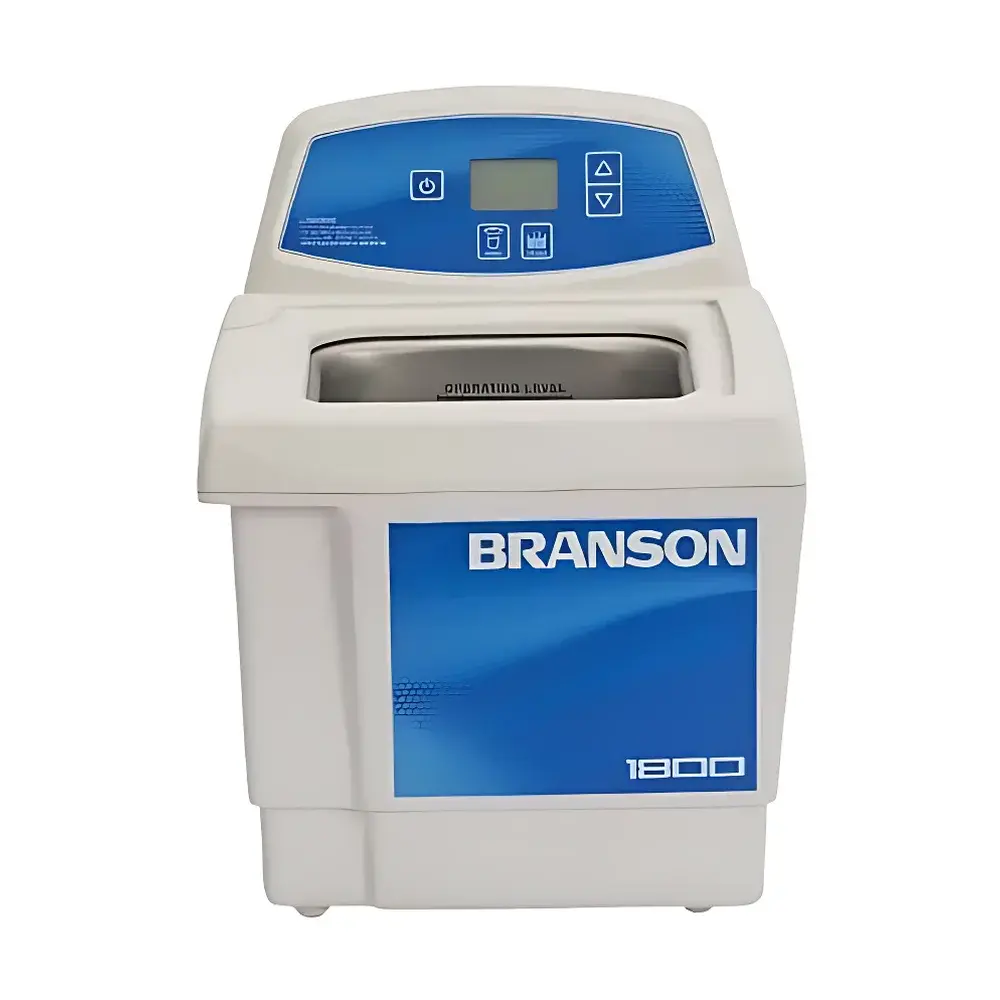
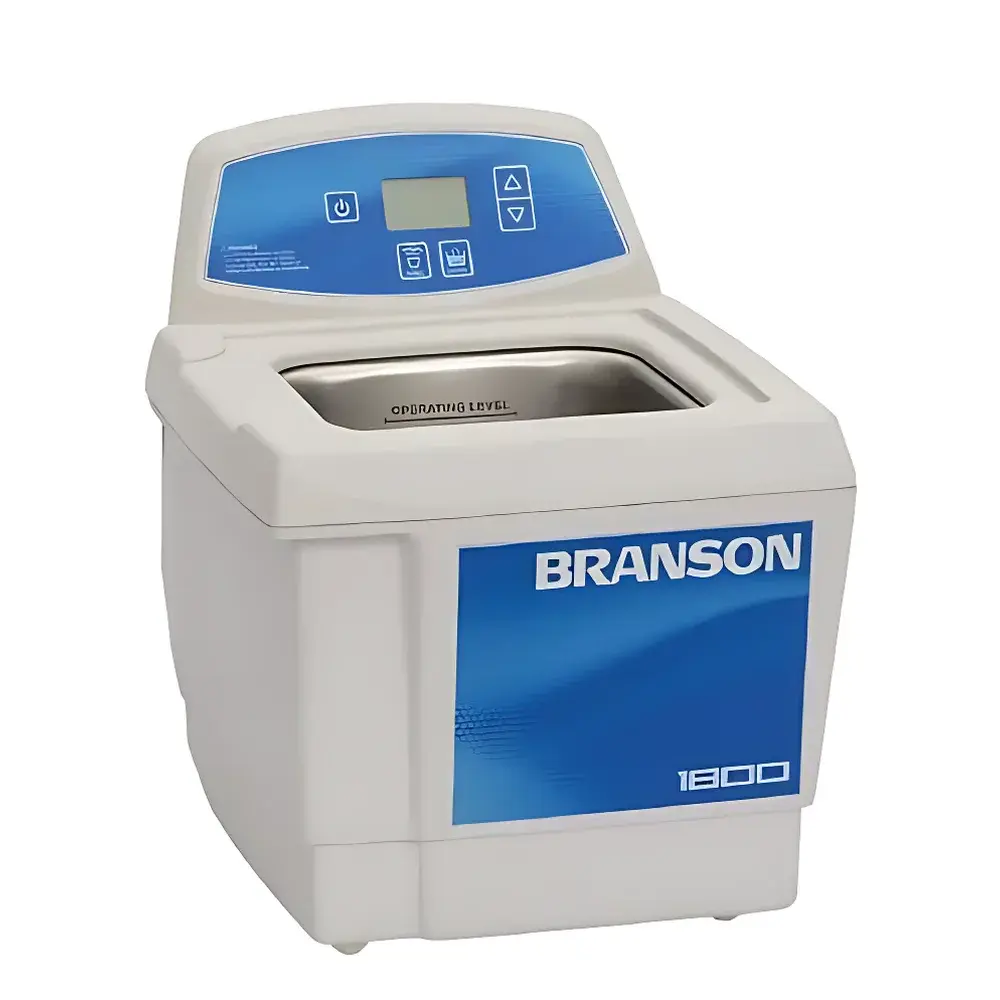
Branson CPX1800-C Benchtop Ultrasonic Cleaner
| Brand | Branson |
|---|---|
| Origin | Mexico |
| Model | CPX1800-C |
| Capacity | 1.9 L |
| Ultrasonic Frequency | 40 kHz |
| Ultrasonic Power | 90 W |
| Adjustable Power | Yes |
| Timer Range | 1–99 min (or continuous mode) |
| Lid with Noise Reduction | Yes |
| Manual Fill/Drain | Yes |
| Construction | Polypropylene (PP) housing with 304 stainless steel tank |
| Safety Certifications | CE, UL, CSA, FCC, TÜV |
Overview
The Branson CPX1800-C is a precision-engineered benchtop ultrasonic cleaner designed for routine laboratory cleaning, degassing, and sample preparation tasks. It operates on the principle of high-frequency acoustic cavitation—generating microscopic implosions in liquid media at 40 kHz—to dislodge particulate contaminants, organic residues, and entrapped air from surfaces of delicate instruments, glassware, surgical tools, electronic components, and analytical substrates. Its compact 1.9 L tank volume makes it ideal for small-batch processing in QC labs, R&D environments, and academic teaching laboratories where space efficiency and reproducible cleaning performance are critical. Unlike analog predecessors, the CPX1800-C integrates digital control logic with real-time power tracking to maintain consistent energy delivery across varying load conditions, ensuring high inter-run reproducibility—a prerequisite for GLP-compliant sample handling.
Key Features
- Digital microprocessor control with intuitive front-panel interface and LED display for precise parameter setting
- Automatic power tracking system maintains stable acoustic output regardless of transducer loading or bath temperature drift
- Two-level power selection (high/low) enables optimization for fragile substrates (e.g., microfluidic chips) versus heavily soiled items (e.g., metal fixtures)
- Professional degassing mode with adjustable duration up to 99 minutes supports solvent deaeration prior to HPLC or GC analysis
- Langevin-type piezoelectric transducers—metal-ceramic composite design—mounted via advanced adhesive bonding for long-term mechanical integrity and minimal acoustic attenuation
- Vertical PCB orientation and elevated control panel placement prevent moisture ingress and enhance operational longevity
- Polypropylene (PP) housing resists corrosion from common lab solvents including alcohols, acetone, and dilute acids; interior tank constructed from electropolished 304 stainless steel for inertness and cleanability
- Integrated noise-reduction lid doubles as a drip tray and incorporates a manual drain valve for rapid bath exchange
- Factory-calibrated water level indicator ensures optimal coupling between transducers and cleaning solution for maximum cavitation efficiency
Sample Compatibility & Compliance
The CPX1800-C accommodates a broad range of sample types—including pipette tips, crucibles, filters, optical lenses, printed circuit boards, and chromatography vials—without risk of surface pitting or etching when operated within recommended parameters. Its construction and electrical architecture comply fully with international safety standards: UL 61010-1 (North America), EN 61010-1 (EU), CSA C22.2 No. 61010-1, FCC Part 15 Class B, and TÜV-certified functional safety per IEC 61000-6-3. All units undergo accelerated life testing—including thermal cycling, humidity exposure (85% RH at 40°C), and 10,000-cycle timer endurance validation—to verify robustness under sustained laboratory use. While not intended for sterilization, the device supports validated cleaning protocols aligned with ISO 15883-1 and ASTM D4167 for non-critical device reprocessing.
Software & Data Management
The CPX1800-C operates as a standalone instrument without proprietary software dependency. All settings—including time, power level, and degas mode—are stored in non-volatile memory and retained after power cycling. The absence of external connectivity (USB/Ethernet) eliminates cybersecurity concerns while supporting compliance with FDA 21 CFR Part 11 requirements for audit-trail-free operation in regulated environments where manual logbooks remain standard practice. For laboratories requiring documentation, optional third-party environmental data loggers may be deployed to record ambient temperature, operating duration, and cycle completion timestamps—supporting traceability in GMP-aligned workflows.
Applications
- Routine cleaning of volumetric glassware and reusable labware prior to calibration or analytical use
- Removal of flux residues and solder particles from PCB assemblies during electronics manufacturing QA
- Pre-analytical degassing of mobile phases in HPLC method development to minimize baseline noise and bubble-induced pressure fluctuations
- Disaggregation of nanoparticle suspensions and cell culture debris in life science sample prep
- Surface decontamination of reusable surgical instruments before autoclaving in hospital central sterile supply departments (CSSD)
- Extraction assistance for solid-phase microextraction (SPME) and leaching studies in environmental chemistry
FAQ
Does the CPX1800-C support temperature control?
No—this model features fixed-temperature operation only. For heated cleaning applications, consider the Branson CPX-H series or the larger-capacity Branson 5510/8810 models with integrated thermostatic control.
Is the unit compatible with flammable solvents?
Only when used inside an explosion-proof fume hood and strictly following NFPA 30 and OSHA 1910.106 guidelines. The CPX1800-C lacks intrinsic safety certification for volatile organic solvent use.
Can the transducers be replaced in the field?
Transducer replacement requires factory service due to precision alignment and epoxy-curing requirements. Unauthorized disassembly voids TÜV and UL certifications.
What is the expected service life under normal lab usage?
Based on Branson’s accelerated reliability testing, the CPX1800-C demonstrates ≥5 years of continuous daily operation (8 hrs/day, 5 days/week) with no degradation in cavitation intensity or timing accuracy.
How does the automatic power tracking function improve cleaning consistency?
It continuously monitors transducer impedance and dynamically adjusts drive voltage to compensate for load variations—such as changing liquid levels, part geometry, or solution viscosity—ensuring constant acoustic energy density across all cycles.



