
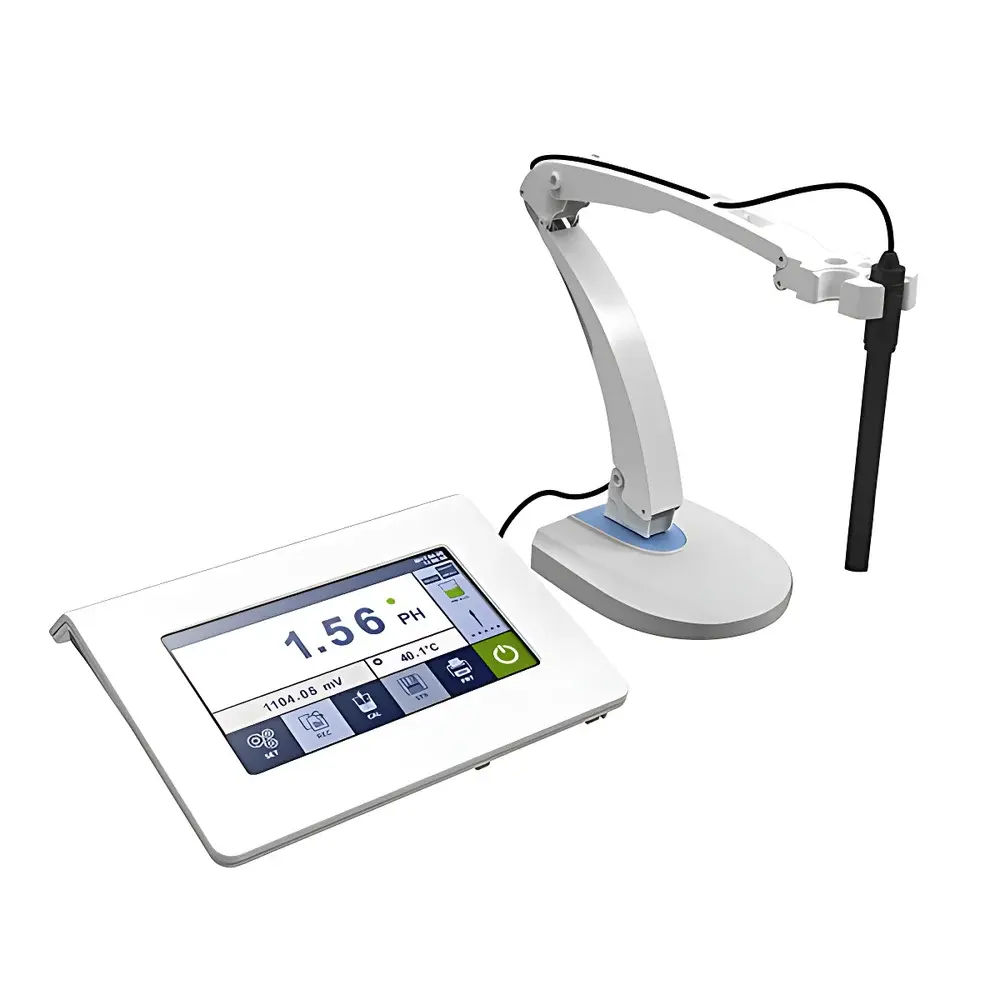
Yoke P10 Series Benchtop Touchscreen pH Meter
| Brand | Yoke |
|---|---|
| Origin | Shanghai, China |
| Manufacturer Type | Manufacturer |
| Regional Category | Domestic (China) |
| Model | P10 |
| Instrument Type | Benchtop |
| Parameter Type | Single-parameter (pH) |
| Measurement Accuracy | ±0.02 pH |
| pH Range | -2.00 to 19.99 pH |
| Resolution | 0.01 pH |
| Calibration Standards | US/EU Series, NIST Series, and Chinese Standard Buffer Series |
| Display | 7-inch capacitive touchscreen (1024 × 600) |
| Input Impedance | ≥1 × 10¹² Ω |
| Input Current | ≤2 × 10⁻¹² A |
| mV Range | -1999 to +1999 mV |
| mV Resolution | 1 mV |
| mV Accuracy | ±0.1% FS |
| Temperature Range | 0–100 °C |
| Temp. Resolution | 0.1 °C |
| Temp. Compensation | Manual/Automatic (0–100 °C) |
| Calibration Points | 1–3-point |
| Data Storage | 2000 sets |
| Connectivity | USB 2.0, Bluetooth (optional) |
| IP Rating | IP54 |
| Power Supply | 12 V DC (110–220 V AC, 50–60 Hz adapter) |
| Dimensions & Weight | 160 × 190 × 70 mm / 880 g |
Overview
The Yoke P10 Series Benchtop Touchscreen pH Meter is a precision electrochemical instrument engineered for reliable, high-accuracy pH measurement in laboratory, quality control, and educational environments. Based on potentiometric principle using a glass electrode and reference electrode assembly, the P10 measures hydrogen ion activity in aqueous solutions by detecting the potential difference across the pH-sensitive membrane—converted into pH units via the Nernst equation. Its extended measurement range (−2.00 to 19.99 pH) supports highly acidic, neutral, and strongly alkaline samples—including non-aqueous or low-ionic-strength media when paired with appropriate electrodes. Designed for operational consistency, the instrument features automatic temperature compensation (ATC) and intelligent electrode diagnostics to minimize drift and ensure traceable, reproducible results aligned with routine analytical workflows.
Key Features
- 7-inch high-resolution capacitive touchscreen (1024 × 600) with adjustable brightness and intuitive dual-language interface (English/Chinese), enabling efficient navigation without physical buttons.
- Compliance with GLP (Good Laboratory Practice) requirements, including full audit trail support: time-stamped calibration records, electrode history, and user-defined ID logging.
- Triple-buffer series recognition—automatically identifies and applies correction factors for US/EU (e.g., pH 4.01, 7.00, 10.01), NIST-traceable (e.g., pH 4.005, 7.000, 10.012), and Chinese national standard buffers (GB/T 604.1–2021).
- Integrated electrode health monitoring: real-time impedance assessment and slope evaluation (mV/pH) to alert users of degraded or contaminated electrodes prior to measurement error.
- Dual data management: internal storage of up to 2000 measurement sets with timestamp, temperature, and calibration status; export via USB flash drive in CSV format compatible with Excel, LibreOffice, and LIMS integration.
- Optional Bluetooth 4.2 module enables wireless printing to certified thermal printers and secure point-to-point data transfer to Windows PCs or Android/iOS devices—no proprietary software required.
- Robust industrial design meeting IP54 rating for dust resistance and splash protection, suitable for shared lab benches or production floor use under controlled ambient conditions (5–40 °C, 5–85% RH).
Sample Compatibility & Compliance
The P10 accommodates standard combination pH electrodes (BNC connector) and optional temperature-compensated probes (e.g., Pt1000 or NTC thermistors). It supports measurements in aqueous solutions, buffer standards, pharmaceutical formulations, food extracts, wastewater effluents, and basic chemical reagents. While not intended for direct sterilization or high-pressure autoclaving, its input impedance (≥1 × 10¹² Ω) and ultra-low input current (≤2 × 10⁻¹² A) ensure minimal loading error with high-resistance electrodes—critical for low-conductivity samples per ISO 7888 and ASTM D1293 protocols. The instrument conforms to IEC 61010-1 safety standards and supports documentation required for ISO/IEC 17025-accredited laboratories, including calibration certificate traceability to national metrology institutes.
Software & Data Management
Data acquisition and reporting are fully file-based: no installation or driver dependencies. All stored entries include pH value, mV reading, temperature, date/time stamp, calibration parameters (offset, slope, buffer IDs), and electrode serial number (if entered manually). USB exports generate plain-text CSV files with UTF-8 encoding, ensuring compatibility with statistical analysis tools (e.g., JMP, Minitab) and electronic lab notebooks (ELNs). Bluetooth transmission follows RFCOMM protocol with AES-128 encryption for secure local network exchange. Audit logs retain all user-initiated actions—including calibration edits, parameter changes, and factory resets—for regulatory review under FDA 21 CFR Part 11 (when used with validated procedures and access controls).
Applications
- Pharmaceutical QC: pH verification of injectables, oral suspensions, and cleaning validation solutions per USP and EP 2.2.3.
- Environmental testing: surface water, leachate, and soil extract analysis compliant with EPA Method 9040C and ISO 10523.
- Food & beverage R&D: titratable acidity estimation, fermentation monitoring, and shelf-life stability studies.
- Academic teaching labs: demonstration of acid-base equilibria, buffer capacity, and electrode theory with visual real-time response.
- Chemical manufacturing: batch release testing of catalyst slurries, electrolytes, and polymerization inhibitors.
FAQ
Does the P10 support automatic calibration with multiple buffer points?
Yes—the instrument supports 1-, 2-, or 3-point calibration with auto-recognition of buffer pH values from three standardized series.
Can measurement data be exported directly to Excel without proprietary software?
Yes—CSV files generated via USB export open natively in Microsoft Excel, Google Sheets, and LibreOffice Calc.
Is Bluetooth connectivity included as standard or optional?
Bluetooth 4.2 is an optional add-on module; default configuration includes only USB 2.0 interface.
What temperature compensation methods are available?
Both manual entry and automatic compensation via integrated or external Pt1000/NTC sensors (0–100 °C range).
How is electrode performance monitored during operation?
The P10 continuously calculates electrode slope (%Nernst) and asymmetry potential, displaying warnings if deviation exceeds configurable thresholds (e.g., slope 105%).
Related Products





