
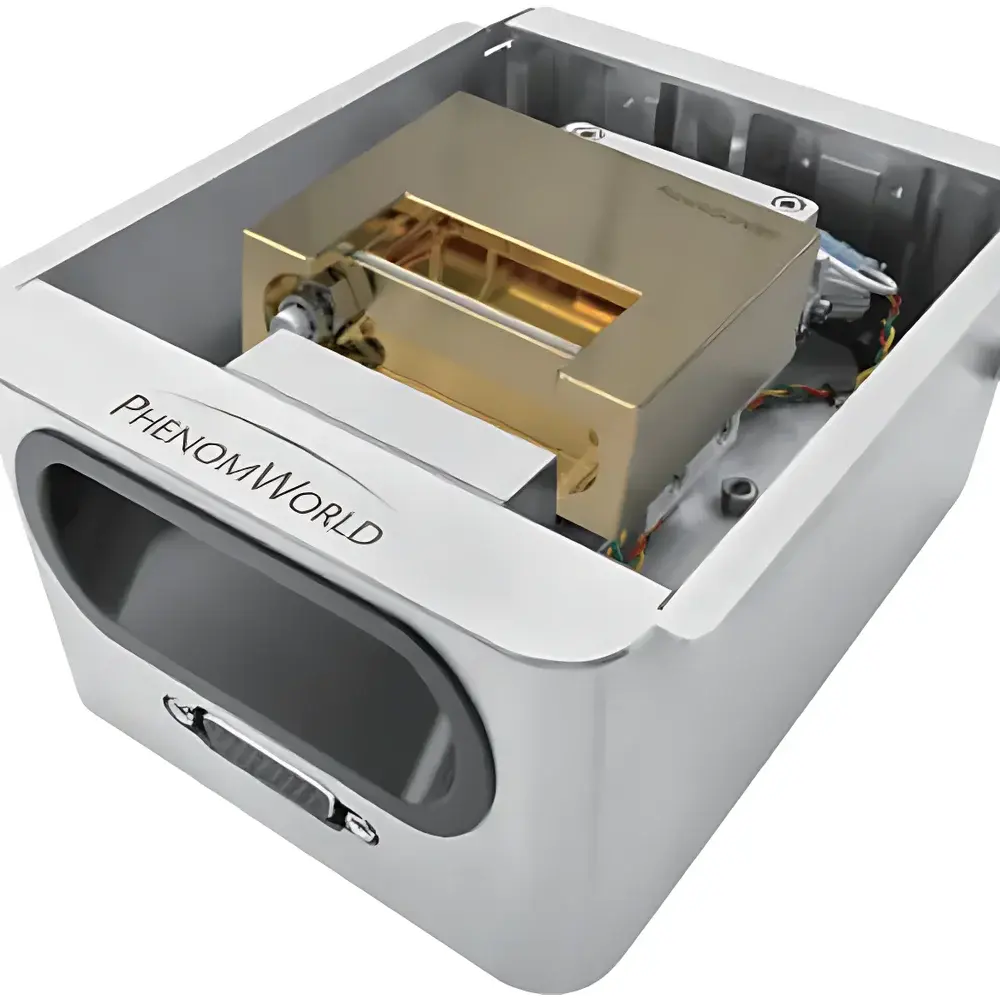
Phenom Vacuum Transfer Multi-Function Sample Holder for SEM
| Brand | Phenom |
|---|---|
| Origin | Netherlands |
| Manufacturer Type | Original Equipment Manufacturer (OEM) |
| Import Status | Imported |
| Model | Vacuum Sample Holder |
| Pricing | Upon Request |
| Dimensions | 70 × 60 × 20 mm (L×W×H) |
| Operating Vacuum Range | 10⁻¹–10⁻³ Pa |
| Optional Integrated Functions | Heating (RT to ≥100 °C, ±0.5 °C stability), In-Situ Charge/Discharge (0–30 V / 0–0.5 A), Mechanical Force Application (0–250 N with force curve logging) |
Overview
The Phenom Vacuum Transfer Multi-Function Sample Holder is an engineered solution for the in-situ transfer and characterization of air-sensitive, reactive, or electrochemically active specimens—particularly those prepared inside inert-atmosphere gloveboxes—into scanning electron microscopes (SEM) and other high-vacuum analytical instruments. Designed around passive vacuum actuation principles, the holder eliminates reliance on external power, electrical feedthroughs, or manual intervention during vacuum cycling. Its operation is governed by differential pressure: as system vacuum reaches the operational threshold (10⁻¹–10⁻³ Pa), internal mechanical linkages respond to pressure differentials to automatically open the sample chamber lid; upon venting, spring-loaded retraction ensures hermetic closure. This fully passive, fail-safe mechanism preserves sample integrity across repeated transfer cycles while maintaining compatibility with ultra-high vacuum (UHV)-compatible SEM stages and load-lock systems.
Key Features
- Vacuum-Actuated Passive Lid Mechanism: No electronics, no wiring, no user input required—lid opens/closes solely via intrinsic pressure-driven actuation, ensuring reliability and eliminating electromagnetic interference.
- Non-Magnetic Architecture: Entire structural body fabricated from precision-machined, surface-treated copper alloy with internally polished cavity surfaces—guaranteeing zero magnetic perturbation to electron beam trajectories and detector performance.
- Compact Footprint & Universal Interface: Overall dimensions of 70 × 60 × 20 mm (L×W×H), with a minimal 15 mm sample chamber height and 50 mm length—engineered for seamless integration into standard SEM stub mounts, cryo-transfer holders, and multi-chamber vacuum interconnect systems.
- Modular Functional Expansion: Three independently configurable in-situ capabilities—temperature control, charge/discharge biasing, and mechanical force application—can be combined without hardware conflict or signal crosstalk.
- Glovebox-Compatible Sealing Protocol: Includes O-ring-sealed loading port compatible with standard N₂- or Ar-purged glovebox antechambers, enabling contamination-free specimen loading under inert atmosphere prior to transfer.
Sample Compatibility & Compliance
The holder supports specimens ranging from battery electrode cross-sections and solid-state electrolyte thin films to catalyst nanoparticles, lithium metal anodes, and organic semiconductor layers—all of which degrade rapidly upon ambient exposure. Its design conforms to ISO 14644-1 Class 5 cleanroom handling standards during loading and aligns with ASTM E2982-22 guidelines for in-situ SEM sample environment control. The non-magnetic construction meets SEM manufacturers’ specifications for magnetic field tolerance (<1 µT at stage position), and all materials are outgassing-certified per ESA ECSS-Q-ST-70-02C for low-volatility vacuum environments. No adhesives or polymer components contact the sample zone, eliminating carbon contamination risks during imaging or EDS analysis.
Software & Data Management
While the base holder operates autonomously, optional functional modules interface with industry-standard SEM control platforms—including Thermo Fisher Scientific Avizo, JEOL JSM-IT series controllers, and Zeiss SmartSEM—via isolated analog I/O and digital TTL triggers. Temperature regulation employs PID feedback with integrated Pt100 sensors; charge/discharge sequencing supports programmable voltage ramps and current-limited hold modes; force application integrates with load cell calibration tables traceable to NIST standards. All parameter logs (time-stamped temperature, voltage, current, force, and vacuum status) export in HDF5 or CSV format, supporting GLP-compliant audit trails and FDA 21 CFR Part 11–aligned electronic records when paired with validated LIMS integration.
Applications
- In-situ observation of SEI layer evolution on Li-metal anodes during electrochemical cycling in SEM-compatible battery test cells.
- Real-time monitoring of thermal expansion, phase transitions, or dewetting behavior in thin-film devices between room temperature and 100 °C.
- Mechanical deformation studies of soft biomaterials or polymer composites under controlled normal loads, with synchronized topographic and compositional mapping.
- Charge-induced surface charging mitigation for insulating ceramics or MOFs, enabling stable secondary electron imaging without conductive coating.
- Correlative analysis combining SEM imaging, EBSD, and energy-dispersive X-ray spectroscopy (EDS) across multiple vacuum transfer cycles without sample relocation error.
FAQ
Does the holder require external power to operate the lid mechanism?
No—the lid actuation is entirely passive and driven by vacuum differential pressure; no power supply, batteries, or control signals are needed.
Can this holder be used with cryo-SEM systems?
Yes, provided the base temperature remains above the copper alloy’s ductile-to-brittle transition; custom low-temperature variants with enhanced thermal contraction compensation are available upon request.
Is the heating function compatible with EDS acquisition?
Yes—copper’s low X-ray fluorescence yield and absence of interfering spectral lines (e.g., no Fe, Ni, or Cr) ensure minimal background contribution during elemental quantification.
How is force calibration performed and maintained?
Each unit ships with individual load cell calibration certificate traceable to national metrology institutes; recalibration intervals follow ISO/IEC 17025 recommendations based on usage frequency and environmental conditions.
Are custom interface flanges or mounting adapters available?
Yes—Phenom offers mechanical drawings and CNC-machined adapter plates for proprietary SEM stages, FIB-SEM dual-beam systems, and custom vacuum manifolds upon technical specification submission.




