
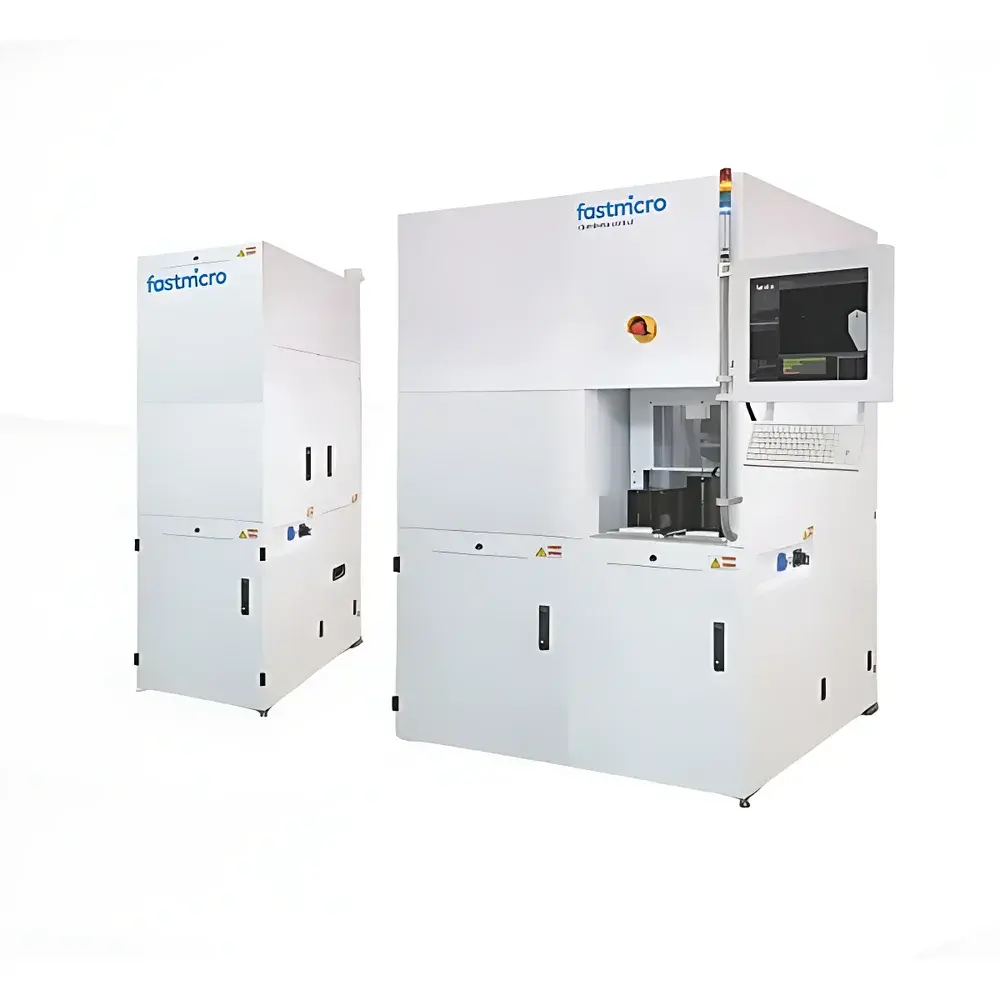
Fastmicro FM-PR-PDS Optical Surface Particle Detection System
| Brand | Fastmicro |
|---|---|
| Origin | Netherlands |
| Manufacturer Type | Authorized Distributor |
| Origin Category | Imported |
| Model | FM-PR-PDS |
| Instrument Type | Optical Particle Counter |
| Detection Threshold | ≥0.1 µm (PSL-equivalent, NIST-traceable) |
| Throughput | Up to 400 Wafers per Hour (WPH) |
| Dual-Side Inspection | Simultaneous front & back surface imaging |
| Compliance | ISO 14644-9 (Cleanroom classification reporting), Supports SCP (Surface Contamination Particle) grading in PDF and GUI |
| Measurement Mode | Static Field-of-View Imaging (no stage motion during acquisition) |
| Application Scope | DUV/EUV photomask pellicles, reticles, semiconductor wafers, advanced packaging substrates, and precision optical substrates |
Overview
The Fastmicro FM-PR-PDS Optical Surface Particle Detection System is a high-throughput, non-contact inspection platform engineered for quantitative surface contamination analysis of critical optics and semiconductor substrates. It employs wide-field dark-field illumination combined with high-resolution monochrome CMOS imaging and real-time sub-pixel centroid detection algorithms to identify, localize, and size particulate contaminants on flat, reflective, or semi-transparent surfaces. Unlike scanning-based laser particle counters or manual microscopy workflows, the FM-PR-PDS captures full-surface data in a single static exposure—eliminating mechanical drift, stage synchronization errors, and throughput bottlenecks inherent in raster-scanned systems. Its core measurement principle relies on Mie scattering contrast enhancement under controlled illumination geometry, calibrated against NIST-traceable polystyrene latex (PSL) standards to ensure metrological traceability for particles ≥0.1 µm. Designed specifically for cleanroom-integrated process monitoring, the system supports both inline quality gate verification and offline R&D characterization across photomask fabrication, EUV pellicle qualification, compound semiconductor wafer processing, and advanced heterogeneous packaging.
Key Features
- Static Field-of-View Imaging: Full-surface capture without stage translation—enables sub-second acquisition per substrate and eliminates motion-induced artifacts.
- Dual-Side Simultaneous Inspection (optional configuration): Integrated top/bottom optical paths allow concurrent front-and-back surface analysis without manual flipping or repositioning.
- High Sensitivity Detection: Validated detection limit of ≥0.1 µm PSL-equivalent particles on reflective surfaces (e.g., Cr-on-Quartz masks) and semi-transparent pellicles (e.g., SiN, polymer-based).
- Automated SCP Classification: Real-time calculation and reporting of Surface Contamination Particle (SCP) levels per ISO 14644-9 Annex B, with direct export to PDF reports compliant with internal QA documentation requirements.
- Modular Hardware Architecture: Interchangeable optical modules support wavelength-specific optimization (e.g., 193 nm DUV, 13.5 nm EUV-compatible pellicle transmission analysis via proxy illumination) and future upgrade paths for multi-spectral or polarization-resolved detection.
- Low-Cost-of-Ownership Design: Solid-state illumination, maintenance-free optics, and automated self-calibration routines reduce scheduled downtime and technician dependency compared to legacy laser-scanning platforms.
Sample Compatibility & Compliance
The FM-PR-PDS accommodates standard semiconductor formats including 150 mm, 200 mm, and 300 mm wafers; 6-inch and 9-inch photomasks (reticles); and custom-shaped substrates up to 330 × 330 mm. It supports both bare and pellicle-protected mask surfaces, as well as polished silicon, quartz, sapphire, and low-k dielectric substrates. All measurement protocols adhere to ISO 14644-9:2012 for surface cleanliness assessment and are compatible with internal process control limits defined under SEMI E10 and ITRS roadmap requirements. Data audit trails—including timestamped image metadata, calibration log entries, and operator ID—are recorded in accordance with GLP/GMP-aligned data integrity practices. While not FDA 21 CFR Part 11 certified out-of-the-box, the system’s software architecture supports optional validation packages for regulated environments upon customer request.
Software & Data Management
The embedded FM-Insight™ software suite provides intuitive workflow-driven operation—from auto-alignment and focus optimization to defect clustering, size distribution histogramming, and spatial density mapping. All raw images and processed results are stored in vendor-neutral TIFF + XML metadata format, enabling integration with factory MES systems via RESTful API or SECS/GEM protocol adapters. Batch reporting includes pass/fail flagging against user-defined particle count thresholds per zone (e.g., active circuit area vs. scribe line), along with statistical summaries (mean, std dev, Cpk) for SPC charting. Audit logs retain full provenance: instrument configuration, calibration status, environmental sensor readings (temperature/humidity), and operator actions—ensuring full traceability for internal audits or external regulatory review.
Applications
- Photomask and Pellicle Qualification: In-process verification of EUV/DUV mask cleanliness pre- and post-pellicle bonding, including edge defect screening and pellicle membrane integrity assessment.
- Advanced Packaging Substrate Inspection: Quantitative particle mapping on fan-out wafer-level packaging (FOWLP) substrates, interposer surfaces, and redistribution layer (RDL) films.
- R&D Process Development: Correlation of cleaning efficacy (e.g., megasonic, supercritical CO₂, plasma ash) with residual particle counts across multiple process steps.
- Supplier Acceptance Testing: Objective, operator-independent evaluation of incoming bare wafers, SOI substrates, or specialty glass carriers used in hybrid bonding applications.
- Failure Analysis Support: High-resolution coordinate tagging enables seamless handoff to SEM/FIB tools for root-cause investigation of yield-limiting defects.
FAQ
What particle size range is detectable on EUV pellicles?
The FM-PR-PDS achieves reliable detection of ≥0.12 µm PSL-equivalent particles on standard 50 nm-thick SiN pellicles using optimized 405 nm illumination; performance may vary slightly depending on pellicle material thickness and optical density.
Can the system be integrated into an automated cluster tool?
Yes—via SECS/GEM interface and configurable I/O signals, the FM-PR-PDS supports fully automated loading/unloading in SMIF/FOUP environments with minimal footprint (standard 19″ rack-mount chassis option available).
Is NIST traceability documented per unit?
Each shipped system includes a Certificate of Calibration referencing NIST SRM 1963 and SRM 2800, with annual recalibration services available through Fastmicro’s Amsterdam service center.
Does the software support custom particle classification rules?
Yes—users can define morphology-based filters (aspect ratio, circularity, intensity gradient) and hierarchical grouping logic to distinguish nuisance particles (e.g., fiber fragments) from process-critical defects.
What environmental conditions are required for stable operation?
Ambient temperature stability ±0.5°C over 24 h and relative humidity 30–50% RH (non-condensing) are recommended; optional vibration-isolation mounts and thermal enclosures are available for high-bay fab environments.



