
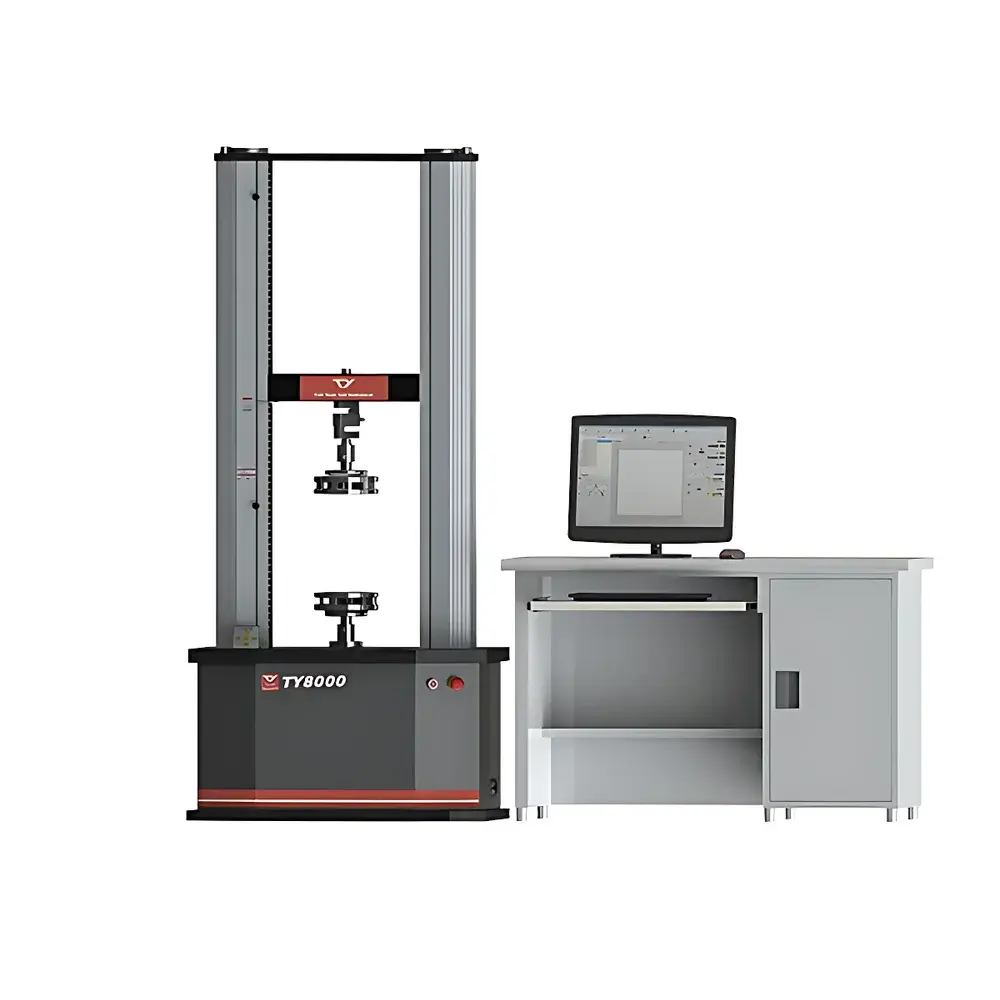
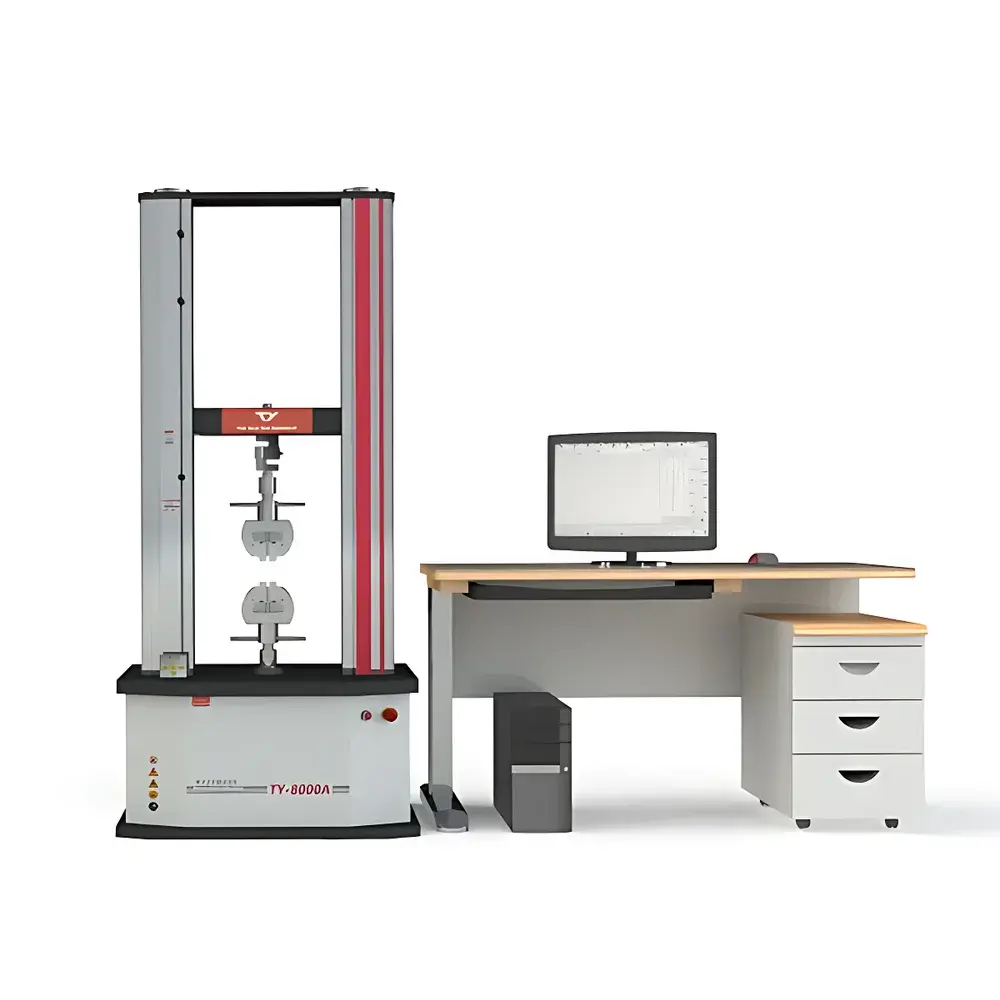
TianYuan TY8000-A Series 50 kN Electromechanical Universal Testing Machine
| Brand | TianYuan |
|---|---|
| Origin | Jiangsu, China |
| Manufacturer Type | Direct Manufacturer |
| Model Range | 10–50 kN |
| Instrument Type | Electromechanical Universal Testing Machine |
| Load Frame Capacity Options | 5, 10, 20, 50, 100, 200, 500, 1000 kg (0.05–10 kN) |
| Force Measurement Accuracy Class | 0.5 |
| Force Resolution | 1/500,000 FS |
| Force Measurement Range | 0.4–100% FS |
| Deformation Measurement Range | 0.2–100% FS |
| Force Control Rate Range | 0.01–5% FS/s |
| Force Control Accuracy | ±1% of set value |
| Displacement Resolution | 0.001 mm |
| Crosshead Speed Range | 0.001–500 mm/min |
| Speed Accuracy | ≤±0.3% |
| Maximum Travel (excluding grips) | 1000 mm |
| Effective Test Width | 420 mm |
| Power Supply | 380 V AC, 500 W |
| Dimensions (W×D×H) | 800 × 500 × 1600 mm |
| Weight | 230 kg |
Overview
The TianYuan TY8000-A Series 50 kN Electromechanical Universal Testing Machine is a high-precision, servo-controlled static mechanical testing system engineered for rigorous tensile, compression, flexural, shear, tear, peel, and puncture testing of metallic and non-metallic materials. Based on closed-loop electromechanical actuation with precision planetary gear reduction and high-resolution load cell feedback, the system delivers stable force application, repeatable displacement control, and traceable deformation measurement across a wide dynamic range. Its architecture conforms to fundamental principles of uniaxial quasi-static mechanical testing as defined in ISO 7500-1 (static calibration of testing machines) and ASTM E4 (load verification procedures), ensuring metrological integrity for quality control, R&D, and regulatory submission environments.
Key Features
- High-accuracy load measurement via imported IMG LOGICS load cell (0.5-class accuracy, 1/500,000 internal resolution) calibrated per ISO 376 and traceable to NIST-equivalent national standards.
- Panasonic AC servo motor and driver system coupled with Taiwan Liming planetary gearbox — delivering low backlash (<1 arcmin), high positional repeatability, zero-maintenance operation, and extended service life compared to conventional worm-gear alternatives.
- Multi-mode closed-loop control: constant-rate loading, constant-strain-rate, constant-displacement-rate, and fully programmable cyclic protocols (load, strain, or displacement-controlled low-cycle fatigue).
- Real-time dual-channel data acquisition (force + displacement) at ≥1 kHz sampling rate, supporting post-test reconstruction of full test history including stress–strain, load–displacement, load–time, and strain–time curves.
- Robust structural frame with 420 mm effective test width and 1000 mm maximum crosshead travel, accommodating standard and custom fixtures for ASTM D638, ISO 527, ISO 178, ISO 34, and ISO 37 compliant specimen geometries.
- Integrated safety interlocks, emergency stop circuitry, and overload protection aligned with IEC 61000-6-2/6-4 EMC requirements and CE machinery directive compliance.
Sample Compatibility & Compliance
The TY8000-A accommodates standardized specimens from rigid metals (e.g., aluminum alloys, stainless steels) to compliant polymers (thermoplastics, elastomers, composites), thin films, textiles, adhesives, and biomedical materials. It supports both standard and non-standard geometries via interchangeable grip systems—including wedge-action tensile grips, compression platens, three- and four-point bend fixtures, peel testers, and pneumatic clamps (optional). The system is pre-configured with over 200 test methods aligned to GB/T, ISO, and ASTM standards, including but not limited to: ISO 527 (tensile properties of plastics), ISO 178 (flexural properties), ISO 34 (tear strength of vulcanized rubber), ISO 37 (tensile stress–strain behavior of vulcanized rubber), ASTM D638, D790, D1708, and D3045. All calibration and verification procedures comply with ISO/IEC 17025 requirements for accredited testing laboratories.
Software & Data Management
The Windows-based VISIT test software provides intuitive workflow-driven test definition, real-time monitoring, automated result calculation (e.g., tensile strength, yield point, Young’s modulus, elongation at break, energy absorption), and customizable reporting. Raw data files are stored in ASCII-compatible .csv format with embedded metadata (operator ID, timestamp, standard reference, calibration certificate ID). Audit trail functionality records all user actions, parameter changes, and report generations in accordance with FDA 21 CFR Part 11 requirements for electronic records and signatures. Export options include PDF reports with embedded graphs, Excel-compatible datasets, and image exports of curve overlays for comparative analysis across material batches or processing conditions.
Applications
- Quality assurance of incoming raw materials (e.g., polymer pellets, metal sheets, rubber compounds) against supplier specifications and internal QC limits.
- Mechanical property mapping during formulation development (e.g., plasticizer content vs. tensile modulus, filler loading vs. fracture energy).
- Validation of manufacturing process parameters (e.g., extrusion temperature, injection molding pressure, heat treatment cycles) through correlation of mechanical performance with process variables.
- Support for regulatory submissions under ISO 13485 (medical devices), IATF 16949 (automotive), and aerospace QMS frameworks requiring documented traceability and method validation.
- Educational use in university materials science labs for hands-on instruction in solid mechanics, constitutive modeling, and failure analysis fundamentals.
FAQ
What standards does the TY8000-A support out-of-the-box?
The system includes preloaded test templates for ISO 527, ISO 178, ISO 34, ISO 37, ASTM D638, D790, GB/T 528, and GB/T 529, with full configurability to add custom methods.
Is the system compliant with FDA 21 CFR Part 11 for regulated industries?
Yes — VISIT software implements role-based access control, electronic signatures, and immutable audit trails required for GLP/GMP environments.
Can the machine perform cyclic loading tests?
Yes — it supports fully programmable load, displacement, or strain-controlled low-cycle fatigue sequences with user-defined ramp rates, dwell times, and reversal thresholds.
What is the typical calibration interval and traceability path?
Annual recalibration is recommended; certified load cells and displacement transducers are traceable to CNAS-accredited calibration laboratories with NIST-traceable reference standards.
Are third-party grips and accessories compatible?
Yes — the machine uses standard M12 threaded mounting interfaces and accepts ISO/ASTM-compliant auxiliary fixtures from major global suppliers (e.g., Instron, Zwick, Tinius Olsen).



