
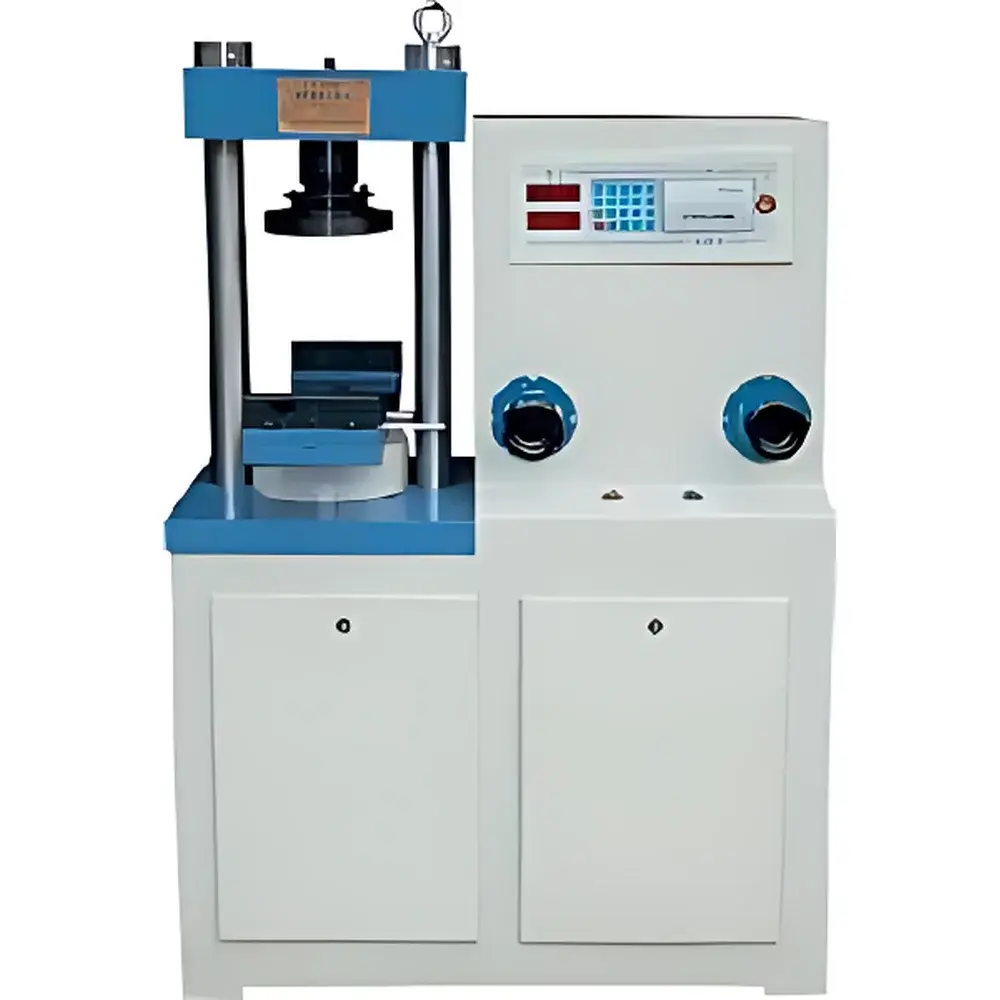
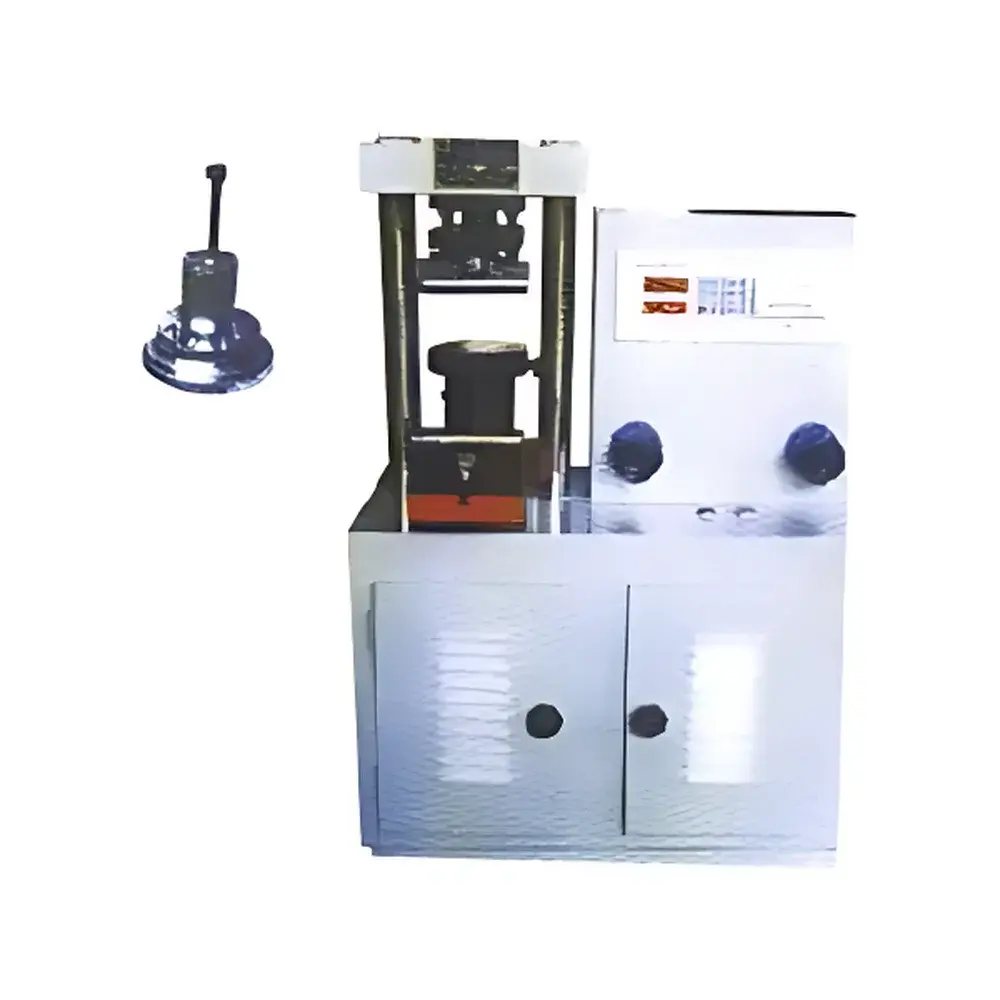
TianYuan TY-8000 Flexural Strength Tester
| Brand | TianYuan |
|---|---|
| Origin | Jiangsu, China |
| Manufacturer Type | Direct Manufacturer |
| Model | TY-8000 |
| Maximum Load | 100 kN |
| Relative Indication Error | ±1% |
| Hydraulic Pump Rated Pressure | 8.3 MPa |
| Flexural Roller Diameter | 30 mm (customizable) |
| Max Vertical Spacing Between Upper and Lower Rollers | 165 mm |
| Column Spacing | 460 mm |
| Piston Diameter × Stroke | 125 mm × 80 mm |
| Motor Power | 0.75 kW |
| Dimensions (L×W×H) | 850 × 600 × 1340 mm |
| Net Weight | 450 kg |
Overview
The TianYuan TY-8000 Flexural Strength Tester is a dual-mode universal testing system engineered for standardized mechanical evaluation of brittle and quasi-brittle construction materials under three-point and four-point bending configurations. It operates on a robust hydraulic loading principle coupled with high-stability electronic load measurement, enabling precise determination of flexural strength (modulus of rupture), elastic modulus in bending, and compressive strength per ASTM C78, ASTM C39, ISO 10110-5, GB/T 2542, GB/T 17671, and EN 196-1. The machine integrates a fixed-frame architecture with dual vertical columns, precision-machined hardened steel rollers, and a digitally regulated hydraulic actuation system—designed to deliver consistent force application across variable specimen geometries while maintaining traceable calibration integrity.
Key Features
- Hydraulic actuation system with rated pressure of 8.3 MPa ensures stable, low-drift load generation up to 100 kN, suitable for standard-sized concrete beams (e.g., 150 mm × 150 mm × 600 mm), refractory bricks, and ceramic tiles.
- Dual-function capability: configurable for both flexural testing (three-point bending per ASTM C78 or four-point bending per ASTM C1161) and uniaxial compression testing (e.g., cement mortar cubes per ISO 679).
- Real-time digital display interface showing applied load (kN), loading rate (kN/s), and peak load retention—fully compliant with GLP documentation requirements for laboratory record-keeping.
- Mechanically adjustable lower roller spacing and upper roller height accommodate specimens ranging from 50 mm to 165 mm in effective span, supporting customization for non-standard geometries including refractory monoliths and insulating firebricks.
- Integrated overload protection circuitry and automatic hydraulic relief valve activation prevent mechanical damage during specimen fracture events or operator error.
- 0.75 kW energy-efficient motor drives a low-noise gear pump, minimizing thermal drift and ensuring long-term operational stability without forced cooling.
Sample Compatibility & Compliance
The TY-8000 accommodates rigid, non-ductile specimens commonly used in building materials quality control: Portland cement mortars, fired clay bricks, autoclaved aerated concrete (AAC), sintered refractories, silicon carbide ceramics, and castable linings. Specimen dimensions are constrained by maximum span (165 mm), column clearance (460 mm), and roller contact geometry (standard 30 mm diameter rollers, optionally available in 20 mm or 40 mm diameters for specialized standards). All mechanical components conform to ISO 7500-1 Class 1 accuracy for static force measurement. The system supports audit-ready operation under ISO/IEC 17025-accredited laboratories when paired with certified calibration certificates traceable to NIM (China National Institute of Metrology).
Software & Data Management
While the base configuration features a standalone digital indicator with local data storage (up to 99 test records), optional RS-232/USB connectivity enables integration with TianYuan’s TY-DataLink software suite. This platform provides automated report generation compliant with ASTM E178 statistical outlier detection rules, exportable CSV/Excel datasets, time-stamped test logs with operator ID tagging, and optional 21 CFR Part 11–compliant electronic signatures when deployed with validated user access controls and audit trail modules. Raw load–displacement curves can be exported for post-test analysis in third-party tools such as MATLAB or OriginLab.
Applications
- Quality assurance of precast concrete elements in ready-mix plants and prefabrication facilities.
- Routine flexural strength verification of refractory products per ASTM C133 and ISO 13757.
- Research-grade mechanical characterization of novel geopolymer binders and alkali-activated cements.
- Compliance testing of fired clay and concrete masonry units per ASTM C67 and EN 772-1.
- Evaluation of thermal shock resistance in ceramic substrates via sequential flexural testing before/after thermal cycling.
- Teaching laboratories requiring reproducible, hands-on demonstration of stress–strain behavior in brittle solids.
FAQ
What standards does the TY-8000 support for flexural testing?
ASTM C78 (third-point loading), ASTM C293 (center-point loading), ISO 10110-5 (optical glass flexure), GB/T 2542 (masonry units), and EN 1338 (concrete paving blocks).
Can the machine perform compression tests on cement cubes?
Yes—the upper platen can be reconfigured as a flat compression plate; it meets ASTM C39 and ISO 679 requirements for 40 mm × 40 mm × 160 mm mortar prisms and 150 mm cubes.
Is calibration certification included with delivery?
A factory calibration certificate traceable to national standards is supplied; users must schedule annual third-party verification per ISO/IEC 17025 to maintain accreditation.
What maintenance is required for long-term hydraulic system reliability?
Monthly inspection of hydraulic oil level and cleanliness; biannual replacement of filter elements; annual recalibration of pressure transducer and load cell.
Does the system support automated loading rate control?
The base model uses manual needle-valve regulation; optional closed-loop servo-hydraulic upgrade enables programmable ramp-and-hold profiles per ASTM E4.



