
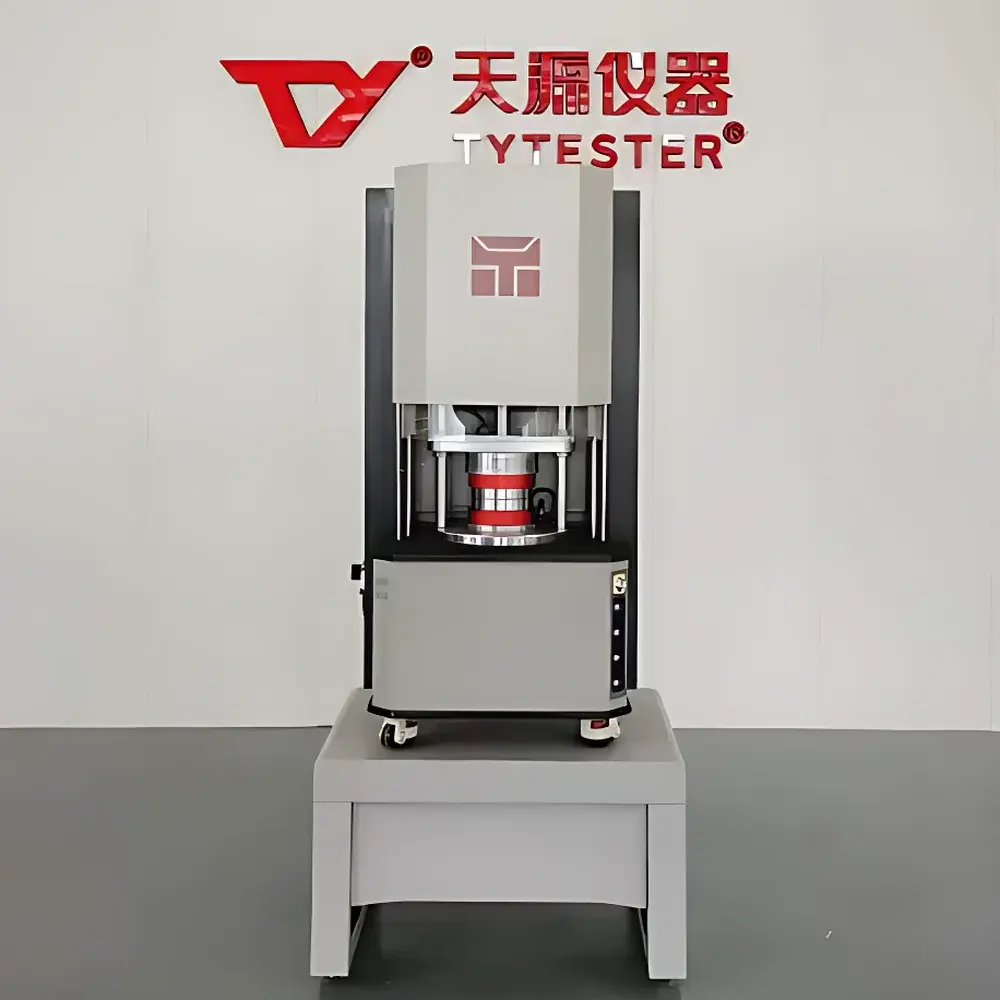
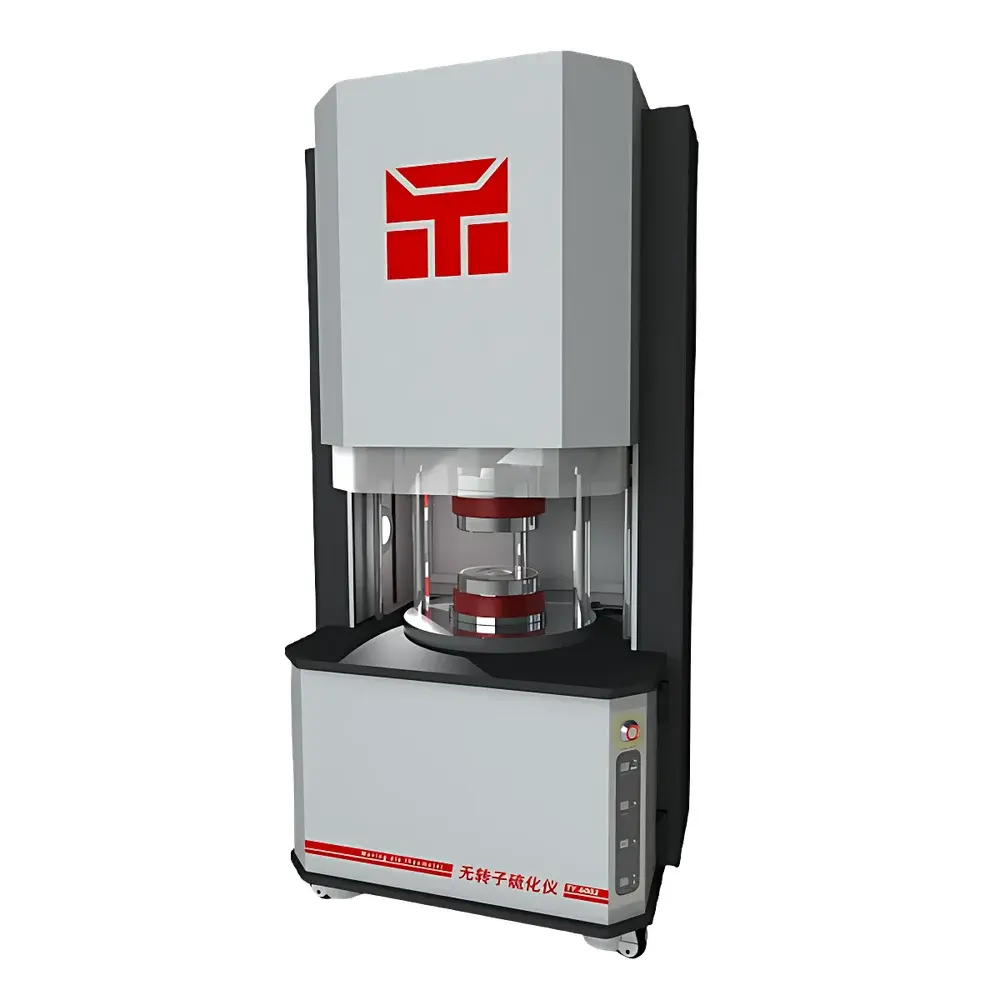
TianYuan TY-6004 Mooney Viscometer
| Brand | TianYuan |
|---|---|
| Origin | Jiangsu, China |
| Manufacturer Type | Direct Manufacturer |
| Country of Origin | China |
| Model | TY-6004 |
| Price Range | USD 5,300 – 8,100 (FOB) |
| Measurement Range | 0–200 Mooney Units |
| Accuracy | ±0.5 MU |
| Resolution | 0.1 MU |
| Temperature Range | Ambient to 200 °C |
| Temp. Stability | ±0.5 °C |
| Heating Rate | <5 min (Ambient to 100 °C) |
| Rotor Speed | 2.00 ± 0.02 rpm |
| Applied Pressure | 0.5 MPa |
| Power Supply | AC 220 V ±10%, 50/60 Hz |
| Power Consumption | 800 W |
| Dimensions | 660 × 570 × 1300 mm |
| Weight | 260 kg |
| Rotor Material | Cr6WV tool steel |
| Data Interface | USB |
| Control System | PC-based with embedded IC module and touch HMI |
| Compliance | GB/T 1232, GB/T 1233, ISO 289, ISO 667 |
Overview
The TianYuan TY-6004 Mooney Viscometer is a precision-engineered instrument designed for the quantitative evaluation of viscoelastic behavior in uncured rubber compounds. It operates on the principle of rotational shear rheometry under standardized thermal and mechanical conditions—specifically, measuring the torque resistance exerted by a rotating disk-shaped rotor embedded in a heated rubber sample confined within a sealed cavity. This torque, expressed in Mooney Units (MU), directly correlates with compound viscosity, scorch time (t5), and vulcanization index (Δt30), enabling quality control laboratories to assess processability, storage stability, and cure kinetics prior to extrusion or molding. The instrument conforms to internationally recognized test protocols including ASTM D1646 (equivalent to ISO 289 and ISO 667), GB/T 1232, and GB/T 1233, ensuring data comparability across global supply chains and regulatory submissions.
Key Features
- High-stability temperature control system with intelligent digital PID regulation, maintaining ±0.5 °C accuracy across the full operating range (ambient to 200 °C); heating rate from ambient to 100 °C completes in under 5 minutes.
- Cr6WV alloy rotor—heat-treated for exceptional wear resistance and dimensional stability during repeated high-pressure (0.5 MPa) compression cycles.
- Dual-mode human-machine interface: integrated 7-inch high-resolution capacitive touchscreen + Windows 7–compatible software suite (TY Viscosity), supporting mouse-driven and touch-activated operation.
- Precision stepper motor (optionally upgradable to Panasonic servo drive) coupled with planetary gear reduction ensures consistent 2.00 ± 0.02 rpm rotation speed—critical for reproducible torque transduction.
- Automated safety architecture: 5-mm acrylic transparent shield synchronized with mold actuation; shield locks in closed position upon power loss; physical enable button required for closing cycle to prevent accidental activation.
- LED illumination system activated automatically during mold opening, enhancing visual inspection of sample integrity and cavity cleanliness.
- Embedded signal acquisition module with USB 2.0 interface enables real-time data streaming, timestamped curve logging, and post-test analysis without external DAQ hardware.
Sample Compatibility & Compliance
The TY-6004 accommodates standard 45 g rubber specimens (diameter 44.5 mm, thickness 5.5 mm) per ISO 289 and GB/T 1232 requirements. It supports natural rubber (NR), styrene-butadiene rubber (SBR), ethylene propylene diene monomer (EPDM), nitrile rubber (NBR), chloroprene (CR), and reclaimed rubber formulations. All measurement outputs—including Mooney viscosity (ML1+4), scorch time (t5), and cure rate index (Δt30)—are traceable to NIST-traceable torque calibration standards. The system meets GLP documentation requirements through audit-ready test reports containing operator ID, environmental temperature/humidity stamps, calibration certificate references, and electronic signatures (when deployed with compliant Windows OS configurations).
Software & Data Management
TY Viscosity software provides comprehensive test lifecycle management: automated method templates for ML1+4, t5, and t35; overlay comparison of up to eight historical curves; deviation alerts based on user-defined tolerance bands; and export to CSV, PDF, or XML formats for LIMS integration. Raw torque vs. time datasets are stored with full metadata (temperature setpoint, actual cavity temp, rotor speed, pressure status). Software supports multi-language UI (English, Simplified/Traditional Chinese, Russian) and complies with FDA 21 CFR Part 11 when configured with Windows domain authentication, electronic signature workflows, and audit trail logging enabled.
Applications
- Raw material acceptance testing for incoming natural and synthetic rubber lots.
- Batch-to-batch consistency verification in compound development labs.
- Accelerated aging studies assessing scorch safety under elevated storage temperatures.
- Formulation optimization for extrusion grade compounds requiring low ML1+4 and extended t5.
- Supporting ISO/TS 16949 and IATF 16949 process validation dossiers for automotive elastomer suppliers.
- Generating reference data for finite element modeling (FEM) of rubber flow in die channels.
FAQ
What standards does the TY-6004 comply with?
It fully implements GB/T 1232, GB/T 1233, ISO 289, and ISO 667. Test reports include automatic citation of clause numbers and measurement uncertainty statements aligned with ISO/IEC 17025 Annex A.5.
Can the instrument be integrated into an existing LIMS?
Yes—via structured CSV export or optional OPC UA server add-on (hardware revision ≥2023Q3), enabling bidirectional communication with LabWare, Thermo Fisher SampleManager, or custom SQL-based systems.
Is rotor calibration traceable to national metrology institutes?
Each unit ships with a factory calibration certificate referencing torque calibration against NIST SRM 2460/2461 equivalents, with recalibration interval recommendation of 12 months or 500 test cycles—whichever occurs first.
Does the system support ASTM D1646 test methods?
Yes—the software includes preconfigured ASTM D1646 Method A (standard disk rotor) and Method B (large-disk variant), with automatic calculation of ML1+8 and t35 parameters per specification.
What maintenance is required for long-term accuracy?
Monthly verification of temperature uniformity using calibrated PT100 probe; biannual cleaning of rotor cavity with solvent-resistant lint-free wipes; annual torque sensor linearity check using certified deadweight loading kit (optional accessory).






