
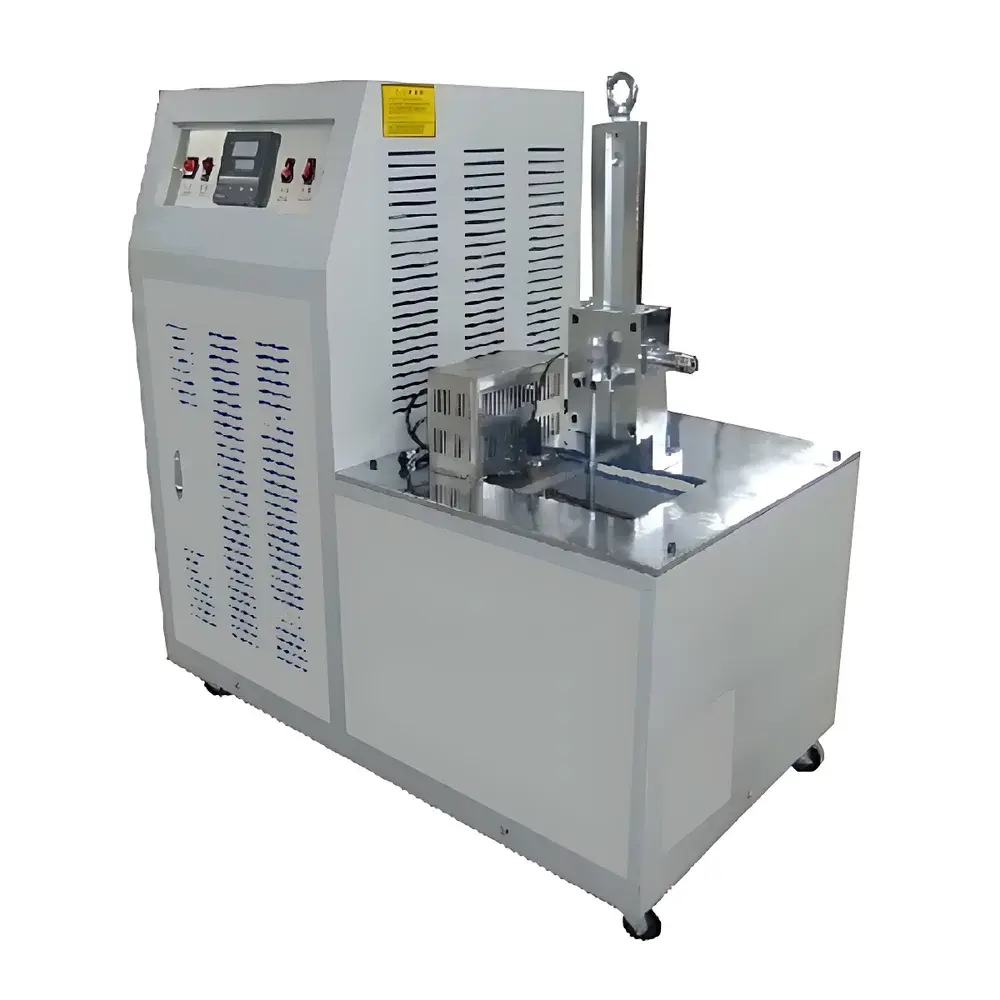
TianYuan TY-5003 Single-Specimen Rubber Low-Temperature Brittleness Tester
| Brand | TianYuan |
|---|---|
| Origin | Jiangsu, China |
| Manufacturer Type | Direct Manufacturer |
| Country of Origin | China |
| Model | TY-5003 Single-Specimen |
| Cooling Medium | Ethanol or Non-Freezing Fluid |
| Temperature Control Range | −70 °C |
| Temperature Stability During Test (3 min) | ±0.5 °C |
| Cooling Time to −70 °C (at 23–25 °C ambient) | ~120 min |
| Chamber Internal Dimensions (L×H×W) | 200×140×100 mm |
| Overall Dimensions (L×H×W) | 720×1380×700 mm |
| Stirring Motor Power | 15 W |
| Power Supply | 220–240 V AC, 50 Hz, 2 kW |
| Impact Velocity | 2.0 ± 0.2 m/s |
| Minimum Impact Energy per Specimen | 3.0 J |
| Specimen Dimensions (per GB/T 1682 & ISO 812) | 31.75 ± 6.35 mm (L) × 6.35 ± 0.51 mm (W) × 1.91 ± 0.13 mm (T) |
| Compliance | GB/T 1682–2014, GB/T 5470–2008, ISO 812:2006, ASTM D2137–1994 |
Overview
The TianYuan TY-5003 Single-Specimen Rubber Low-Temperature Brittleness Tester is a precision-engineered thermal-mechanical testing instrument designed to determine the brittle temperature (Tb) of vulcanized rubber and elastomeric materials under standardized impact conditions. Based on the principle of controlled low-temperature embrittlement followed by dynamic mechanical impact, the system identifies the highest temperature at which a specimen exhibits macroscopic fracture upon a single, reproducible impact event. This critical parameter reflects the material’s resistance to crack initiation and propagation at sub-ambient temperatures — a key performance indicator for automotive seals, aerospace gaskets, cryogenic hoses, and industrial belting. The instrument implements a dual-stage cascade compression refrigeration architecture, enabling stable operation down to −70 °C with high thermal uniformity across the test chamber. Its design adheres strictly to the thermodynamic and kinematic requirements specified in GB/T 1682–2014 (equivalent to ISO 812:2006), ensuring metrological traceability and inter-laboratory comparability.
Key Features
- Single-specimen configuration ensures unambiguous failure attribution and eliminates cross-contamination risk between sequential tests;
- Cascade refrigeration system with imported compressors delivers rapid cooling (≤120 min to −70 °C) and maintains temperature stability within ±0.5 °C over 3-minute dwell periods — meeting the stringent thermal homogeneity criteria of GB/T 1682 and ISO 812;
- Precision-machined impact assembly: hardened steel anvil, gravity-driven hammer with self-locking release mechanism, and calibrated impact velocity of 2.0 ± 0.2 m/s — verified via optical timing gates during qualification;
- Thermally isolated cold bath with integrated magnetic stirrer (15 W) ensures uniform coolant temperature distribution and minimizes thermal stratification;
- Adjustable specimen holder configured as a cantilever beam, engineered to prevent bending deformation during clamping while maintaining consistent impact geometry (e.g., 3.6 ± 0.1 mm clearance for Type A specimens);
- Dedicated ethanol-compatible chamber with 75 ± 10 mm immersion depth specification for compliant specimen submersion per standard procedure;
- Front-access service panel and side ventilation design facilitate compressor heat dissipation under continuous operation at rated load.
Sample Compatibility & Compliance
The TY-5003 accommodates standard rectangular dumbbell-shaped specimens conforming to GB/T 1682–2014 and ISO 812:2006 dimensions: 31.75 ± 6.35 mm length, 6.35 ± 0.51 mm width, and 1.91 ± 0.13 mm thickness. Surface finish must be free of machining marks, particulate contamination, or microcracks — consistent with GLP-compliant sample preparation protocols. The system supports both Type A and Type B specimen geometries, with interchangeable impact anvils and alignment fixtures certified to dimensional tolerances (e.g., punch radius 1.6 ± 0.1 mm; lateral clearance ±0.1 mm). Full compliance is documented against GB/T 1682–2014, GB/T 5470–2008 (for thermoplastics), ISO 812:2006, and ASTM D2137–1994. While not inherently 21 CFR Part 11 compliant, audit-ready test logs — including timestamped temperature profiles, impact timestamps, and operator IDs — can be exported in CSV format for integration into validated LIMS environments supporting GMP/GLP workflows.
Software & Data Management
The TY-5003 operates via an embedded microcontroller-based interface with dual digital displays: one for real-time bath temperature (0.1 °C resolution), and another for elapsed chilling time (0.1 s resolution). All operational parameters — setpoint temperature, dwell duration, and impact trigger confirmation — are manually entered and retained in non-volatile memory. No proprietary software is required; however, optional RS-232 or USB-to-serial adapters enable connection to external PCs for automated data capture using third-party SCADA or LabVIEW applications. Temperature logging intervals (1 Hz default) and impact event tagging are configurable via firmware update. Raw thermal and timing datasets export without modification, supporting post-test statistical analysis per ISO/IEC 17025 requirements for uncertainty budgeting (e.g., combined standard uncertainty in Tb determination).
Applications
- Quality control of incoming raw elastomers (e.g., natural rubber, SBR, EPDM, FKM) prior to compound formulation;
- Comparative evaluation of low-temperature performance across competing polymer grades or curing systems;
- Validation of cold-flexibility specifications for automotive NVH components (door seals, trunk lid gaskets);
- Failure analysis of field-return parts exhibiting low-temperature cracking;
- Supporting regulatory submissions requiring ISO 812 or ASTM D2137 test evidence (e.g., EU REACH, FDA 510(k) for medical tubing);
- Accelerated aging studies where brittle temperature shift correlates with oxidative degradation kinetics.
FAQ
What cooling medium is recommended for routine operation?
Ethanol (≥99.5% purity) is the default medium specified in GB/T 1682–2014. Alternatives such as propylene glycol–water mixtures or commercial non-freezing fluids may be used if validated for thermal conductivity and chemical compatibility with stainless-steel bath components.
Can the instrument perform multi-specimen testing?
No — the TY-5003 is configured exclusively for single-specimen testing per ISO 812 and GB/T 1682. Multi-specimen variants require separate model designation and revalidation of thermal mass dynamics.
Is calibration traceable to national standards?
Yes — the integrated Pt100 sensor is factory-calibrated against NIM (National Institute of Metrology, China) reference standards. Users receive a calibration certificate with measurement uncertainty (k=2) stated for the −70 °C to 25 °C range.
What maintenance intervals are recommended?
Compressor oil inspection every 12 months; coolant replacement every 6 months or after 200 test cycles; mechanical impact alignment verification before each test series using gauge blocks and dial indicators.
Does the system meet CE or UKCA marking requirements?
The TY-5003 complies with IEC 61010-1:2010 for electrical safety and EN 60529:2013 (IP20 enclosure rating). CE marking is available upon request for EU-distributed units with accompanying EC Declaration of Conformity and technical file.



