
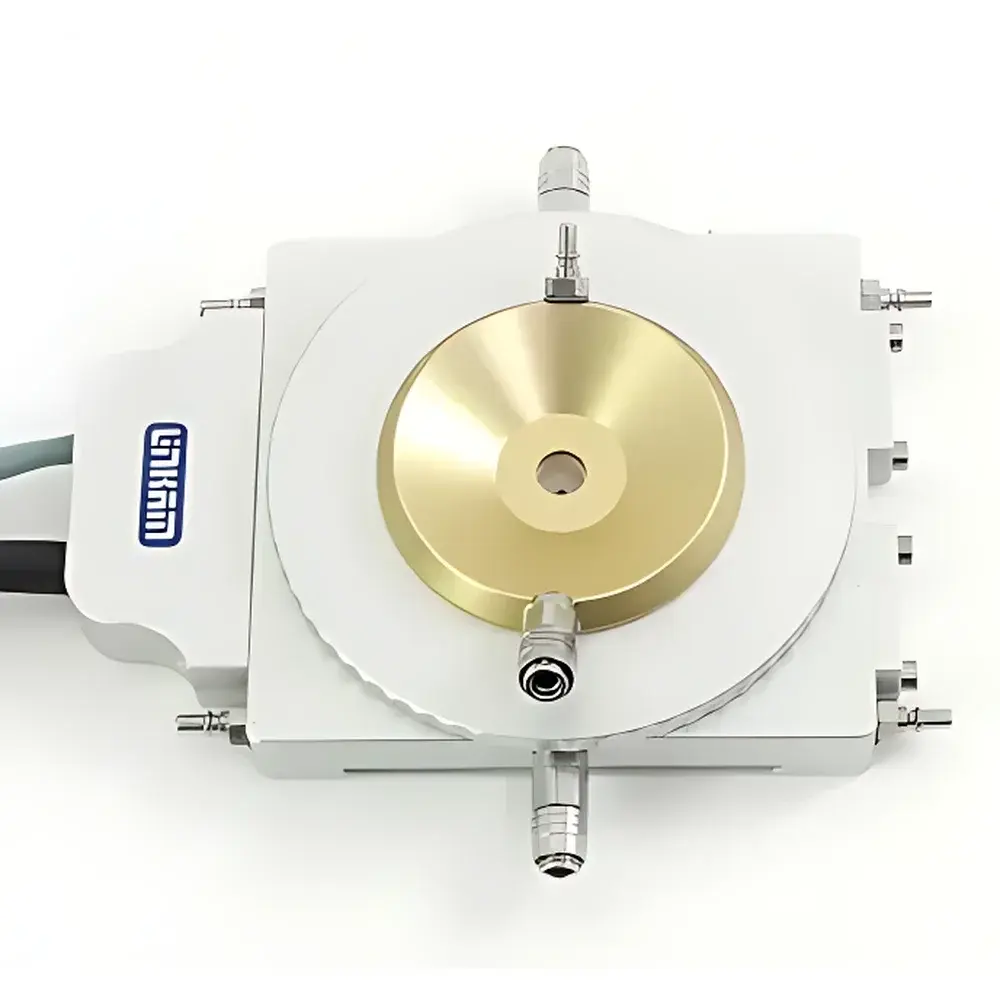
Linkam TS1200 Heating and Cooling Stage
| Brand | Linkam |
|---|---|
| Origin | United Kingdom |
| Model | TS1200 |
| Temperature Range | Ambient to 1200 °C |
| Temperature Accuracy & Stability | ±1 °C |
| Optical Aperture Diameter | 1.7 mm |
| Sample Chamber Dimensions | Ø10 × 5 mm |
| Maximum Heating Rate | 200 °C/min |
| Minimum Objective/Condenser Working Distance | 6.0 mm / 14.8 mm |
Overview
The Linkam TS1200 is a high-precision, dual-mode heating and cooling stage engineered for in-situ thermal analysis under optical microscopy and spectroscopic observation. Based on resistive heating of a platinum-wound ceramic cup and active water cooling of the stage body and radiation shield, the TS1200 enables stable, repeatable temperature control from ambient to 1200 °C. Its design follows Couette-type thermal architecture—where heat is delivered radially and axially through a low-thermal-mass ceramic sample chamber—ensuring minimal thermal lag and high spatial uniformity across the field of view. The stage integrates seamlessly with upright and inverted optical microscopes, FTIR, Raman, and synchrotron beamlines, supporting both transmission and reflection modalities via its central 1.7 mm optical aperture. Unlike conventional hot stages relying on simple resistive coils or furnace-style enclosures, the TS1200 employs a closed-loop PID-controlled thermocouple system embedded flush with the top surface of the ceramic cup, directly adjacent to a 7 mm sapphire window that serves as the sample support. Sapphire’s exceptional thermal conductivity (>35 W/m·K at 1000 °C), chemical inertness, and broad spectral transparency (0.15–5.5 µm) make it ideal for high-fidelity thermal imaging and quantitative optical property measurements at extreme temperatures.
Key Features
- Wide operational range: ambient to 1200 °C with ±1 °C accuracy and stability over extended dwell periods
- Ultra-fast thermal response: programmable ramp rates up to 200 °C/min enabled by low-thermal-mass ceramic construction and DC-powered solid-state heating
- Optimized optical access: 1.7 mm central aperture aligned with standard microscope optical paths; compatible with objectives down to 6.0 mm working distance and condensers ≥14.8 mm WD
- Hermetically sealed sample chamber: supports inert gas purging (N₂, Ar) or vacuum operation down to 10⁻³ mbar using external vacuum pumps
- Optional electrode integration: two gold-plated feedthroughs enable simultaneous electrical biasing and impedance monitoring during thermal cycling
- Dual-stage active cooling: independent water circuits for both stage body and radiation shield prevent lens overheating and maintain microscope alignment integrity
- EMI-suppressed DC power supply: eliminates electromagnetic interference critical for sensitive detectors (e.g., EMCCD, photodiodes, lock-in amplifiers)
Sample Compatibility & Compliance
The TS1200 accommodates solid samples up to Ø10 mm × 5 mm in volume, including ceramics, metallic alloys, geological thin sections, polymer films, and battery electrode composites. Its sapphire support window is chemically resistant to molten oxides, carbonates, and halide salts commonly encountered in metallurgical and geochemical studies. The stage conforms to ISO 11357 (Plastics — Differential Scanning Calorimetry), ASTM E1142 (Standard Guide for Thermal Analysis of Solids), and supports GLP-compliant workflows when paired with Linkam’s TMS94 or LTS420 temperature controllers featuring audit-trail logging and user-access controls per FDA 21 CFR Part 11 requirements. All materials in contact with the sample chamber are RoHS-compliant and non-outgassing under vacuum.
Software & Data Management
The TS1200 operates via Linkam’s proprietary Linksys software platform, which provides synchronized temperature profiling, real-time data logging (≥10 Hz sampling), and hardware-triggered image capture integration with major microscope manufacturers (Olympus, Zeiss, Nikon, Leica). Temperature programs—including multi-step ramps, isothermal holds, and cyclic profiles—are defined using intuitive drag-and-drop logic. Raw thermocouple voltage, stage status flags, and user-defined metadata are exported in CSV and HDF5 formats for traceable post-processing in MATLAB, Python (NumPy/Pandas), or OriginLab. Software updates are distributed through Linkam’s secure firmware portal, with version history and validation reports available upon request for regulated laboratory environments.
Applications
- In-situ phase transition analysis of refractory ceramics and high-entropy alloys during sintering
- Melt crystallization kinetics of pharmaceutical polymorphs under controlled atmospheres
- Thermal expansion coefficient (CTE) mapping of composite laminates using digital image correlation (DIC)
- Oxidation behavior of turbine blade coatings observed via time-resolved reflectance microscopy
- Electrochemical-thermal coupling in solid-state battery cathodes under simultaneous bias and heating
- Volcanic mineral dehydration sequences imaged under hydrous vacuum conditions
FAQ
What is the maximum recommended heating rate for long-term stage reliability?
For optimal longevity of the ceramic heater assembly and thermocouple junction, Linkam recommends sustained ramp rates ≤100 °C/min; 200 °C/min is specified for short-duration qualification tests only.
Can the TS1200 be used with oil-immersion objectives?
No—oil immersion is incompatible due to thermal degradation of immersion oils above 60 °C and risk of contamination; dry or water-dipping objectives are required.
Is calibration traceable to NIST standards?
Yes—each TS1200 ships with a factory calibration certificate traceable to UKAS-accredited standards; on-site recalibration services are available globally through Linkam’s certified service centers.
Does the stage support automated focus correction during thermal expansion?
Not natively—the TS1200 does not include motorized Z-axis compensation; however, it outputs TTL sync pulses compatible with third-party autofocus systems (e.g., Prior ProScan III, Ludl MAC5000) for external integration.
What vacuum pump specifications are required to achieve 10⁻³ mbar?
A two-stage rotary vane pump with <5 × 10⁻⁴ mbar base pressure and ≥4 m³/h pumping speed is sufficient; for lower base pressures, a turbomolecular pump may be added downstream.




