
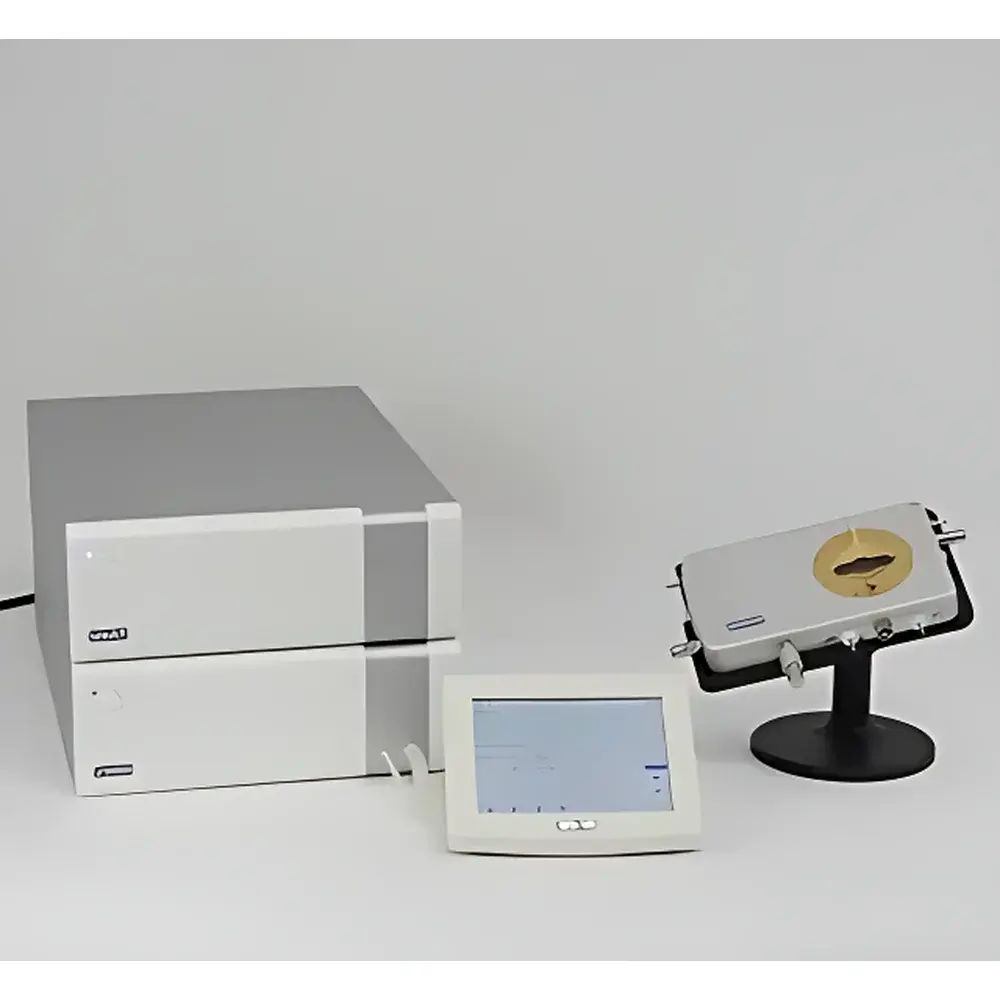
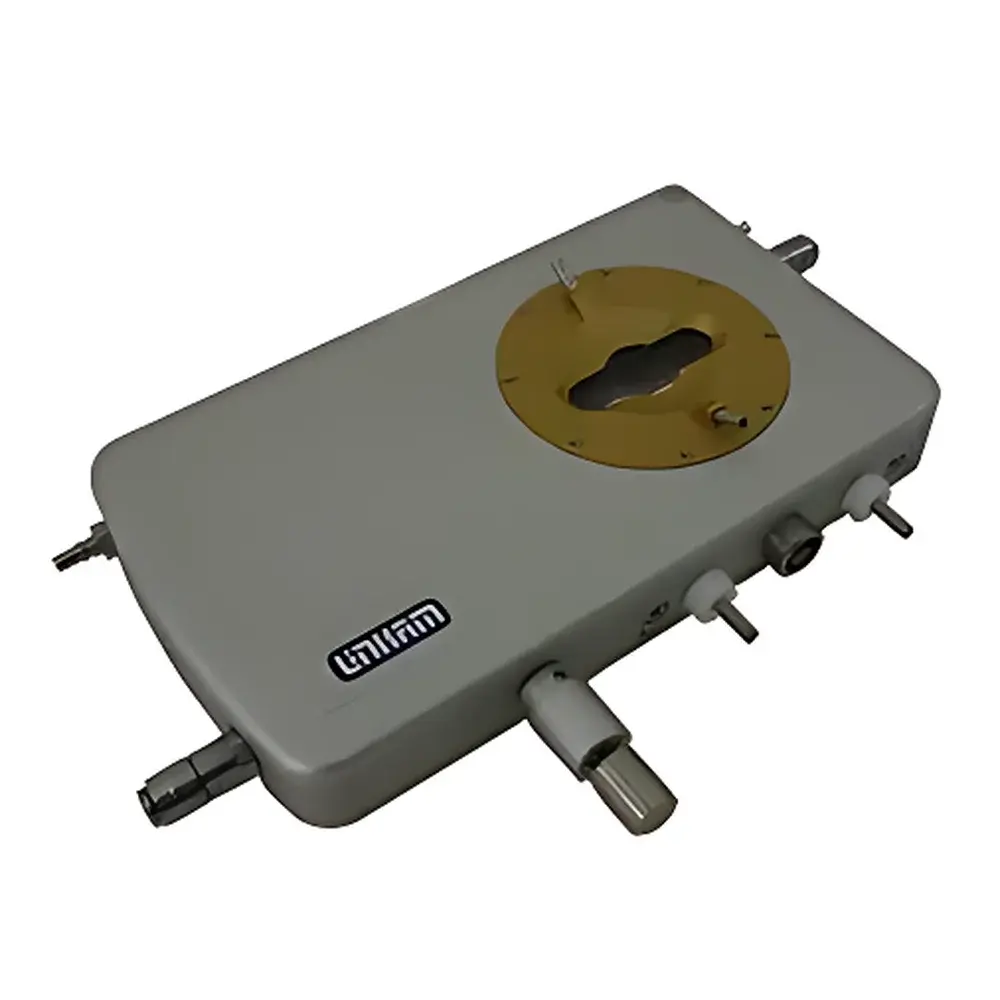
Linkam CAP500 Cryo-Heating Stage for Microscopy
| Brand | Linkam |
|---|---|
| Origin | United Kingdom |
| Model | CAP500 |
| Temperature Range | −180 °C to +500 °C |
| Temperature Accuracy | ±0.1 °C |
| Temperature Stability | <0.1 °C |
| Heating/Cooling Rate | 1–50 °C/min |
| Sample X-Axis Translation | 20 mm |
| Quartz Window Aperture | 22 mm long × 1.6 mm diameter groove for capillary insertion |
| Minimum Working Distance | Objective 4.5 mm / Condenser 12.5 mm |
Overview
The Linkam CAP500 Cryo-Heating Stage is a precision-engineered thermal stage designed for in-situ optical microscopy analysis of synthetic fluid inclusion analogues—particularly capillary-based microsystems—under controlled temperature and pressure conditions. Operating on the principle of resistive heating combined with liquid nitrogen cryogenic cooling, the CAP500 enables high-fidelity thermal cycling across an exceptionally broad range: from −180 °C to +500 °C. Its architecture integrates a dedicated quartz-windowed sample chamber with a precisely machined 22 mm-long, 1.6 mm-diameter groove optimized for alignment and thermal coupling of fused silica or glass capillaries. This geometry ensures uniform heat transfer along the capillary length while maintaining optical clarity for transmitted-light microscopy, polarized light observation, and confocal Raman spectroscopy. The stage mounts directly onto standard upright or inverted microscope stages via a universal dovetail or threaded adapter, requiring no optical path modification. A proprietary dual-zone thermal control algorithm minimizes thermal lag and spatial gradients, supporting reproducible phase transition studies—including ice-melting, hydrocarbon freezing, salt hydrate dissociation, and volatile fluid homogenization.
Key Features
- Ultra-wide operational temperature range (−180 °C to +500 °C) validated per IEC 61000-4-30 for thermal stability under dynamic load
- High-resolution X-axis mechanical translation (20 mm travel, micrometer-adjustable) enabling precise capillary positioning relative to objective focal plane
- Dual-mode thermal actuation: PID-controlled resistive heating + regulated liquid nitrogen flow (via integrated solenoid valve and pressure-regulated dewar interface)
- Integrated piezoresistive pressure sensor (optional calibration traceable to NIST standards) for real-time monitoring of internal capillary pressure during thermal cycling
- Optimized optical access: 4.5 mm minimum objective working distance and 12.5 mm condenser clearance accommodate high-NA dry and long-working-distance objectives
- Lateral access ports on both stage flanks facilitate insertion and manipulation of extended-length capillaries (>50 mm) without disassembly
- Thermal shielding and vacuum-compatible design (optional O-ring sealed housing) support operation under low-pressure or inert-gas environments
Sample Compatibility & Compliance
The CAP500 is engineered for compatibility with synthetic capillary fluid inclusions—typically fabricated from borosilicate or fused silica tubing (inner diameters 0.1–1.0 mm)—filled with aqueous electrolytes, hydrocarbons, CO₂, CH₄, or mixed volatile systems. It conforms to ASTM D5292 (Standard Test Method for Melting Point of Petroleum Waxes by Capillary Tube Method) and supports experimental protocols aligned with ISO 17025-accredited laboratories. All electronic components meet CE/UKCA electromagnetic compatibility (EMC) directives. The stage’s firmware and controller interface comply with GLP data integrity requirements, including audit-trail-enabled parameter logging (time-stamped setpoints, actual temperatures, pressure readings, and user IDs). When paired with validated third-party software, it satisfies FDA 21 CFR Part 11 criteria for electronic records and signatures in regulated research environments.
Software & Data Management
The CAP500 operates with Linkam’s TC125 temperature controller, featuring a 5.7″ touchscreen HMI and embedded 16-bit ADC for sub-millidegree resolution. Controller firmware (v4.2+) supports programmable multi-segment ramp/soak profiles, real-time derivative calculation (dT/dt), and synchronized analog output triggering for external detectors (e.g., Raman spectrometers or FTIR units). Data export is native to CSV and HDF5 formats, with optional integration into LabVIEW™, MATLAB®, or Python-based analysis pipelines via RS232/USB virtual COM port. All thermal and pressure logs include ISO 8601 timestamps, instrument serial identifiers, and metadata tags for full traceability—critical for publication-grade data curation and regulatory submission packages.
Applications
- In-situ characterization of synthetic fluid inclusions to calibrate natural geological fluid inclusion thermobarometry
- Phase equilibria mapping of CO₂–H₂O–salt systems relevant to carbon capture and storage (CCS) reservoir modeling
- Crystallization kinetics of pharmaceutical hydrates and co-crystals under controlled thermal stress
- Thermal expansion and softening behavior of polymer nanocomposites in capillary confinement
- Validation of molecular dynamics simulations through direct comparison with observed melting/homogenization temperatures
- Development and testing of high-temperature optical sensors and microfluidic reference standards
FAQ
Is the CAP500 compatible with confocal Raman microspectroscopy?
Yes—the quartz window transmission exceeds 85% from 200 nm to 3500 nm, and the minimized thermal drift (<0.1 °C over 1 h at 300 °C) ensures spectral stability during long acquisitions.
Can the stage operate under vacuum or inert gas?
The base configuration supports ambient air; optional vacuum-rated housing (with Viton® seals and feedthroughs) enables operation down to 10⁻³ mbar.
What is the calibration interval recommendation?
Linkam recommends annual recalibration against NIST-traceable reference cells (e.g., ITS-90 fixed points at −38.8344 °C, 0.01 °C, and 419.527 °C) performed by an ISO/IEC 17025-accredited service provider.
Does the system support automated pressure–temperature cycling?
When equipped with the optional pressure transducer and Linkam’s Peltier-driven back-pressure module, closed-loop PT cycling (e.g., isothermal pressure ramps at fixed T) is fully programmable via the TC125 interface.
Are replacement capillary holders or custom groove inserts available?
Yes—Linkam offers OEM-machined inserts for alternative capillary geometries (square, rectangular, or multi-channel arrays) under part numbers CAP500-INSERT-XX series.





