
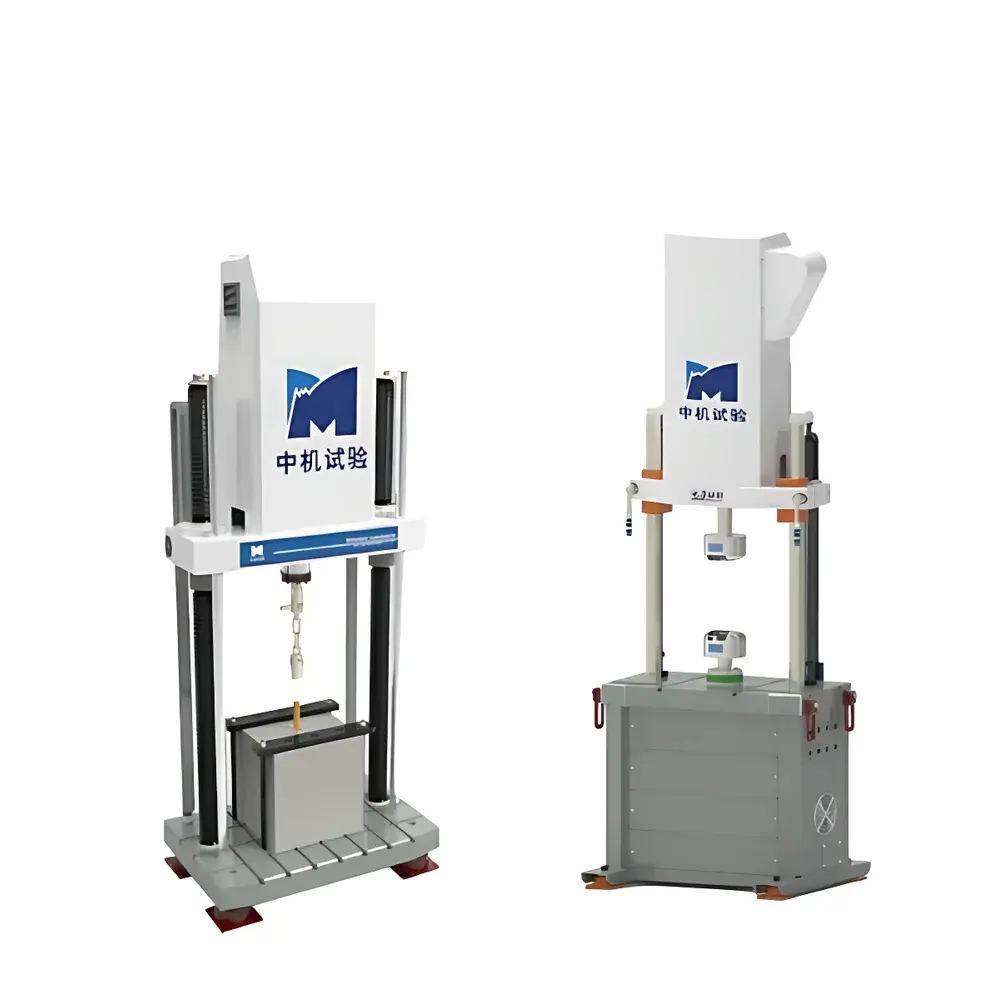
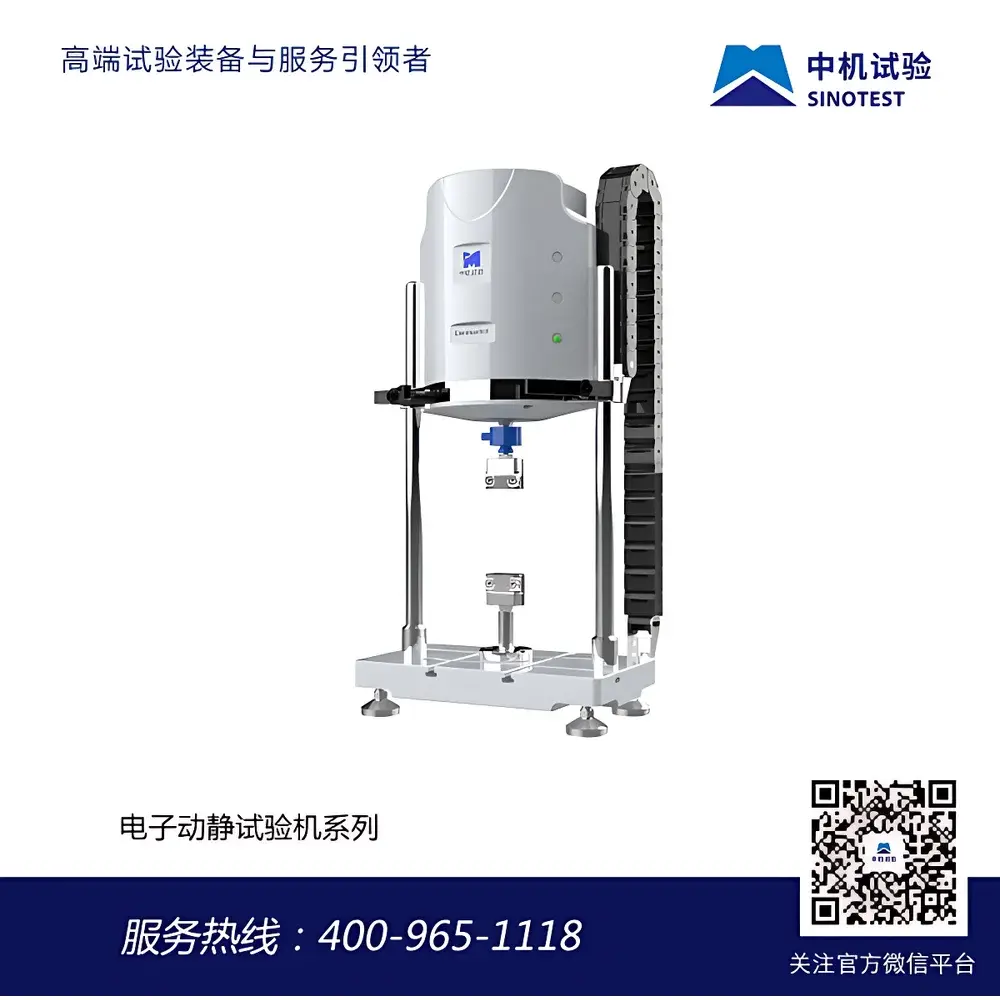
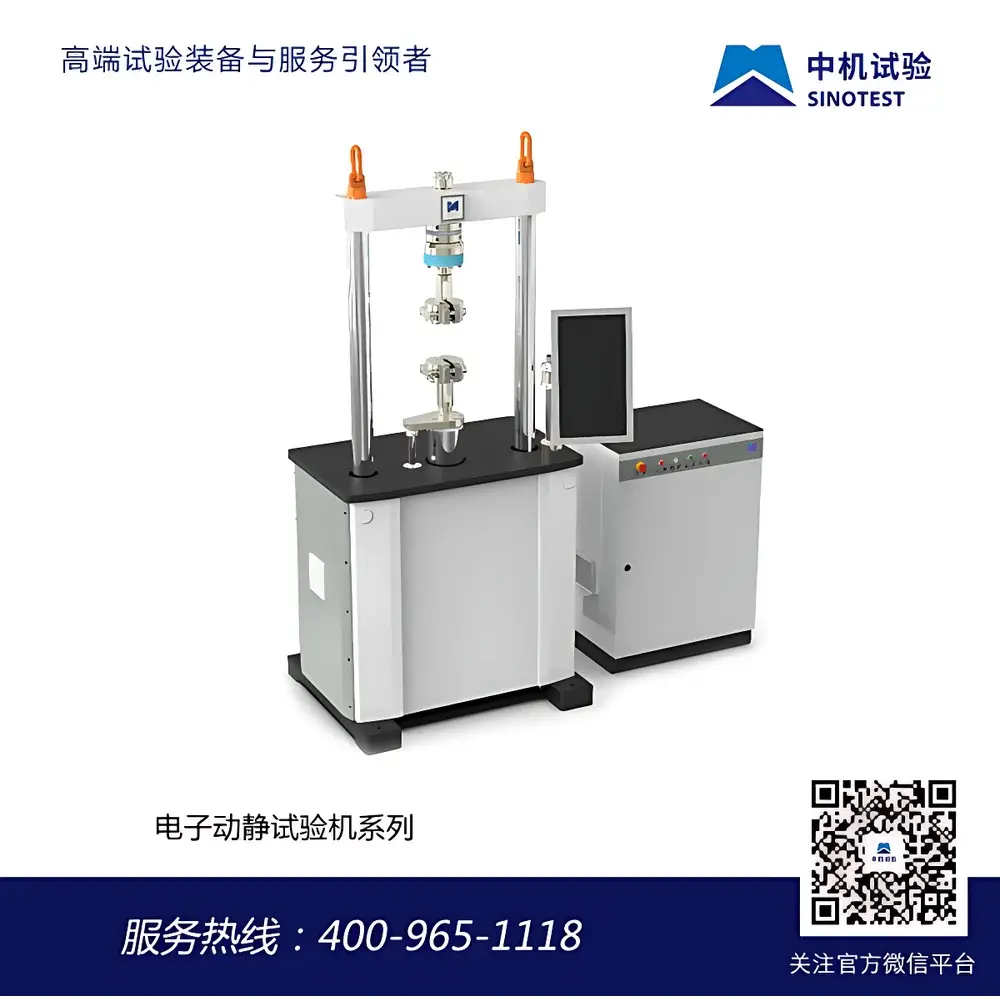
Servo-Electric Dynamic and Static Testing Machine SINOTEST SZL Series
| Brand | SINOTEST |
|---|---|
| Origin | Jilin, China |
| Manufacturer Type | Original Equipment Manufacturer (OEM) |
| Product Origin | Domestic (China) |
| Model | SZL |
| Instrument Category | Electromechanical Fatigue Testing System |
| Pricing | Available Upon Request |
Overview
The SINOTEST SZL Series Servo-Electric Dynamic and Static Testing Machine is an electromechanical testing system engineered for high-precision, low-noise, and energy-efficient evaluation of mechanical behavior under both static and dynamic loading conditions. Unlike hydraulic fatigue testers, this system employs a high-bandwidth servo-electric actuator driven by a precision brushless AC servo motor and planetary roller screw transmission, enabling closed-loop control of force, displacement, and strain with sub-micron resolution and exceptional repeatability. The machine operates on the principle of controlled cyclic loading—applying sinusoidal, block, trapezoidal, or user-defined waveforms—to quantify material response across stress–strain, load–displacement, and cycle-life domains. It is designed to meet the functional requirements of ISO 12107, ASTM E466, ASTM E606, and ASTM E2207 for constant-amplitude and variable-amplitude fatigue testing, supporting both R-ratio (minimum/maximum load) and mean-load-controlled test protocols.
Key Features
- Electromechanical actuation architecture eliminates hydraulic fluid maintenance, leakage risks, and ambient temperature sensitivity—ideal for clean-room and regulated laboratory environments.
- Integrated high-fidelity load cell (±0.5% full-scale accuracy) and non-contact extensometer (optional) ensure traceable force and strain measurement per ISO 7500-1 Class 1 compliance.
- Modular frame design with adjustable crosshead travel (standard 1,000 mm; extendable up to 1,500 mm) accommodates specimens from miniature coupons (e.g., ASTM E606 dog-bone) to structural components.
- Dual-mode controller supporting simultaneous real-time monitoring of up to eight channels—including load, displacement, strain, temperature (via optional thermocouple input), and acoustic emission triggers.
- Robust industrial PC-based control platform with deterministic real-time OS, offering ≥1 kHz closed-loop update rate and <100 µs latency for high-frequency fatigue testing (up to 100 Hz).
- Pre-configured test templates aligned with common standards: tensile strength (ASTM E8/E21), compression (ASTM E9), flexural modulus (ASTM D790), and fully reversed axial fatigue (ASTM E466).
Sample Compatibility & Compliance
The SZL series supports standardized metallic, polymeric, composite, and ceramic specimens conforming to ASTM, ISO, GB/T, and JIS geometries—including round, flat, notched, and threaded configurations. Gripping systems include pneumatic wedge grips (for metals), serrated face grips (for composites), and custom fixture interfaces for aerospace fasteners or biomedical implants. All hardware and firmware comply with CE Machinery Directive 2006/42/EC, EMC Directive 2014/30/EU, and RoHS 2011/65/EU. Software execution adheres to ALCOA+ principles (Attributable, Legible, Contemporaneous, Original, Accurate, Complete, Consistent, Enduring, Available) and supports audit-ready electronic records per FDA 21 CFR Part 11 when configured with digital signature and role-based access controls.
Software & Data Management
Control and analysis are performed using SINOTEST TestMaster™ v4.x—a Windows-based application built on .NET Framework with modular architecture. The software provides intuitive test sequencing via drag-and-drop workflow editor, real-time FFT spectral analysis for resonance detection, and automated S–N curve generation with statistical confidence bands (Weibull or log-normal distribution fitting). Raw data is stored in vendor-neutral HDF5 format with embedded metadata (test parameters, calibration certificates, operator ID, timestamp), ensuring long-term interoperability with MATLAB, Python (h5py), or third-party LIMS platforms. Export options include CSV, XML, and PDF reports compliant with ISO/IEC 17025 documentation requirements.
Applications
- Qualification testing of aerospace alloys (e.g., Ti-6Al-4V, Inconel 718) under spectrum loading simulating flight cycles.
- Biomedical device validation—including fatigue life assessment of orthopedic implants (ISO 14801) and cardiovascular stents (ISO 14001-1).
- Automotive component durability evaluation: suspension bushings, engine mounts, and EV battery module housings under combined thermal–mechanical loading.
- Research into crack initiation and propagation thresholds using in-situ DIC (Digital Image Correlation) synchronization.
- Quality assurance for additive-manufactured parts where microstructure heterogeneity demands high-cycle fatigue screening (>10⁶ cycles).
FAQ
What is the maximum dynamic force capacity of the SZL series?
The standard configuration offers ±50 kN peak dynamic force; higher-capacity variants (±100 kN and ±250 kN) are available upon request with reinforced load frame and upgraded actuator assembly.
Can the system perform thermomechanical fatigue (TMF) testing?
Yes—when integrated with a programmable environmental chamber (−70 °C to +300 °C) and synchronized thermal profiling, the SZL supports out-of-phase and in-phase TMF protocols per ASTM E2368.
Is third-party calibration certification included?
Each unit ships with a NIST-traceable factory calibration certificate for load and displacement channels; ISO/IEC 17025 accredited field calibration services are offered separately.
Does the software support automated pass/fail criteria based on cycle count or crack detection?
Yes—user-defined termination logic includes cycle limits, load drop thresholds, displacement runaway, and external trigger inputs (e.g., from eddy current or AE sensors).
What maintenance intervals are recommended for long-term reliability?
Servo motor and roller screw require lubrication every 2,000 operating hours; load cell verification is advised annually or after any impact event exceeding 110% of rated capacity.



