
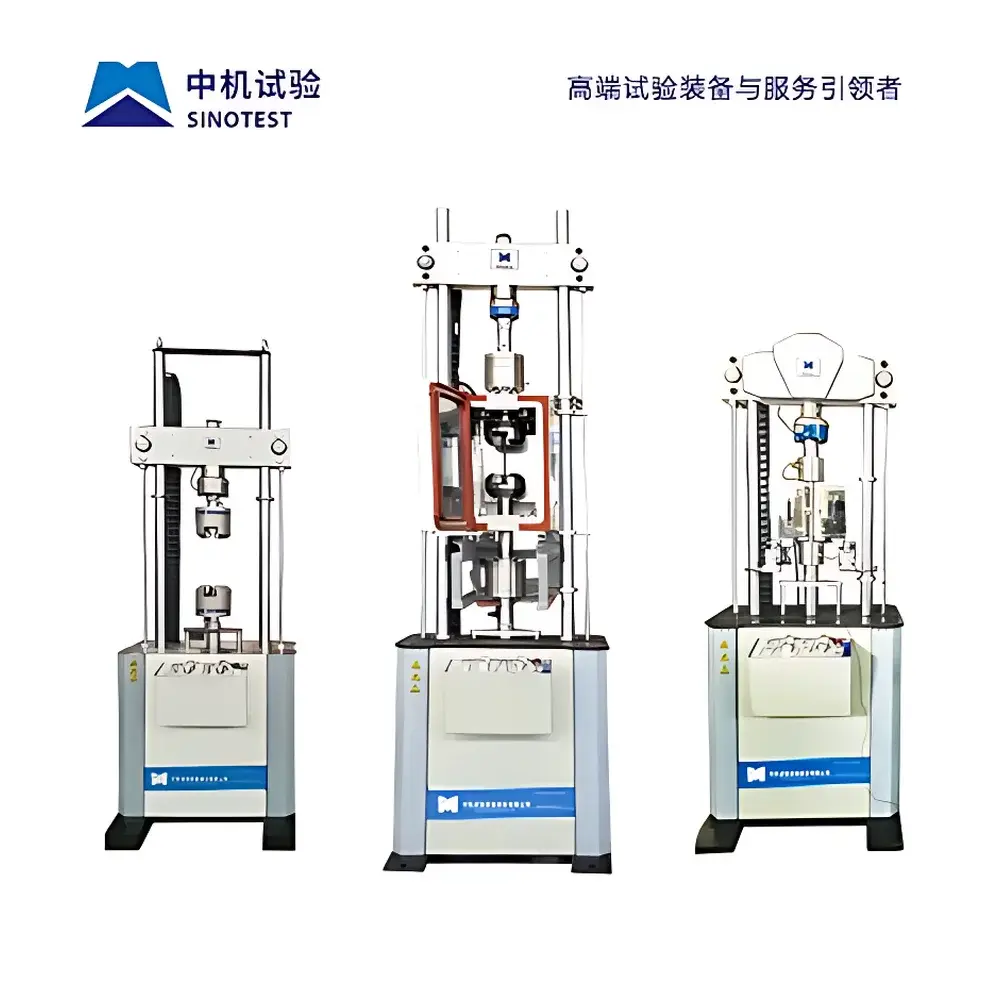
SINOTEST S-Series Electro-Hydraulic Servo Fatigue Testing Machine
| Brand | SINOTEST |
|---|---|
| Origin | Jilin, China |
| Manufacturer Type | Direct Manufacturer |
| Product Origin | Domestic (China) |
| Model | S-Series |
| Price Range | USD 42,000 – 70,000 |
| Instrument Type | Electro-Hydraulic Servo Fatigue Testing Machine |
| Maximum Test Load | 10–3000 kN |
| Frequency Range | 5–120 Hz |
| Mainframe Weight | 1100–20,000 kg |
Overview
The SINOTEST S-Series Electro-Hydraulic Servo Fatigue Testing Machine is a high-performance, modular test system engineered for precision dynamic and quasi-static mechanical characterization of structural materials and components. Based on six decades of core expertise in hydrostatic bearing technology, closed-loop control architecture, high-fidelity transduction, and domain-specific application software, the S-Series implements advanced servo-hydraulic actuation to deliver stable, repeatable force and displacement control across wide frequency and load domains. It operates on the principle of electro-hydraulic servo feedback control—where real-time load/displacement/strain signals from calibrated sensors are continuously compared against reference waveforms (e.g., sinusoidal, block, random, or user-defined profiles), with proportional-integral-derivative (PID) algorithms driving high-bandwidth hydraulic valves to minimize tracking error. This architecture enables rigorous compliance with internationally recognized fatigue testing standards—including ASTM E466, ASTM E606, ISO 1099, ISO 12106, EN 6072, and GB/T 3075—making it suitable for high-cycle fatigue (HCF), low-cycle fatigue (LCF), thermomechanical fatigue (TMF), and fracture mechanics applications such as KIC, J-integral, and ΔK threshold testing.
Key Features
- High-rigidity, preloaded frame architecture with hydrostatic bearing-supported crossheads ensures exceptional axial alignment (<±0.02 mm eccentricity) and minimal parasitic bending moments during cyclic loading.
- Wide operational envelope: programmable test frequencies from 5 Hz to 120 Hz at full rated load; maximum static and dynamic force capacity spanning 10 kN to 3000 kN, scalable via modular load cell and actuator configurations.
- Dedicated dynamic load cells with integrated inertial compensation algorithms eliminate phase lag and amplitude distortion under high-frequency excitation—critical for accurate stress-life (S–N) and strain-life (ε–N) data acquisition.
- Real-time digital controller featuring dual-loop (force + displacement/strain) synchronization, adaptive gain scheduling, and anti-windup logic for robust performance across nonlinear specimen behavior.
- Modular hydraulic power unit (HPU) options with variable-speed pump drives, temperature-regulated oil conditioning, and pressure ripple suppression ensure consistent actuation fidelity over extended test durations (>107 cycles).
- Comprehensive safety architecture including hardware-based emergency stop interlocks, overload cut-off, thermal monitoring, and redundant position sensing compliant with ISO 13850 and IEC 61508 SIL2 requirements.
Sample Compatibility & Compliance
The S-Series accommodates specimens ranging from standard metallic coupons (e.g., ASTM E8/E647 tensile bars, compact tension C(T) specimens) to large-scale structural assemblies (e.g., welded joints, turbine blades, railway axles, and composite laminates). Fixture interfaces conform to ISO 26203 and ASTM E1012 for alignment verification. All system-level calibration procedures follow ISO/IEC 17025 guidelines and are traceable to NIM (National Institute of Metrology, China) and NIST standards. The platform supports full audit trail generation and electronic signature functionality aligned with FDA 21 CFR Part 11 and EU Annex 11 for regulated environments requiring GLP/GMP-compliant fatigue data reporting.
Software & Data Management
Control and analysis are executed via SINOTEST’s proprietary TestMaster™ software suite—a Windows-based, multi-threaded application supporting real-time waveform synthesis, closed-loop profile execution, and synchronized multi-channel data acquisition at up to 10 kHz sampling rate. The software includes built-in modules for automated S–N curve generation, Rainflow cycle counting (ASTM E1049), crack growth rate (da/dN) calculation per ASTM E647, and statistical life prediction using Weibull or lognormal distributions. Raw test data is stored in HDF5 format with embedded metadata (test parameters, calibration history, operator ID, environmental conditions), enabling seamless integration with LIMS and enterprise QA databases. Export options include CSV, MATLAB .mat, and universal MDF4 for third-party post-processing.
Applications
- Metallic material qualification: HCF/LCF life prediction for aerospace alloys (Ti-6Al-4V, Inconel 718), automotive steels, and nuclear-grade stainless steels.
- Fracture mechanics research: Mode I/II/III crack propagation studies, R-curve determination, and environment-assisted cracking (EAC) under corrosive or elevated-temperature conditions.
- Component validation: Full-scale fatigue testing of landing gear struts, wind turbine drivetrain components, rail vehicle bogies, and orthopedic implants per ISO 14801 and ASTM F2193.
- Advanced material development: Characterization of additively manufactured (AM) parts, fiber-reinforced polymer composites, and shape memory alloys under complex multiaxial loading paths.
- Standards-compliant certification: Third-party verification for ASME BPVC Section VIII, API RP 2A, and EN 1993-1-9 fatigue design assessments.
FAQ
What standards does the S-Series support for fatigue testing?
The system is pre-configured to execute tests per ASTM E466 (constant-amplitude axial fatigue), ASTM E606 (strain-controlled fatigue), ISO 1099 (axial fatigue testing), and GB/T 3075–2008 (Chinese national standard for axial-force-controlled fatigue). Custom protocol scripting allows implementation of non-standard waveforms and multi-step loading sequences.
Can the system perform thermomechanical fatigue (TMF) testing?
Yes—when integrated with optional furnace systems (−100°C to +1200°C) and high-temperature extensometry, the S-Series supports out-of-phase and in-phase TMF testing per ASTM E2368 and ISO 12111.
Is remote operation and monitoring supported?
TestMaster™ includes secure web-based remote access (HTTPS/TLS 1.2), enabling real-time dashboard viewing, alarm notification, and limited parameter adjustment via authenticated client terminals—fully auditable per IT security policies.
What maintenance intervals are recommended for the hydraulic system?
Oil analysis and filter replacement every 2000 operating hours; full hydraulic fluid exchange and valve recalibration every 8000 hours or biannually—whichever occurs first—per ISO 4406 cleanliness class 18/16/13.
Does SINOTEST provide installation and validation services?
Yes—factory acceptance testing (FAT), site acceptance testing (SAT), IQ/OQ documentation, and ISO/IEC 17025-compliant calibration certificates are available as optional service packages.



