
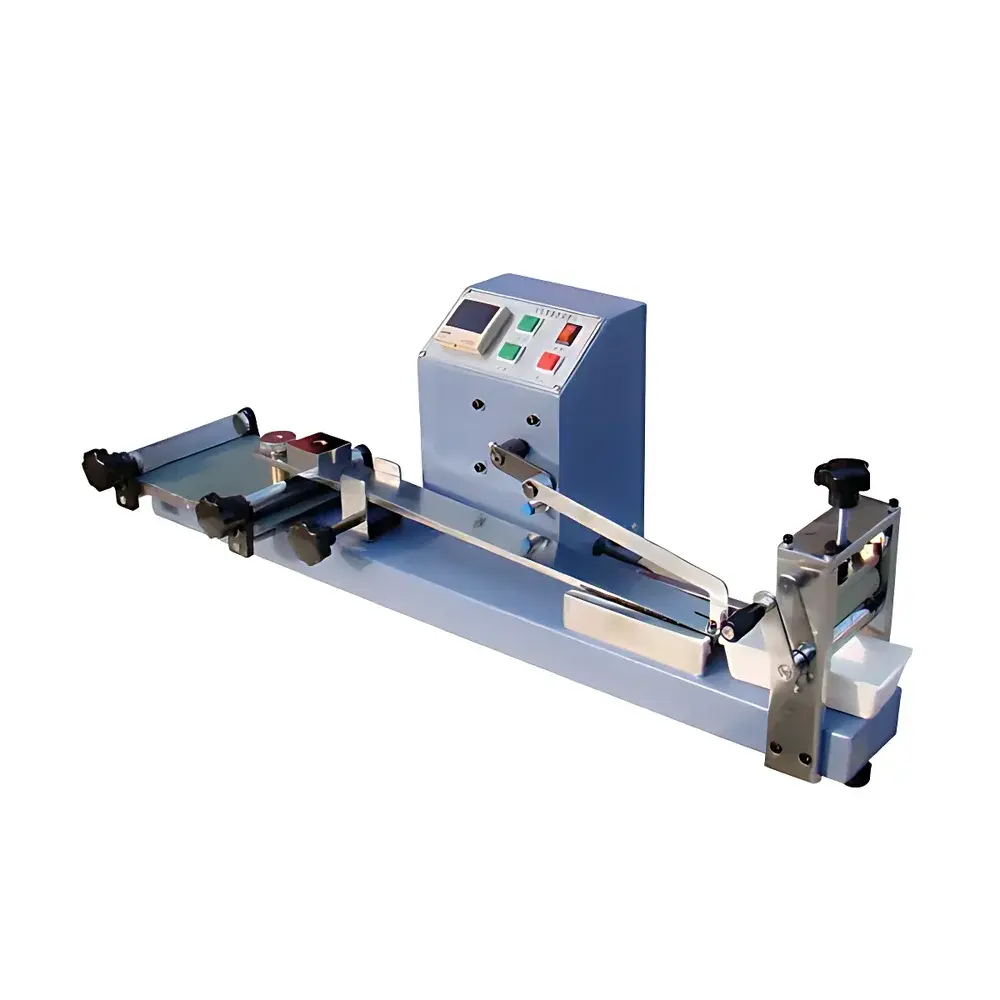
NYX HY-767K Wallpaper Dry/Wet Rub Fastness Tester
| Brand | NYX |
|---|---|
| Origin | Tianjin, China |
| Manufacturer Type | Direct Manufacturer |
| Country of Origin | China |
| Model | HY-767K |
| Pricing | Available Upon Request |
| Reciprocating Stroke | 100 ± 3 mm |
| Normal Load on Rubbing Head | 2 ± 0.1 N |
| Reciprocating Frequency | 30 ± 3 cycles/min |
| Rubbing Head Diameter | Ø16 ± 0.1 mm |
| Cycle Count Range | 1–9999 (LCD-controlled) |
| Motion Path | Linear Guided Translation |
| Dampening Unit | Adjustable Laboratory Mangle for Precise Moisture Control of Test Cloth (for Wet Rub Testing) |
| Dimensions (L×W×H) | 76 × 20 × 20 cm |
| Net Weight | 25 kg |
Overview
The NYX HY-767K Wallpaper Dry/Wet Rub Fastness Tester is a precision-engineered instrument designed to evaluate color transfer resistance and surface durability of decorative wallcoverings under standardized mechanical stress conditions. It operates on the principle of controlled linear reciprocation, applying defined normal force and motion frequency to simulate real-world abrasion encountered during installation, cleaning, or incidental contact. The device complies with key Chinese national light industry standards QB/T 4034 and QB/T 3805—both of which align structurally and methodologically with ISO 105-X12 (Textiles — Tests for Color Fastness — Colour Fastness to Rubbing/Crocking) and ASTM D5034 (Standard Test Method for Breaking Strength and Elongation of Textile Fabrics), adapted for non-woven and coated paper-based substrates typical in modern wallpaper manufacturing. Its robust mechanical architecture ensures high repeatability across dry rub, wet rub, and wear-cycle assessments—critical for quality assurance in production environments and R&D laboratories serving architectural finish suppliers.
Key Features
- Linear-guided reciprocating mechanism with precision-machined rails ensures consistent stroke length (100 ± 3 mm) and eliminates lateral deviation during testing.
- Calibrated spring-loaded loading system maintains constant normal force of 2 ± 0.1 N on the Ø16 ± 0.1 mm cylindrical rubbing head—critical for inter-laboratory comparability.
- Microprocessor-controlled timing circuit delivers stable reciprocating frequency at 30 ± 3 cycles per minute, adjustable within tolerance limits to accommodate protocol-specific deviations.
- Integrated LCD interface enables precise setting and real-time monitoring of cycle count (1–9999), with automatic termination and audible alert upon completion.
- Dedicated dampening unit—a manually adjustable laboratory mangle—allows reproducible conditioning of cotton rubbing cloth to specified moisture content prior to wet rub testing, supporting compliance with QB/T 3805’s wet-state requirements.
- Compact footprint (76 × 20 × 20 cm) and modular design facilitate integration into QC labs with space constraints while maintaining full operational integrity.
Sample Compatibility & Compliance
The HY-767K accommodates standard wallpaper specimens measuring ≥100 mm × 100 mm, secured via clamping fixtures compatible with vinyl-coated, non-woven, fabric-backed, and cellulose-based wallcoverings. Its test methodology satisfies regulatory expectations for product conformity in domestic Chinese markets and supports technical documentation required for CE-marked export variants where mechanical fastness data are referenced in Declaration of Performance (DoP) files. While not certified to ISO/IEC 17025 as a standalone test system, the instrument meets essential metrological requirements outlined in GB/T 27025 for in-house calibration traceability when used with NIST-traceable force gauges and calibrated timers. It supports GLP-aligned recordkeeping when paired with external lab notebooks or LIMS-integrated reporting workflows.
Software & Data Management
The HY-767K operates via embedded firmware without proprietary PC software; all parameters and cycle logs are retained locally on the LCD controller’s volatile memory. For audit readiness, users are advised to document test conditions—including specimen ID, operator initials, ambient temperature/humidity, rubbing cloth lot number, and post-test evaluation results—using standardized paper-based or electronic templates compliant with ISO 17025 Clause 7.5 and FDA 21 CFR Part 11 (when deployed in regulated manufacturing facilities). Optional RS-232 or USB-to-serial adapters may be integrated for automated log export to validated data acquisition platforms.
Applications
- Quality control of printed and embossed wallpapers during batch release.
- Comparative assessment of pigment binding performance across different ink systems (water-based, solvent-based, UV-curable).
- Evaluation of protective topcoat efficacy against mechanical degradation.
- Validation of substrate–coating adhesion stability under cyclic shear stress.
- Supporting technical dossiers for green building certifications (e.g., GreenGuard, LEED) where surface durability influences VOC emission profiles over time.
- Root cause analysis of premature color migration observed in field installations.
FAQ
Does the HY-767K comply with international standards beyond QB/T 4034 and QB/T 3805?
Yes—the mechanical configuration and operational parameters are functionally equivalent to ISO 105-X12 and ASTM D5034, enabling cross-referenced reporting when justified by method equivalence statements.
Can the rubbing head be replaced with alternative geometries (e.g., rectangular or curved)?
No—the instrument is validated exclusively for the Ø16 ± 0.1 mm cylindrical head per QB/T specifications; substitution invalidates conformance claims.
Is calibration certification included with delivery?
Factory calibration verification is provided; however, users must perform periodic in-house verification using traceable force and displacement standards per their internal QA procedures.
What type of rubbing cloth is recommended for wet rub testing?
100% bleached cotton fabric (typically 10–12 cm², GSM 100–120), conditioned to 100% pick-up ratio using the integrated mangle and verified gravimetrically before each test sequence.
How often should maintenance be performed?
Lubrication of linear guides and inspection of spring load elements are recommended every 500 operational hours or quarterly—whichever occurs first—to ensure long-term force fidelity and stroke accuracy.



