
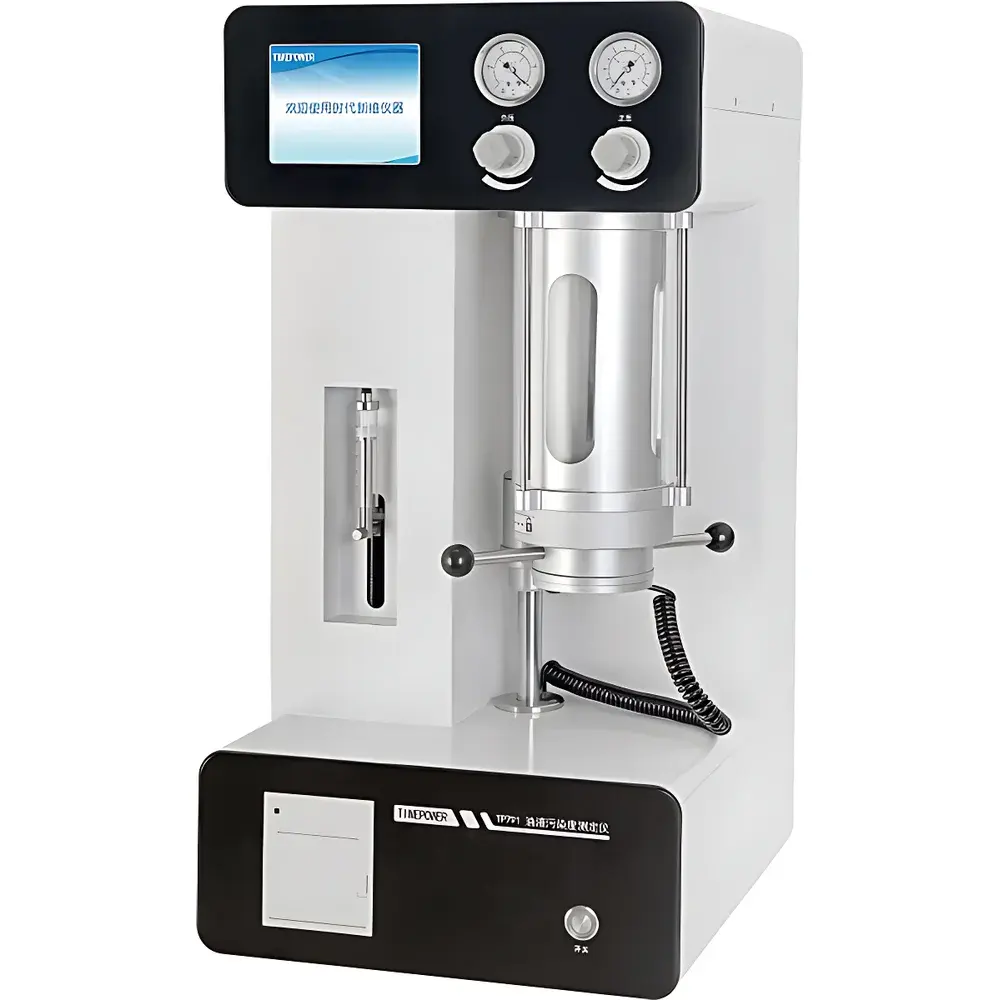
TimePower TP791 Oil Particle Counter & Fluid Contamination Analyzer
| Brand | TimePower |
|---|---|
| Origin | Beijing, China |
| Manufacturer Type | Direct Manufacturer |
| Origin Category | Domestic (China) |
| Model | TP791 |
| Pricing | Upon Request |
| Light Source | Semiconductor Laser |
| Measurement Principle | Light Obscuration (LO) per ISO 11171 & ISO 4402 |
| Measurement Range | 0.8 µm to 500 µm (sensor-dependent) |
| Number of Detection Channels | 8 (user-definable size thresholds within calibration range) |
| Sample Volume | 0.2–1000 mL (programmable) |
| Flow Rate | 5–80 mL/min |
| Resolution | <10% (per ISO 21501-4) |
| Coincidence Limit | 10,000 particles/mL |
| Pressure Chamber | +0.8 MPa (positive), –0.08 MPa (negative) |
| Data Output | Built-in thermal printer + RS232 serial interface |
| Operating Temperature | 10–40 °C |
| Power Supply | AC 220 V ±10%, 50 Hz ±10% |
| Power Consumption | ≤200 W |
| Dimensions | 390 × 340 × 660 mm |
| Weight | 23.5 kg |
| Compliance Standards | GJB-420B, NAS 1638, ISO 4406, GOCT 17216 (built-in) |
| Sample Compatibility | Hydraulic oils, lubricants, transformer oil, turbine oil, gear oil, engine oil, jet fuel (Jet A/A-1), water-glycol fluids, polymer solutions, and other non-aqueous organic liquids |
| Calibration | Multi-point NIST-traceable reference standards |
Overview
The TimePower TP791 Oil Particle Counter & Fluid Contamination Analyzer is a precision laboratory instrument engineered for quantitative assessment of solid particulate contamination in industrial fluids. It operates on the internationally standardized light obscuration (LO) principle—defined in ISO 11171 and ISO 4402—as the primary detection methodology. In this technique, fluid is drawn through a precisely dimensioned sensing zone where a collimated semiconductor laser beam intersects the flow path orthogonally. Each particle passing through the beam causes a transient reduction in transmitted light intensity proportional to its projected area. The resulting pulse amplitude is digitized and classified into user-selectable size channels (eight programmable thresholds), enabling simultaneous quantification of particle concentration per unit volume across multiple size bins. This method delivers high reproducibility, minimal inter-laboratory variance, and direct traceability to national metrology institutes when calibrated with ISO 11171-certified reference materials. The TP791 is designed for routine compliance testing in mission-critical fluid systems where contamination control directly impacts equipment reliability, service life, and safety—particularly in aerospace hydraulics, power generation turbines, and high-voltage insulation applications.
Key Features
- Light obscuration detection system compliant with ISO 11171 and ISO 4402, ensuring alignment with global regulatory and industry test protocols.
- Dual-pressure sample handling architecture: positive pressure up to 0.8 MPa and vacuum capability down to –0.08 MPa, enabling controlled degassing and stable aspiration of viscous or volatile samples without cavitation.
- Programmable syringe pump with volumetric accuracy better than ±1% across the full 0.2–1000 mL range; flow rate adjustable from 5 to 80 mL/min to accommodate viscosity-dependent optimal shear conditions.
- Eight-channel particle sizing with fully customizable threshold settings within the 0.8–500 µm dynamic range—supporting granular analysis for both coarse wear debris (>25 µm) and sub-micron contaminants relevant to filter integrity verification.
- Integrated clean-air purge module maintains ISO Class 5 (Class 100) internal environment during measurement, eliminating ambient airborne interference and preserving baseline stability over extended operational cycles.
- Built-in multi-standard evaluation engine with native support for GJB-420B (Chinese military), NAS 1638 (U.S. aerospace), ISO 4406 (international coding), and GOCT 17216 (Russian Federation); allows real-time conversion between codes and user-defined grading logic.
Sample Compatibility & Compliance
The TP791 is validated for use with a broad spectrum of non-aqueous fluids including mineral- and synthetic-based hydraulic oils (MIL-PRF-5606, MIL-PRF-83282), turbine oils (ASTM D4378), insulating oils (IEC 60296, ASTM D877/D1816), gear oils (AGMA 9005), jet fuels (ASTM D1655), and water-glycol fire-resistant fluids. It also supports analysis of polymer solutions and organic solvents where insoluble particulate presence must be monitored per QC release criteria. All measurements adhere to Good Laboratory Practice (GLP) data integrity requirements: full audit trail logging (operator ID, timestamp, calibration status, sample ID), electronic signature support via RS232-linked LIMS integration, and optional 21 CFR Part 11-compliant software packages available upon request. Instrument validation documentation—including as-delivered performance qualification (PQ) reports and optional third-party metrology certification—can be supplied separately.
Software & Data Management
The TP791 features an embedded ARM-based controller running a deterministic real-time OS, ensuring consistent timing resolution for pulse capture and minimizing data latency. Its 7-inch capacitive touchscreen provides intuitive navigation in English or Chinese UI modes, with alphanumeric input for sample labeling and batch tracking. All raw pulse data, size distribution histograms, and coded contamination grades are stored internally with timestamped metadata and exportable via RS232 to external PCs or enterprise laboratory information management systems (LIMS). Internal memory retains ≥10,000 test records with automatic overwrite protection. The built-in thermal printer produces permanent hardcopy reports showing particle counts per channel, ISO 4406 code (e.g., 18/16/13), NAS class, and pass/fail status relative to user-specified acceptance limits. Export formats include CSV and XML for downstream statistical process control (SPC) analysis.
Applications
- Condition monitoring of hydraulic systems in aircraft landing gear, flight control actuators, and ground support equipment per SAE AS4059 and MIL-STD-1246C.
- Acceptance testing of new and reclaimed transformer oil prior to energization, aligned with IEEE C57.106 and IEC 60422 requirements.
- Verification of filter efficiency and integrity in critical lube oil circuits for gas turbines and steam generators.
- Root cause analysis of bearing wear in wind turbine gearboxes using particle morphology trends derived from multi-channel count profiles.
- Quality control of specialty fluids used in semiconductor manufacturing tools, where sub-5 µm particles may induce wafer defects.
- Regulatory compliance reporting for naval propulsion systems governed by NAVSEA S9074-AQ-GIB-010/248 and NATO AEP-37.
FAQ
What calibration standards are supported for traceability?
The TP791 accepts NIST-traceable ISO 11171 reference materials (e.g., PSL suspensions, ACFTD, MTDD) and includes preloaded calibration curves for GJB-420B, NAS 1638, ISO 4406, and GOCT 17216. Custom calibration curves can be imported via USB or RS232.
Can the instrument handle highly viscous oils such as EP gear oils?
Yes—the dual-pressure aspiration system and variable flow rate (5–80 mL/min) allow stable sampling of oils up to ISO VG 680, provided appropriate pre-heating (within 10–40 °C operating range) and syringe priming protocols are followed.
Is the built-in printer compatible with networked lab environments?
The thermal printer is local-only; however, all data are simultaneously transmitted via RS232 to external computers or LIMS platforms for centralized reporting and archival.
Does the system meet FDA or pharmaceutical-grade cleanliness requirements?
While not designed for sterile pharmaceutical processing, the TP791’s ISO Class 5 internal environment and closed-loop fluid path satisfy ISO 8573-1 purity class verification for compressed air–lubricated instrumentation used in pharma manufacturing support systems.
How is coincidence error managed at high particle concentrations?
The instrument applies real-time coincidence correction algorithms per ISO 21501-4, with a verified upper limit of 10,000 particles/mL before dilution is recommended to maintain counting accuracy within ±5%.





