
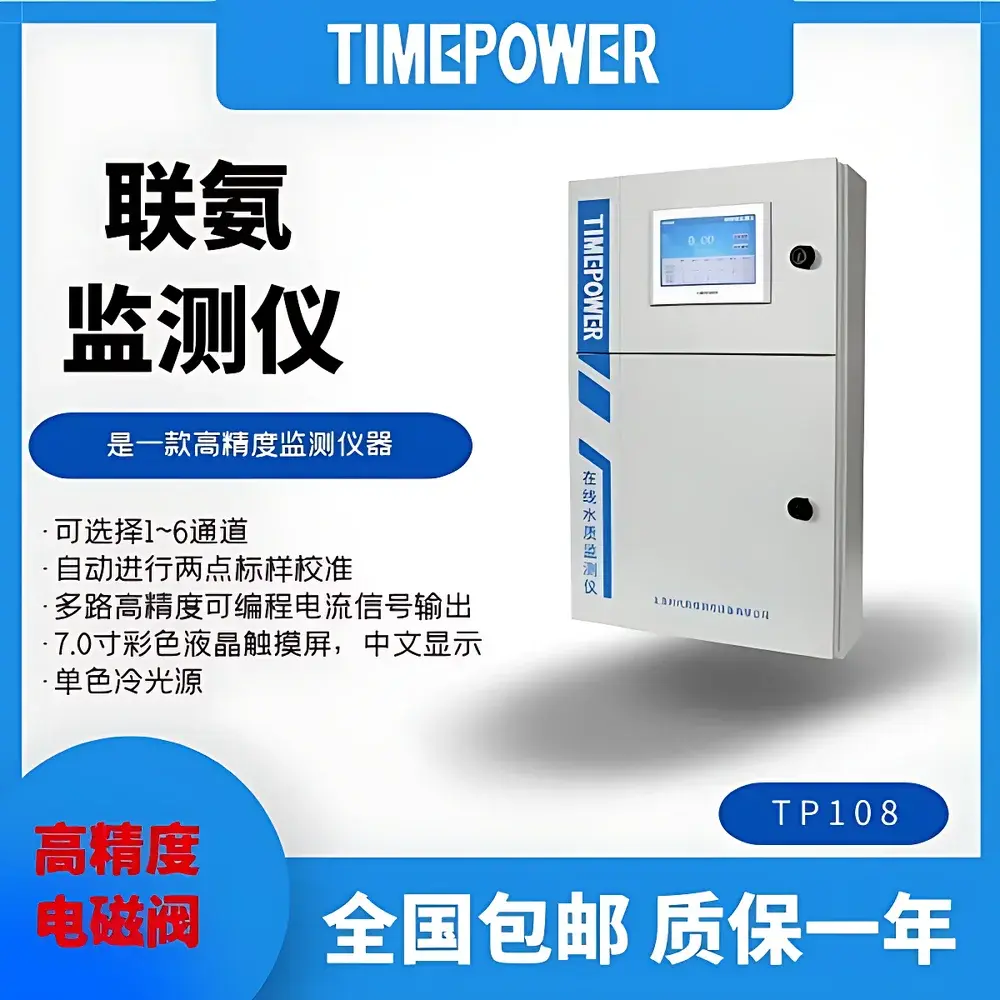
Hydrazine Analyzer TP108 – TimePower Online Hydrazine Monitoring System
| Brand | TimePower |
|---|---|
| Origin | Beijing, China |
| Manufacturer Type | Direct Manufacturer |
| Product Category | Domestic |
| Model | TP108 |
| Instrument Type | Online Analyzer |
| Measurement Principle | Colorimetric Method (Nesslerization or p-Dimethylaminobenzaldehyde-based Reaction) |
| Measurement Range | 0.02–60 mg/L |
| Accuracy | ≤ ±5% of reading |
| Detection Limit | 0.01 mg/L |
| Analysis Cycle Time | 10–15 minutes per sample |
| Batch Capacity | 10 samples per cycle |
| Channel Configuration | 1–6 programmable measurement channels |
| Calibration | Automated dual-point standard calibration at user-defined intervals |
| Display | Color LCD with real-time/historical trend overlay |
| Data Storage | 30 days of timestamped measurement records |
| Light Source | Monochromatic cold LED (≥50,000 hr lifetime) |
| Output | Multiple isolated 4–20 mA analog outputs (configurable per channel) |
| Installation | Panel-mount (cut-out mounting), IP65 front panel rating |
Overview
The TimePower TP108 Online Hydrazine Analyzer is an industrial-grade, colorimetric-based continuous monitoring system engineered for precise, unattended quantification of hydrazine (N₂H₄) in aqueous process streams. Designed specifically for high-purity water systems where residual hydrazine must be tightly controlled—such as boiler feedwater in thermal power plants, reactor coolant loops in nuclear facilities, and catalyst protection streams in petrochemical synthesis—the TP108 employs a validated wet-chemistry photometric detection principle. It operates via controlled reagent addition (typically p-dimethylaminobenzaldehyde or modified Nessler reagents), followed by stable chromophore formation and absorbance measurement at a defined wavelength (e.g., 405 nm or 450 nm). This method complies with established analytical frameworks referenced in ASTM D1317 and ISO 7150-1 for hydrazine determination in low-conductivity water matrices. The analyzer delivers trace-level sensitivity down to 0.01 mg/L while maintaining robust performance across variable temperature (5–45 °C), pressure (up to 1.0 MPa), and conductivity (<1 µS/cm) conditions typical of ultra-pure water applications.
Key Features
- Modular multi-channel architecture supporting 1–6 independent hydrazine measurement paths—enabling parallel monitoring of multiple sampling points without cross-contamination.
- High-reliability solenoid valve manifold with ceramic-seated actuators rated for >500,000 cycles, ensuring long-term reproducibility of reagent dosing and sample aspiration.
- Automated two-point calibration using certified hydrazine standards; scheduled execution preserves measurement integrity over extended unattended operation (>30 days between manual interventions).
- Embedded color LCD interface displaying real-time concentration values, dynamic trend curves (per channel), alarm status, and system diagnostics—all synchronized with UTC timestamps.
- Onboard data logger retains 30 days of second-resolution measurements (including raw absorbance, temperature-compensated concentration, and calibration logs) compliant with basic GLP audit trail requirements.
- Industrial-grade analog output module delivering six isolated 4–20 mA signals, each individually scalable and assignable to specific channels or composite alarms for integration with DCS, PLC, or automated hydrazine dosing controllers.
Sample Compatibility & Compliance
The TP108 is optimized for use with deionized, demineralized, and condensate water streams exhibiting conductivity < 2 µS/cm and suspended solids < 1 mg/L. It accommodates inlet pressures from 0.1 to 1.0 MPa and tolerates ambient temperatures from 5 °C to 45 °C. Sample conditioning—including filtration (5 µm inline filter standard), pressure regulation, and optional temperature stabilization—is supported via auxiliary modules. While not intrinsically safe, the analyzer meets CE electromagnetic compatibility (EMC) Directive 2014/30/EU and Low Voltage Directive 2014/35/EU. Its operational methodology aligns with principles outlined in USP (Total Organic Carbon) and EP 2.2.45 (Hydrazine in Water for Injection), supporting validation documentation for pharmaceutical and biotech clean steam systems.
Software & Data Management
The embedded firmware supports Modbus RTU (RS-485) and optional Modbus TCP/IP communication protocols for remote configuration, data polling, and alarm forwarding. All calibration events, maintenance logs, and error codes are time-stamped and stored locally. Data export is enabled via USB flash drive (CSV format) or serial dump—no proprietary software required. For regulated environments, optional firmware upgrade enables electronic signature support and 21 CFR Part 11–compliant audit trails (user login history, parameter change logs, and calibration verification records), facilitating GMP-compliant deployment in pharmaceutical water systems.
Applications
- Continuous hydrazine residual monitoring in high-pressure boiler feedwater circuits to prevent copper alloy corrosion and ensure ASME PTC 19.11 compliance.
- Real-time control of hydrazine scavenging dosage in nuclear primary coolant purification systems (per EPRI TR-102293 guidelines).
- Quality assurance testing of hydrazine-containing process streams in hydrazine sulfate synthesis, agrochemical intermediate production, and airbag propellant manufacturing.
- Environmental compliance monitoring of effluent discharge from aerospace propulsion test facilities and rocket fuel handling sites (EPA Method 377.1 adapted).
- Validation support for purified water (PW) and water for injection (WFI) systems under EU GMP Annex 1 and FDA guidance on water system qualification.
FAQ
What is the recommended maintenance interval for the TP108?
Routine maintenance—including reagent replacement, optical path cleaning, and zero/span verification—is recommended every 30 days under continuous operation. Full preventive maintenance (valve inspection, tubing replacement, lamp intensity check) is advised every 6 months.
Can the TP108 be integrated into a DeltaV or Siemens PCS7 DCS environment?
Yes—via native Modbus RTU or optional Modbus TCP/IP interface. Preconfigured function blocks and device description (GSD) files are provided for seamless engineering integration.
Does the analyzer require daily manual calibration?
No—automated dual-point calibration eliminates daily intervention. Users define calibration frequency (e.g., every 8 or 24 hours); the system executes it unattended using onboard standard solutions.
Is the detection limit of 0.01 mg/L verified per ISO/IEC 17025?
The stated LOD reflects instrument response under controlled lab conditions using certified reference materials. Full ISO/IEC 17025 validation requires site-specific assessment including matrix interference testing and uncertainty budgeting—documentation templates are included in the IQ/OQ package.
How is reagent consumption managed for multi-channel operation?
Each channel operates independently with dedicated reagent reservoirs. Average reagent usage is ~1.2 mL per analysis cycle; a 500-mL reagent bottle supports ~400 analyses per channel.







