
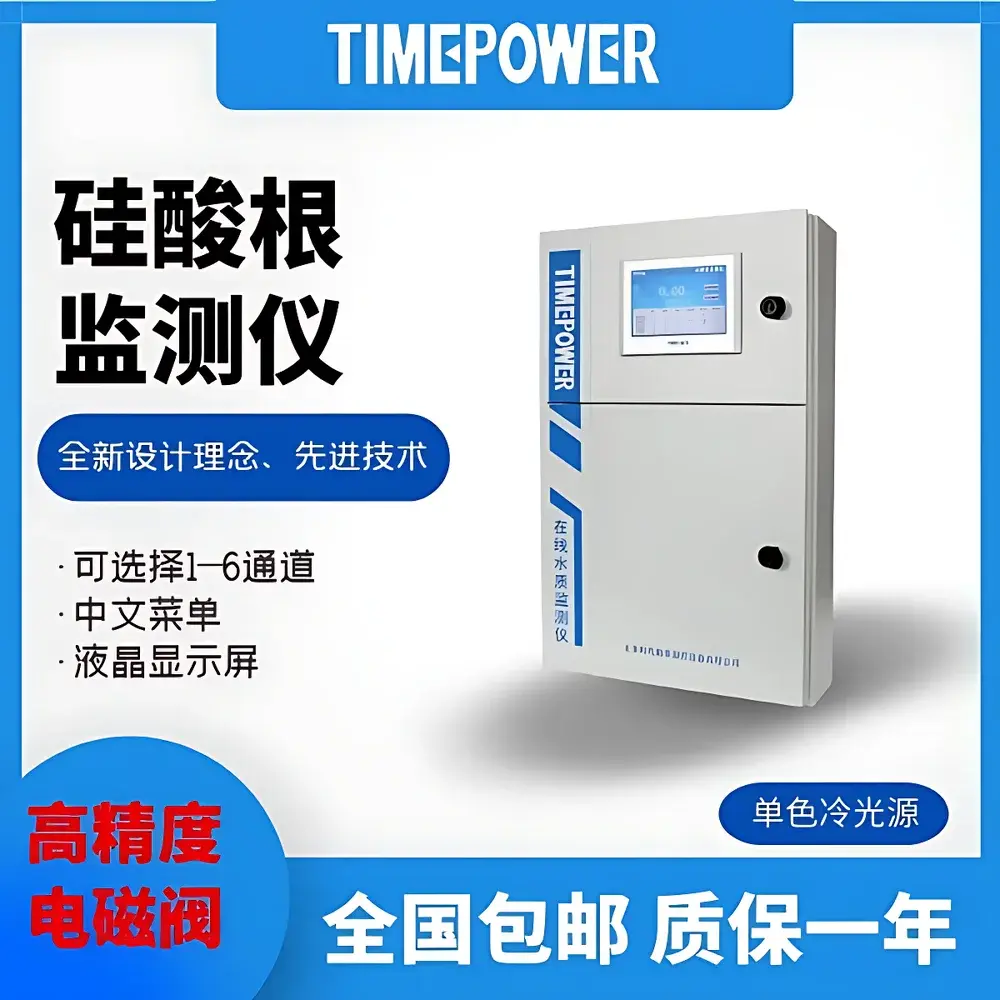
TimePower TP106 Online Silicate Analyzer
| Brand | TimePower |
|---|---|
| Origin | Beijing, China |
| Manufacturer Type | Manufacturer |
| Product Category | Domestic |
| Model | TP106 |
| Instrument Type | Online Analyzer |
| Measurement Principle | Molybdenum Blue Photometric Colorimetry |
| Display | 7.0-inch Color LCD Touchscreen (Chinese UI) |
| Measurement Range | 0.0–200.0 μg/L or 0.0–2000 μg/L (selectable) |
| Accuracy | ±2% F.S. |
| Repeatability | ±1% F.S. |
| Cycle Time | ~12 min per channel |
| Sampling Flow Rate | 10–40 L/h |
| Sample Temperature | 5–45 °C |
| Sample Particulates | <5 µm, no colloidal matter |
| Ambient Temperature | 5–45 °C |
| Ambient Humidity | ≤90% RH (non-condensing) |
| Reagent Consumption | ~2 L/month per reagent (4 reagents total) |
| Digital Output | RS232 or RS485 |
| Analog Output | Isolated DC current signal (0–20 mA / 4–20 mA / 0–10 mA selectable) |
| Alarm Outputs | Independent per channel — sample loss, upper/lower limit |
Overview
The TimePower TP106 Online Silicate Analyzer is an industrial-grade, continuous-monitoring photometric instrument engineered for precise, unattended quantification of soluble silicate (as SiO₂) in aqueous process streams. It operates on the internationally recognized molybdenum blue colorimetric method—where orthosilicic acid reacts with ammonium molybdate under acidic conditions to form a heteropoly blue complex, whose absorbance at 815 nm is linearly proportional to silicate concentration. Designed specifically for compliance with GB/T 12149–2017 (equivalent in scope to ASTM D859 and ISO 10523 for silicate in boiler and cooling water), the TP106 delivers trace-level detection (down to 0.0 μg/L) across two calibrated ranges: 0.0–200.0 μg/L (high-sensitivity mode) and 0.0–2000 μg/L (broad-range mode). Its modular architecture supports 1–6 independent measurement channels within a single chassis, enabling cost-effective multi-point surveillance without redundant hardware. The system integrates sample conditioning, reagent dosing, temperature-controlled reaction, and optical detection into a single compact unit—minimizing footprint, maintenance overhead, and analytical variability.
Key Features
- Multi-channel scalability (1–6 channels) with shared reagent manifold and centralized control logic—reducing CAPEX and simplifying calibration synchronization.
- High-reliability solenoid valve manifold with >500,000 actuation cycles rating; ensures consistent sample aspiration, reagent addition, and waste discharge over extended operation.
- Integrated Peltier-assisted thermal stabilization of the reaction cuvette (±0.2 °C control), critical for reproducible color development kinetics across ambient fluctuations.
- 7.0-inch capacitive touchscreen interface with full Chinese-language HMI; displays real-time silicate concentration, sample temperature, system status, elapsed cycle time, and alarm flags—all simultaneously on one screen.
- Isolated analog outputs (0–20 mA / 4–20 mA / 0–10 mA configurable per channel) compliant with IEC 61000-6-2/4 for noise-immune integration into DCS, PLC, or automatic chemical dosing systems.
- Onboard data logging capacity for ≥6,000 timestamped entries—including measured values, calibration events, system diagnostics, and operator actions—with automatic overwrite management.
- Self-diagnostic routines monitor flow integrity, reagent level, optical path cleanliness, and photodetector linearity—triggering discrete fault alerts before measurement drift occurs.
Sample Compatibility & Compliance
The TP106 is validated for use with low-turbidity, non-colloidal aqueous matrices meeting the following physical specifications: suspended solids <5 µm in diameter, absence of gelling agents or polymeric silica precursors, and dissolved silica predominantly as monomeric orthosilicic acid (H₄SiO₄). It is routinely deployed in high-purity steam-cycle monitoring (e.g., condensate, feedwater, and boiler blowdown), municipal drinking water treatment, semiconductor ultrapure water (UPW) recirculation loops, and effluent discharge compliance tracking. The analyzer conforms to GB/T 12149–2017 and supports audit-ready documentation required under ISO/IEC 17025 quality management systems. While not certified to IEC 61508 SIL or ATEX, its enclosure meets IP65 ingress protection and operates reliably within Class I, Division 2 hazardous area boundaries when installed with appropriate barrier configurations.
Software & Data Management
Firmware v3.2+ includes embedded GLP-compliant data handling: all measurements are automatically stamped with UTC timestamp, channel ID, operator login (optional PIN), and environmental context (temperature, pressure if external sensor connected). Calibration logs record standard concentrations, slope/intercept values, correlation coefficients (R² ≥ 0.999), and verification checks against secondary reference standards. Data export is supported via USB mass storage (CSV format) or serial protocol (Modbus RTU over RS485). Remote access is limited to local network SSH terminal sessions for firmware updates and diagnostic readouts—no cloud connectivity or external telemetry is implemented, preserving data sovereignty and cybersecurity integrity per NIST SP 800-82 guidelines.
Applications
- Real-time silicate trending in fossil-fueled and nuclear power plant water-steam cycles to prevent silica deposition on turbine blades and heat exchanger surfaces.
- Monitoring of demineralized water polishing trains where residual silica must remain <20 μg/L to avoid membrane fouling in RO/EDI systems.
- Process control in phosphate-free boiler water treatment programs, where silicate serves as both corrosion inhibitor and scaling indicator.
- Regulatory reporting for EPA NPDES permits requiring quarterly silicate concentration records in industrial wastewater discharges.
- Validation support for USP purified water and WFI systems, where silica is a critical quality attribute affecting endotoxin retention and stainless-steel passivation stability.
FAQ
What silicate species does the TP106 measure?
It quantifies total reactive silica (expressed as SiO₂), primarily orthosilicic acid and small oligomers that hydrolyze fully under the assay’s acidic digestion conditions. It does not detect colloidal or particulate silica without pretreatment.
Can the TP106 be integrated with a SCADA system?
Yes—via isolated 4–20 mA analog outputs or Modbus RTU over RS485, supporting direct mapping to tag databases in Siemens PCS7, Honeywell Experion, or Emerson DeltaV environments.
How often is manual intervention required?
Routine maintenance is limited to monthly reagent replenishment, quarterly optical window cleaning, and annual photometer verification using NIST-traceable neutral density filters.
Does the analyzer support remote calibration verification?
No—calibration verification requires physical introduction of certified reference standards (e.g., NIST SRM 3178a) at the sample inlet; automated zero/span checks are not implemented due to reagent instability constraints.
Is the TP106 suitable for seawater or brackish influent?
Not without pre-desalination—high chloride (>500 mg/L) and alkalinity interfere with molybdenum blue formation and cause precipitate formation in the reaction chamber.







