
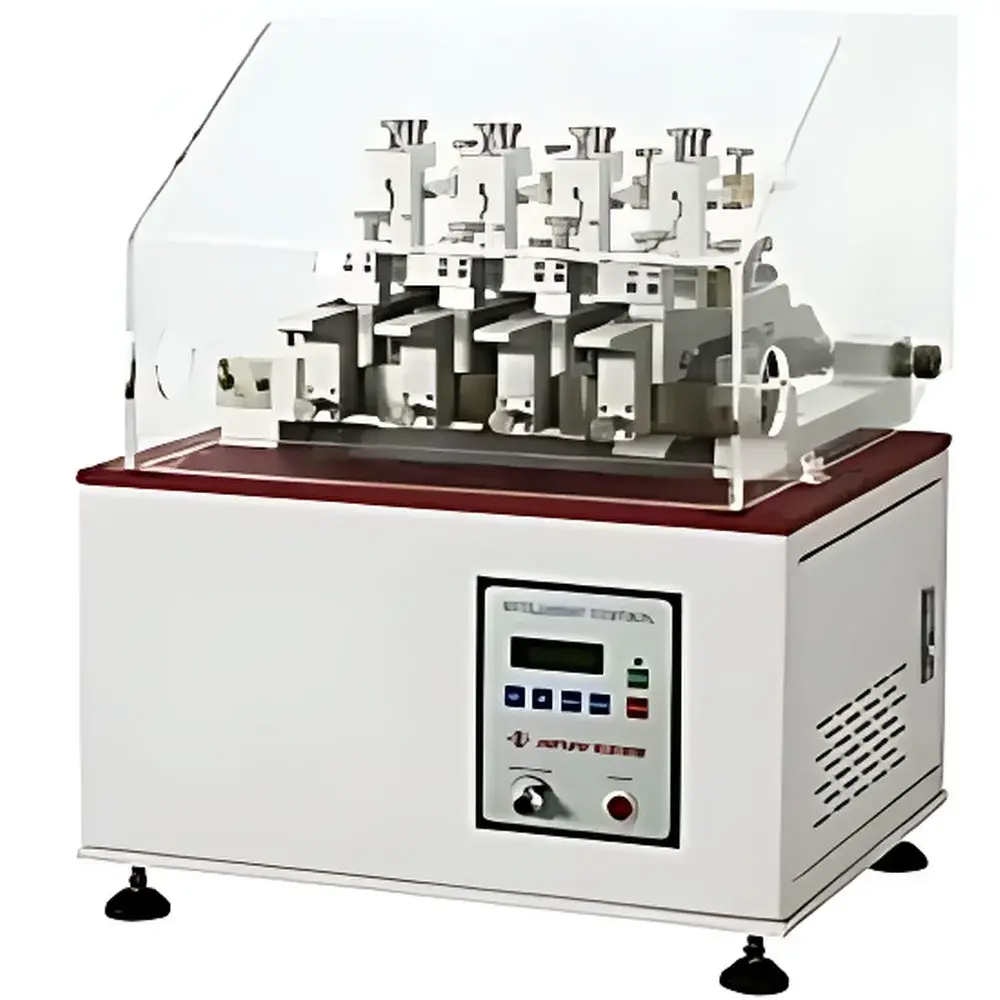
HY603 Wyzenbeek Abrasion Tester (ASTM D4157 Compliant)
| Origin | Tianjin, China |
|---|---|
| Manufacturer Type | Authorized Distributor |
| Origin Classification | Domestic (China) |
| Model | HY603 |
| Price Range | USD 7,000 – 14,000 |
| Instrument Type | Reciprocating Tribological Tester |
| Maximum Friction Force | 26.7 N |
| Friction Force Resolution | 0.1 N |
| Maximum Test Temperature | 35 °C |
| Standards Compliance | ASTM D4157, ASTM D3597, FED-STD-191A Method 5304, SAE J948, SAE J1530, GM 2756M, Toyota TSL 4L120G, BS EN ISO 12402-2 |
Overview
The HY603 Wyzenbeek Abrasion Tester is a precision-engineered reciprocating tribological testing system designed to quantify the abrasion resistance of textile materials under controlled, standardized mechanical stress. Operating on the fundamental principle of linear back-and-forth motion—where a fabric specimen is subjected to repeated frictional contact against a fixed abrasive surface—the instrument replicates real-world wear mechanisms observed in automotive upholstery, residential and commercial furniture, protective workwear, and technical textiles. Its mechanical architecture conforms strictly to the kinematic requirements defined in ASTM D4157, ensuring consistent stroke length (104 mm), cycle frequency (60–70 cycles/min), and normal load application (typically 9–12 N depending on specimen configuration). Unlike rotary or oscillating abrasion testers, the Wyzenbeek method delivers highly reproducible surface degradation patterns aligned with industry expectations for flat-to-textured interface wear.
Key Features
- Reciprocating drive mechanism with programmable cycle count, stroke length, and dwell time—enabling precise replication of ASTM D4157 test protocols.
- High-stability load application system delivering calibrated normal force up to 26.7 N with ±0.1 N resolution, critical for evaluating low-load textile wear behavior.
- Integrated digital force transducer with real-time friction force monitoring and data logging capability at ≥10 Hz sampling rate.
- Modular test head assembly accommodating standard Wyzenbeek abradants—including #10 cotton duck, #60 steel wool, and custom-machined metal mesh per SAE J948 and GM 2756M specifications.
- Temperature-controlled test chamber (ambient to 35 °C) supporting evaluation of thermal influence on fiber cohesion and yarn slippage during abrasion.
- Robust aluminum alloy frame with vibration-dampened base, certified for long-term operational stability in QC laboratories and R&D environments.
Sample Compatibility & Compliance
The HY603 accommodates flat textile specimens measuring 100 mm × 100 mm, mounted taut over a rigid support plate with adjustable clamping pressure. It supports woven, knitted, nonwoven, and coated substrates—including vinyl-laminated fabrics, PU-leather composites, and flame-retardant treated textiles used in transportation interiors. All mechanical tolerances—including stroke repeatability (±0.3 mm), angular alignment (<0.5° deviation), and load vector orthogonality—meet the dimensional verification criteria specified in ASTM D4157 Annex A1. The system is validated for use in GLP-compliant testing facilities; its force calibration traceability aligns with ISO/IEC 17025 requirements when paired with accredited external verification services.
Software & Data Management
The HY603 operates via embedded firmware with USB-C interface and optional PC-based control software (Windows 10/11 compatible). Software features include automated cycle counting with configurable pass/fail thresholds, real-time friction coefficient trend visualization, and export of CSV-formatted datasets containing cycle number, cumulative displacement, peak friction force, and integrated energy dissipation. Audit trail functionality records operator ID, test date/time, calibration status, and parameter changes—supporting compliance with FDA 21 CFR Part 11 when deployed in regulated textile supply chains serving medical or aerospace OEMs. Raw data files are timestamped and digitally signed to ensure integrity for internal QA review or third-party certification audits.
Applications
- Validation of automotive interior fabrics against OEM specifications including GM 2756M (minimum 25,000 cycles for seat bolsters) and Toyota TSL 4L120G (abrasion resistance under combined flex-abrasion loading).
- Pre-shipment quality assurance for contract furniture suppliers complying with ANSI/BIFMA X5.7 durability benchmarks.
- R&D screening of novel yarn architectures (e.g., core-spun elastane blends) and surface treatments (nanosilica coatings, plasma etching) for enhanced pilling and snag resistance.
- Comparative assessment of biodegradable textile alternatives (Tencel™, lyocell, PHA-blends) under accelerated wear conditions simulating 5+ years of domestic use.
- Supporting ISO 12402-2 certification for personal flotation device (PFD) outer shell materials where abrasion resistance directly impacts service life in marine environments.
FAQ
What abradants are compatible with the HY603 tester?
Standard abradants include ASTM D4157-specified #10 cotton duck, SAE J948-compliant steel wool (#60), and custom-fabricated stainless-steel mesh per GM 2756M Appendix B.
Is temperature control mandatory for ASTM D4157 testing?
No—ASTM D4157 specifies ambient temperature testing; however, the 35 °C upper limit enables comparative studies of thermally induced fiber softening in polypropylene or low-melt polyester blends.
Can the HY603 generate friction coefficient (μ) values?
Yes—by synchronizing normal load input with real-time friction force output, the system calculates μ = Ff/Fn at each cycle, supporting advanced tribological analysis beyond cycle-count pass/fail reporting.
Does the instrument meet ISO/IEC 17025 calibration requirements?
The HY603’s force sensor is factory-calibrated with NIST-traceable standards; full metrological validation requires periodic third-party recalibration per ISO/IEC 17025 Clause 6.5.
How is specimen failure objectively determined?
Failure is defined per ASTM D4157 Section 7.3: visible yarn breakage, >2 mm pilling clusters, or complete substrate rupture—as documented via standardized macro photography and verified by two independent observers.



