
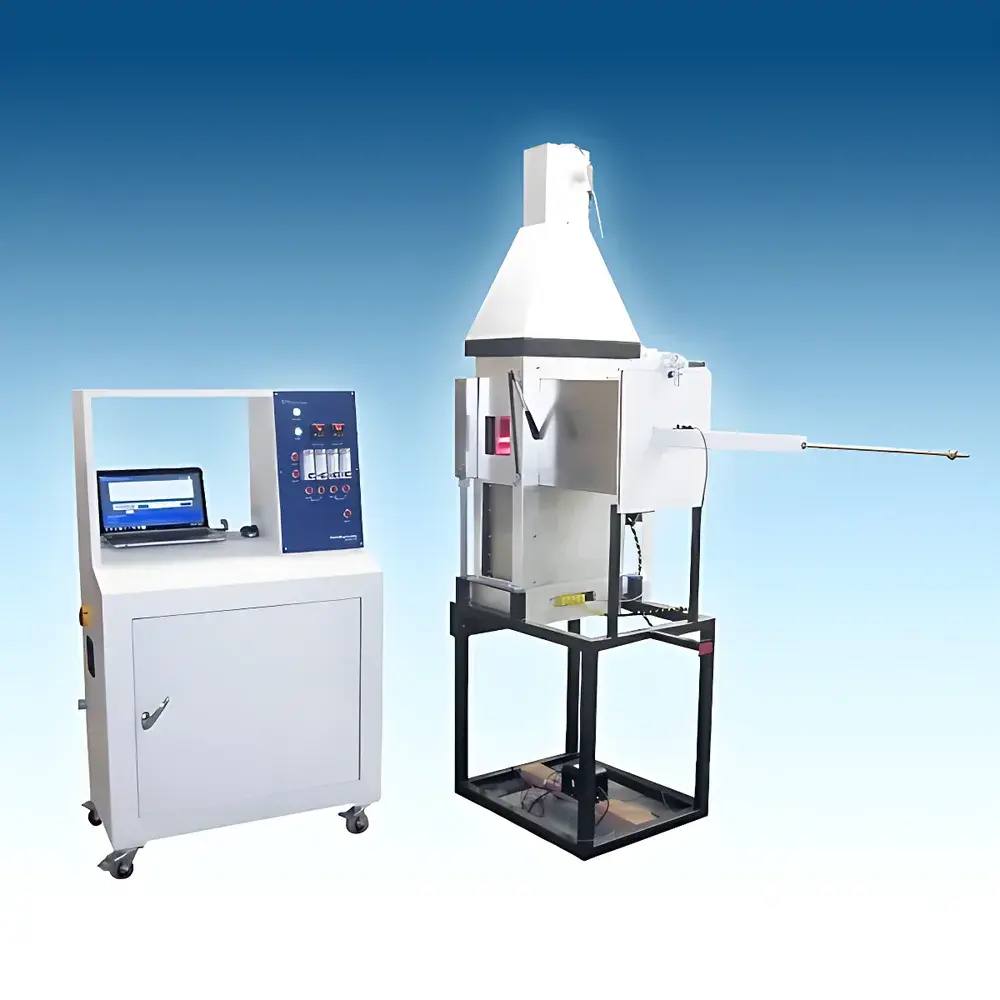
ME1200 FAA FAR OSU Heat Release Rate Tester
| Origin | USA |
|---|---|
| Supplier Type | Authorized Distributor |
| Import Status | Imported |
| Model | ME1200 |
| Pricing | Available Upon Request |
Overview
The ME1200 FAA FAR OSU Heat Release Rate Tester is a federally certified bench-scale fire testing apparatus engineered to quantify the rate of heat release (HRR) from aerospace interior materials under controlled radiant exposure. Based on the Ohio State University (OSU) calorimetric method—originally developed by Dr. Smith in 1972 and subsequently adopted by the U.S. Federal Aviation Administration (FAA)—this instrument implements the oxygen consumption principle in conjunction with calibrated radiant flux measurement to determine HRR per unit surface area (kW/m²). It operates in strict accordance with the thermal exposure protocol specified in 14 CFR Part 25, Appendix F, Part IV, which mandates a nominal incident radiant heat flux of 35 kW/m² to simulate post-ignition fire conditions in aircraft cabin environments. The system integrates a thermally stabilized test chamber, precision-controlled radiant and piloted ignition sources, and a water-cooled quartz-windowed heat flux sensor aligned to ASTM E1354 and ISO 5660-1 metrological frameworks. Its design prioritizes repeatability, traceable calibration, and compliance-ready data structure for regulatory submission to FAA, EASA, and OEM airworthiness authorities.
Key Features
- Stainless-steel test chamber with high-temperature resistant borosilicate observation window for real-time flame propagation monitoring
- Quadruple glow-bar radiant heater array delivering stable, uniform 35 kW/m² incident flux across the specimen surface (±2% spatial uniformity per FAA Fire Test Manual Ch. 5)
- Dual independent PID temperature controllers for precise regulation of glow-bar surface temperature and chamber ambient setpoint
- Automated pneumatic specimen insertion mechanism with interlocked shield door to ensure operator safety and thermal boundary integrity during loading
- Configurable dual-position burner system: fixed upper burner for piloted ignition and motorized lower burner for supplemental flame stabilization
- Calibrated rotameters for manual fine-tuning of propane/air flow to both upper and lower burners, supporting ignition sensitivity validation
- Removable T-type calibration burner assembly with integrated mass flow controller (MFC) for in-situ thermal output verification prior to each test sequence
- Water-cooled thermopile-based heat flux sensor (calibrated traceably to NIST SRM 1971), mounted upstream of the specimen to measure incident radiant flux
- Active air supply conditioning module maintaining constant temperature (±0.5°C) and laminar flow velocity (0.2–0.3 m/s) within the test chamber
- ISO 5167-compliant orifice plate flowmeter for differential pressure-based volumetric flow measurement of chamber inlet air
Sample Compatibility & Compliance
The ME1200 accommodates flat, rigid, or semi-rigid specimens up to 100 mm × 100 mm × 13 mm (L × W × T), including composites, laminates, foams, textiles, and coated substrates used in aircraft seat cushions, sidewall panels, ceiling liners, and insulation blankets. All test protocols are fully aligned with regulatory fire safety requirements including: 14 CFR Part 25, Appendix F, Part IV; Airbus AITM 2.0006; Boeing BSS 7322; and EN 45545-2 R22. The system supports full GLP-compliant audit trails, electronic signature capability, and raw data export in CSV and XML formats compliant with FDA 21 CFR Part 11 requirements for regulated aerospace material qualification laboratories.
Software & Data Management
The proprietary OSU TestSuite™ software provides real-time acquisition of heat flux, chamber temperature, gas flow rates, and time-resolved HRR curves. It includes automated test sequencing, pass/fail logic based on FAR 25.853 peak HRR and total heat release thresholds, and built-in calibration logging with user-accessible audit history. All data files retain embedded metadata—including operator ID, calibration certificate numbers, environmental conditions, and instrument firmware version—for seamless integration into enterprise LIMS or QMS platforms. Software architecture conforms to IEC 62443-3-3 cybersecurity guidelines and supports TLS 1.2 encrypted remote diagnostics.
Applications
This instrument serves as the primary qualification tool for evaluating flame propagation resistance and fire growth potential of aircraft interior materials during FAA Type Certification, OEM supplier approval, and post-certification surveillance testing. Typical use cases include comparative screening of flame-retardant additives, validation of coating durability after abrasion or fluid exposure, assessment of smoke toxicity precursor generation under controlled pyrolysis, and generation of input parameters for CFD fire modeling (e.g., FDS, PyroSim). It is routinely deployed in FAA Designated Engineering Representative (DER) labs, Tier-1 aerospace suppliers’ fire test facilities, and independent ISO/IEC 17025-accredited testing laboratories.
FAQ
What standards does the ME1200 explicitly support?
It is configured and validated for FAR Part 25 Appendix F Part IV, Airbus AITM 2.0006, Boeing BSS 7322, and ISO 5660-1 Annex A.
Is the system suitable for non-aerospace applications?
While optimized for aviation regulatory compliance, its fundamental OSU methodology is applicable to rail (EN 45545-2) and marine (IMO FTP Code) material testing with minor procedural adaptations.
How is calibration traceability maintained?
All critical sensors—including the thermopile heat flux meter, MFCs, and RTDs—are calibrated annually against NIST-traceable standards, with certificates stored in the software’s secure calibration registry.
Can the system be integrated into an existing laboratory network?
Yes—it supports Ethernet TCP/IP communication, OPC UA server interface, and configurable database push to SQL-based LIMS systems.
Does the ME1200 include technical support for regulatory submissions?
Qualified application engineers provide test report review, deviation justification documentation, and audit readiness preparation aligned with FAA Order 8110.4B and EASA AMC 20-22 guidance.



