
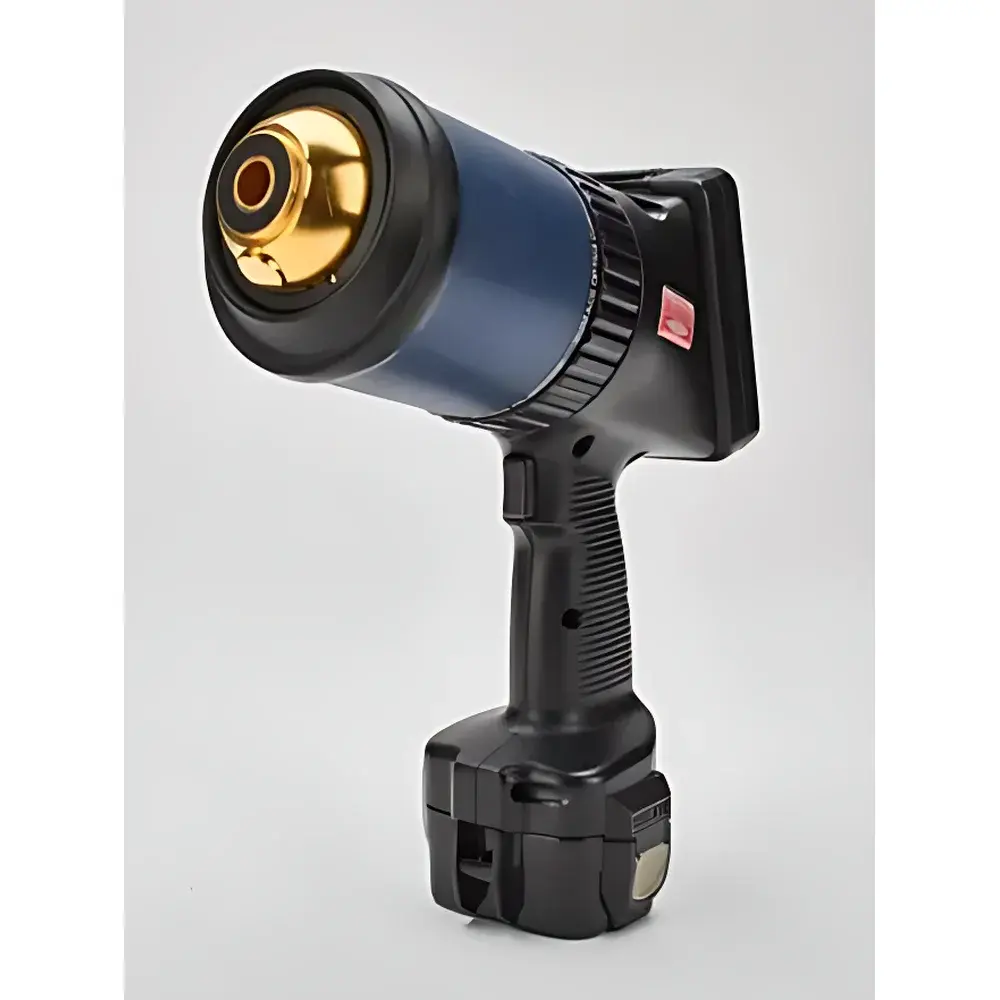
SurfaceOptics SOC 410DHR Portable Directional-Hemispherical Reflectometer
| Brand | SurfaceOptics (SOC) |
|---|---|
| Origin | USA |
| Model | 410DHR |
| Spectral Range | 0.9–1.1, 1.9–2.4, 3.0–4.0, 3.0–5.0, 4.0–5.0, 8.0–12.0 µm |
| Incident Angles | 20° and 60° from normal |
| Measurement Principle | Modified integrating sphere method (collaboratively validated with NRL and NIST) |
| Detector Count | 6 discrete IR detectors |
| Measurement Time | ≤7 s per acquisition (after 90 s IR source warm-up) |
| Sample Geometry Support | Flat, convex (≥6" radius), concave (≥12" radius) |
| Operating Environment | 0–40 °C, non-condensing |
| Storage Temperature | −25 to 70 °C |
| Power | Rechargeable NiMH battery pack (dual cells) |
| Weight | 2.1 kg (with batteries) |
| Calibration | NIST-traceable gold mirror reference standard included |
| Compliance | Designed for field-deployable radiometric measurement in accordance with ASTM E903, ISO 9050, and MIL-STD-461G optical testing protocols |
Overview
The SurfaceOptics SOC 410DHR is a field-portable, handheld directional-hemispherical reflectometer engineered for high-fidelity spectral reflectance characterization across the near-infrared (NIR) through long-wave infrared (LWIR) spectrum. Unlike conventional spectrophotometers or Fourier-transform instruments, the 410DHR implements a rigorously validated modified integrating sphere methodology—co-developed with the U.S. Naval Research Laboratory (NRL) and National Institute of Standards and Technology (NIST)—to deliver absolute, angle-resolved reflectance data under ambient outdoor or laboratory conditions. It operates on the principle of measuring total hemispherical reflectance (THR) from a defined directional incident beam, enabling quantification of material optical constants—including absorptance, emissivity, and bidirectional reflectance distribution function (BRDF) proxies—without requiring vacuum chambers or cryogenic cooling. Its design targets applications where spectral fidelity, geometric flexibility, and operational robustness are non-negotiable: military camouflage assessment, aerospace thermal control surface validation, solar absorber coating qualification, and environmental remote sensing ground-truthing.
Key Features
- Simultaneous six-band spectral acquisition across 0.9–12.0 µm using thermoelectrically stabilized, discrete-wavelength IR detectors—no scanning or moving parts.
- Two fixed-angle illumination geometry (20° and 60° from surface normal) compliant with ASTM E903 and ISO 9050 for standardized solar-weighted and thermal-emissive reflectance reporting.
- Modular probe architecture supports rapid head interchangeability for varying spatial resolution requirements, field-of-view constraints, or surface curvature adaptation (supports convex surfaces ≥6″ radius and concave surfaces ≥12″ radius).
- Integrated touchscreen PDA with embedded real-time firmware enables fully autonomous operation—no external PC required. All instrument status parameters (battery level, detector temperature, source stability, ambient humidity, GPS timestamp, etc.) are displayed concurrently.
- Onboard Kanthal-alloy infrared source with 90-second thermal stabilization ensures repeatable irradiance output; full spectral measurement completes in ≤7 seconds post-stabilization.
- Supplied with a NIST-traceable gold-coated mirror reference standard, enabling in-field recalibration verification and long-term measurement drift monitoring per ISO/IEC 17025 calibration management practices.
Sample Compatibility & Compliance
The 410DHR accommodates heterogeneous sample geometries without contact or masking: flat substrates, gently curved aerospace composites, textured thermal barrier coatings, and even low-emissivity metallic foils. Its non-destructive, non-contact measurement protocol satisfies GLP-aligned documentation requirements for materials qualification under DoD contracts and NASA SSP 30236. The instrument’s metrological traceability path—through NIST SRM 1921b and NRL-developed sphere correction algorithms—is documented in its Certificate of Calibration and conforms to the uncertainty budgeting framework outlined in GUM (JCGM 100:2008). It meets electromagnetic compatibility (EMC) Class B limits per MIL-STD-461G for deployment aboard mobile test platforms and satisfies IP54-rated ingress protection for dust and light rain exposure during terrestrial field campaigns.
Software & Data Management
Data acquisition, visualization, and export are managed via the proprietary SOC ReflectView™ firmware—preloaded on the integrated PDA. Each measurement generates a timestamped, geotagged ASCII dataset containing absolute reflectance values (unitless, 0–1 scale) for all six bands at both incident angles. Export formats include CSV (for MATLAB, Python, or Excel integration) and XML (supporting ASTM E2935 metadata schema). Audit trails record operator ID, calibration epoch, environmental sensor logs, and firmware revision—ensuring compliance with FDA 21 CFR Part 11 electronic record integrity requirements when used in regulated QC/QA environments. Optional desktop software (ReflectLink™) enables batch processing, spectral interpolation, BRDF model fitting (e.g., Cook-Torrance), and comparative analysis against spectral libraries such as ASTER, USGS, or ECOSTRESS.
Applications
- Military: Validation of low-observable (LO) coatings, multispectral camouflage fabric performance, and signature suppression across NIR/SWIR/MWIR/LWIR bands.
- Aerospace: Thermal control coating emissivity mapping on satellite radiators, solar array substrate reflectance uniformity checks, and re-entry vehicle ablator characterization.
- Renewables: Solar selective absorber efficiency evaluation (α/ε ratio), anti-reflective coating durability testing under accelerated weathering.
- Research: Field spectroscopy ground truth for hyperspectral airborne sensors (e.g., AVIRIS-NG, HySpex), validation of radiative transfer models (e.g., MODTRAN, libRadtran).
- Standards Laboratories: Inter-laboratory comparison studies supporting ISO/CIE working groups on spectral reflectance measurement harmonization.
FAQ
Does the 410DHR require annual recalibration?
Yes. SurfaceOptics recommends NIST-traceable recalibration every 12 months or after 500 measurement cycles, whichever occurs first, to maintain stated uncertainty specifications (±0.015 absolute reflectance, k=2).
Can it measure specular versus diffuse reflectance separately?
No. The 410DHR reports directional-hemispherical reflectance (DHR), which integrates all scattered and reflected energy within the hemisphere. For BRDF decomposition, paired measurements with goniometric accessories or complementary instruments (e.g., SOC 420BRDF) are required.
Is GPS synchronization mandatory for data validity?
GPS is optional but strongly recommended for georeferenced field campaigns. Timestamps are maintained internally via RTC even without GPS lock; however, location metadata is omitted from exported files unless enabled.
What is the maximum allowable surface temperature during measurement?
The instrument is rated for use on samples up to 80 °C. Higher temperatures may induce thermal drift in detector responsivity and require extended stabilization intervals.
Are third-party spectral libraries supported?
Yes—ReflectLink™ supports import of user-defined spectral databases in ENVI .hdr/.dat format and exports to SpectraSuite-compatible XML for cross-platform interoperability.






