
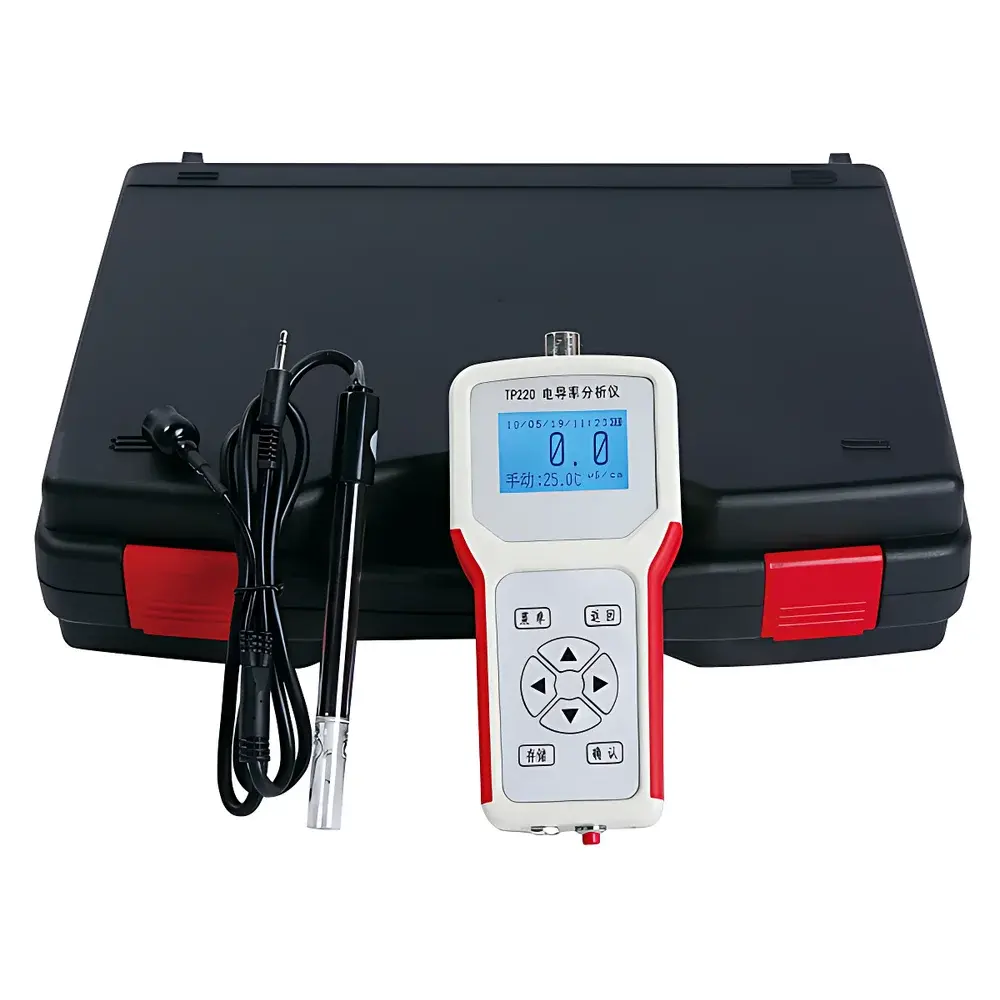
Timepower TP220 Portable Precision Conductivity Analyzer
| Brand | Timepower |
|---|---|
| Origin | Beijing, China |
| Manufacturer Type | Direct Manufacturer |
| Product Category | Domestic |
| Model | TP220 |
| Detection Parameter | Single-parameter (Conductivity) |
| Portability | Portable |
| Conductivity Range | 0–200 mS/cm |
| TDS Range | 0–2 g/L |
| Resistivity Range | 0–1 MΩ·cm |
| Salinity Range | 0–2 ppt |
| Temperature Range | 5–45 °C |
| Accuracy | ±2.5% F.S. |
| Minimum Resolution | 0.001 µS/cm |
Overview
The Timepower TP220 Portable Precision Conductivity Analyzer is a field-deployable, single-parameter electrochemical instrument engineered for high-reliability measurement of electrical conductivity in aqueous solutions. It operates on the fundamental principle of conductance measurement via two parallel electrodes (or cylindrical electrode pairs) with a fixed geometric cell constant (K), immersed in the sample. A low-amplitude, high-frequency sinusoidal voltage (1–3 kHz) is applied across the electrodes to minimize polarization and electrolytic decomposition, while the resulting current is measured to calculate solution conductance. The instrument automatically compensates for temperature-induced variations using an integrated Pt1000 sensor and applies standardized linear or non-linear temperature correction algorithms per ISO 7888 and ASTM D1125. Designed specifically for compliance with GB/T 6908—“Methods for determination of conductivity in boiler water and cooling water”—the TP220 delivers traceable, repeatable results in environments where portability, battery endurance, and operational robustness are critical.
Key Features
- True portable architecture: Compact form factor (80 × 30 × 175 mm), lightweight design (0.26 kg), and ergonomic handheld configuration for field use.
- Multi-range auto-ranging capability: Supports four selectable cell constants (K = 0.01, 0.1, 1.0, and 10.0 cm⁻¹) to optimize sensitivity and accuracy across ultra-pure water (≤1 µS/cm), potable water, industrial process streams, and high-conductivity brines.
- High-fidelity signal acquisition: 24-bit analog-to-digital conversion ensures stable baseline performance and minimizes quantization error, especially at low-conductivity thresholds.
- Intuitive Chinese-language user interface: 128 × 64 dot-matrix LCD with real-time concurrent display of conductivity, temperature, timestamp, and system status.
- Adjustable backlighting: Enables operation under low-ambient-light conditions while supporting power conservation through manual dimming or auto-off functionality.
- Extended battery life: Up to 8 hours of continuous measurement on a single full charge; internal non-volatile memory retains data for ≥10 years after power loss.
- Integrated temperature compensation: Pt1000 sensor with automatic temperature correction over 0–60 °C, compliant with standard reference temperature conventions (e.g., 25 °C).
Sample Compatibility & Compliance
The TP220 is validated for routine analysis of aqueous samples across diverse industrial and regulatory contexts—including boiler feedwater, cooling tower circuits, wastewater effluents, pharmaceutical purified water (PW), and municipal drinking water distribution systems. Its measurement range (0.000 µS/cm to 200 mS/cm) and resolution (0.001 µS/cm) meet minimum requirements for USP , EP 2.2.38, and ISO 7888 Annex A. While not certified to IEC 61000-6-2/4 for EMC immunity or IP67 for ingress protection, its housing meets basic environmental resilience standards for indoor and sheltered outdoor deployment (operating humidity ≤90% RH, non-condensing; ambient temperature 5–45 °C). For GLP/GMP-aligned workflows, users may implement manual audit trails; however, the device does not support FDA 21 CFR Part 11 electronic signature or automated metadata logging.
Software & Data Management
The TP220 operates as a standalone analyzer without proprietary PC software or cloud connectivity. All measurements are stored locally in a circular buffer with overwrite-on-overflow behavior. Data retrieval requires manual transcription or optional RS232/USB interface (not included by default). No firmware updates or calibration certificate management tools are embedded. Calibration verification follows a two-point method using NIST-traceable KCl standards (e.g., 1413 µS/cm and 12.88 mS/cm at 25 °C), with user-accessible calibration constants stored in EEPROM. Repeatability is verified at ≤1% RSD under controlled laboratory conditions per ISO 5725-2.
Applications
- Power generation: Monitoring condensate purity and demineralizer outlet conductivity in thermal power plants per GB/T 6908 and DL/T 939.
- Chemical & fertilizer manufacturing: In-process control of rinse water, reaction media, and effluent discharge streams.
- Environmental monitoring: Field assessment of surface water, groundwater, and wastewater treatment plant influent/effluent.
- Pharmaceutical water systems: Qualification of purified water (PW) and water for injection (WFI) support loops during commissioning and routine surveillance.
- Food & beverage QA/QC: Verification of cleaning-in-place (CIP) rinse endpoints and ingredient solution consistency.
- Municipal utilities: Rapid verification of distribution system integrity and desalination pretreatment performance.
FAQ
What cell constant (K-value) electrode should I select for ultrapure water measurement?
For samples below 3 µS/cm—especially those near 0.1 µS/cm—the K = 0.01 cm⁻¹ electrode is recommended. Use with a sealed flow-through cell to prevent CO₂ absorption and surface contamination.
Does the TP220 support automatic temperature compensation (ATC) for non-aqueous solvents?
No. ATC algorithms are optimized exclusively for aqueous electrolyte solutions and are not valid for organic solvents, glycols, or mixed-phase systems.
Can the instrument be calibrated using custom standard solutions?
Yes. Users may perform manual one- or two-point calibration using any certified conductivity standard; however, only KCl-based reference values are pre-programmed.
Is the TP220 suitable for hazardous area deployment?
No. It lacks intrinsic safety certification (e.g., ATEX, IECEx) and is intended for general-purpose, non-explosive environments.
How often should the conductivity cell be cleaned and recalibrated?
Cleaning is required after each measurement in fouling-prone matrices (e.g., wastewater, seawater); recalibration is advised before each daily use or after electrode cleaning, per ISO/IEC 17025 Clause 7.7.
Related Products




