
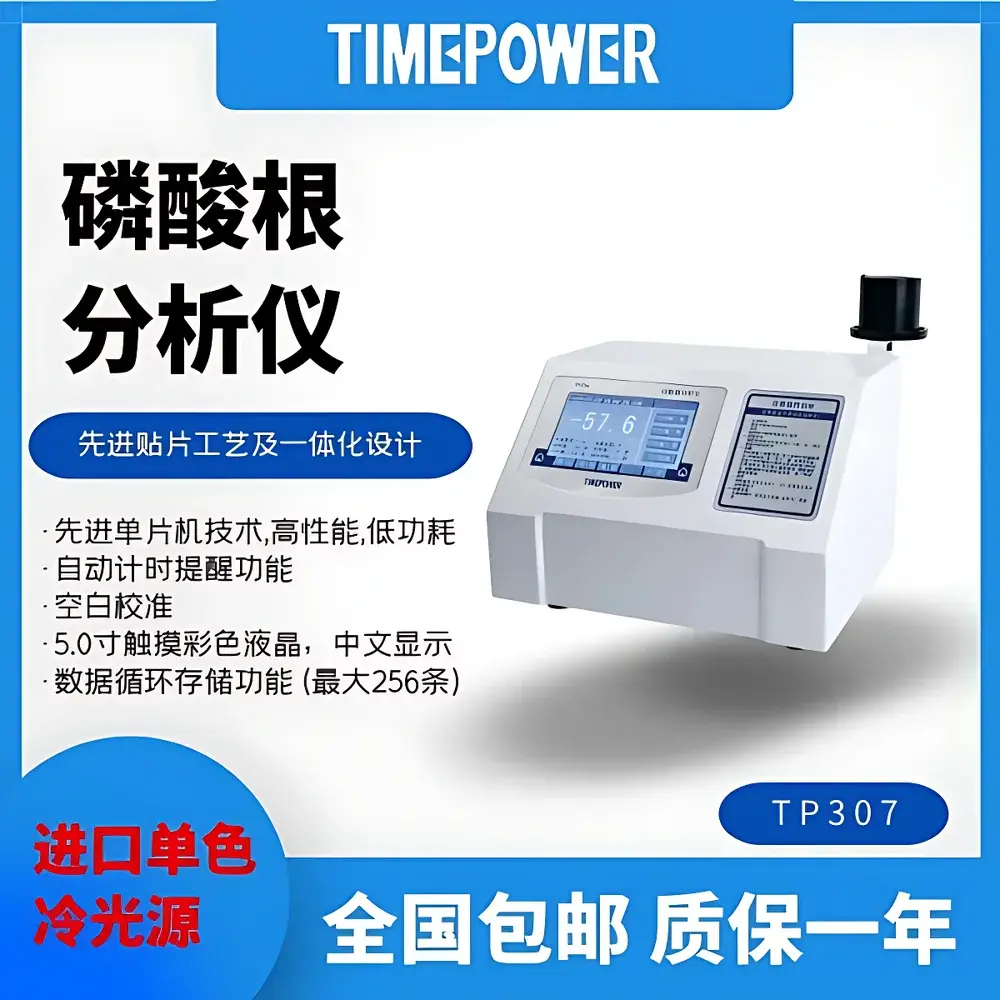
TimePower TP307 Laboratory Phosphate Analyzer
| Brand | TimePower |
|---|---|
| Origin | Beijing, China |
| Manufacturer Type | Direct Manufacturer |
| Product Category | Domestic |
| Model | TP307 |
| Instrument Type | Benchtop Laboratory Analyzer |
| Measurement Principle | Phosphomolybdenum Yellow Colorimetric Method (ISO 6878, ASTM D859) |
| Display | 5.0-inch TFT color touchscreen with Chinese UI |
| Optical Source | Imported monochromatic cold-light LED (λ = 420 nm ± 2 nm) |
| Data Storage | Circular buffer for ≤256 measurement records |
| Calibration | Automatic zero-point compensation via blank calibration |
| Power Consumption | Low-power embedded MCU architecture |
| Enclosure Design | Integrated chassis with surface-mount technology (SMT) PCB assembly |
Overview
The TimePower TP307 Laboratory Phosphate Analyzer is a benchtop spectrophotometric instrument engineered for precise quantification of orthophosphate (PO₄³⁻) concentration in ultra-pure and process water streams. It operates on the internationally standardized phosphomolybdenum yellow colorimetric method—compliant with ISO 6878:2007 (Water quality — Determination of phosphorus — Ammonium molybdate spectrophotometric method) and ASTM D859-21 (Standard Test Method for Silica in Water), with validated adaptation for low-range phosphate detection in high-resistivity matrices. Designed specifically for power generation, pharmaceutical manufacturing, and fine chemical synthesis environments, the TP307 delivers reliable measurements in boiler feedwater, condensate, demineralized water, and steam-cycle chemistry control points where phosphate concentrations typically range from 0.01 to 10.00 mg/L (as PO₄). Its optical architecture employs a stable, temperature-compensated monochromatic cold-light LED source centered at 420 nm—optimized for maximum absorbance sensitivity of the phosphomolybdate complex—ensuring minimal photometric drift over extended operation.
Key Features
- 5.0-inch high-resolution TFT color touchscreen with intuitive Chinese-language interface—designed for rapid parameter navigation and real-time status feedback without external PC dependency.
- Embedded microcontroller unit (MCU) platform featuring low-power consumption design and industrial-grade SMT circuitry—providing long-term operational stability in laboratory and QC room environments.
- Optical system utilizing an imported cold-light LED source with narrow spectral bandwidth (±2 nm tolerance), eliminating thermal noise and extending service life beyond 50,000 hours.
- Automated timing sequence with audible/visual alerts for digestion and color development steps—reducing operator-dependent variability and supporting GLP-aligned procedural consistency.
- Integrated blank calibration routine that compensates for both optical zero drift and electronic baseline offset—critical for maintaining accuracy across daily startup cycles and ambient temperature fluctuations.
- Circular data memory buffer storing up to 256 measurement entries with automatic overwrite logic—enabling traceable recordkeeping without manual file management or external storage media.
Sample Compatibility & Compliance
The TP307 accepts aqueous samples with conductivity < 5 µS/cm and suspended solids < 1 mg/L, making it suitable for high-purity water matrices including turbine condensate, mixed-bed effluent, and pharmaceutical purified water (PW). Sample introduction is performed manually via calibrated volumetric pipettes; no peristaltic pumping or auto-sampling module is included in the base configuration. All reagent kits (ammonium molybdate, ascorbic acid, antimony potassium tartrate, sulfuric acid) are supplied separately and must comply with ACS reagent grade specifications. The analyzer meets mechanical and electrical safety requirements per GB 4793.1–2019 (equivalent to IEC 61010-1) and supports documentation practices aligned with FDA 21 CFR Part 11 when paired with optional audit-trail-enabled software (sold separately). It is not certified for continuous unattended online deployment but qualifies as a reference-grade verification tool within ISO/IEC 17025-accredited laboratories.
Software & Data Management
While the TP307 operates autonomously via its onboard firmware, raw measurement values (absorbance, concentration, timestamp, calibration ID) can be exported via USB interface to CSV-formatted files for integration into LIMS or Excel-based trending systems. No proprietary software driver is required—standard mass-storage mode enables plug-and-play compatibility with Windows, macOS, and Linux hosts. For regulated environments, TimePower offers an optional PC-based data management suite supporting electronic signatures, user access levels (admin/operator), and audit trail generation compliant with Annex 11 and ALCOA+ principles. All stored data retain immutable timestamps synchronized to internal RTC with ±2 sec/month accuracy.
Applications
- Steam-water cycle chemistry monitoring in thermal and nuclear power plants—verifying phosphate hideout mitigation and coordinating pH–phosphate treatment programs.
- Final rinse water testing in sterile pharmaceutical manufacturing lines per USP and EP 2.2.38 conductivity/phosphate limits.
- Quality control of deionized water used in semiconductor wafer cleaning baths, where sub-ppb phosphate interference affects oxide etch uniformity.
- Educational laboratories conducting EPA Method 365.2–based water analysis coursework and method validation studies.
- Contract environmental testing labs performing accredited phosphate determinations for municipal wastewater discharge reporting (e.g., NPDES permits).
FAQ
What is the detection range and typical LOD for the TP307?
The instrument is optimized for 0.01–10.00 mg/L PO₄, with a method limit of detection (LOD) of approximately 0.008 mg/L under controlled lab conditions using ASTM D859-compliant reagent preparation.
Does the TP307 require annual factory recalibration?
No scheduled factory recalibration is mandated; however, users must perform daily blank verification and weekly standard calibration using NIST-traceable phosphate standards (e.g., SRM 3132a) to maintain measurement integrity.
Can the TP307 measure total phosphorus or only orthophosphate?
It measures only filterable orthophosphate (reactive phosphorus); total phosphorus determination requires separate persulfate digestion pretreatment—not supported by the TP307’s built-in protocol.
Is the analyzer compatible with international voltage standards (e.g., 230 VAC, 50 Hz)?
Yes—the universal AC adapter accepts 100–240 VAC, 50/60 Hz input, enabling seamless deployment across EU, APAC, and North American laboratory infrastructures.
How often should the optical path be cleaned?
The cuvette holder and LED/receiver optical windows require inspection and gentle cleaning with lens-grade tissue and isopropyl alcohol every 200 analyses or biweekly—whichever occurs first—to prevent scattering artifacts.
Related Products







