
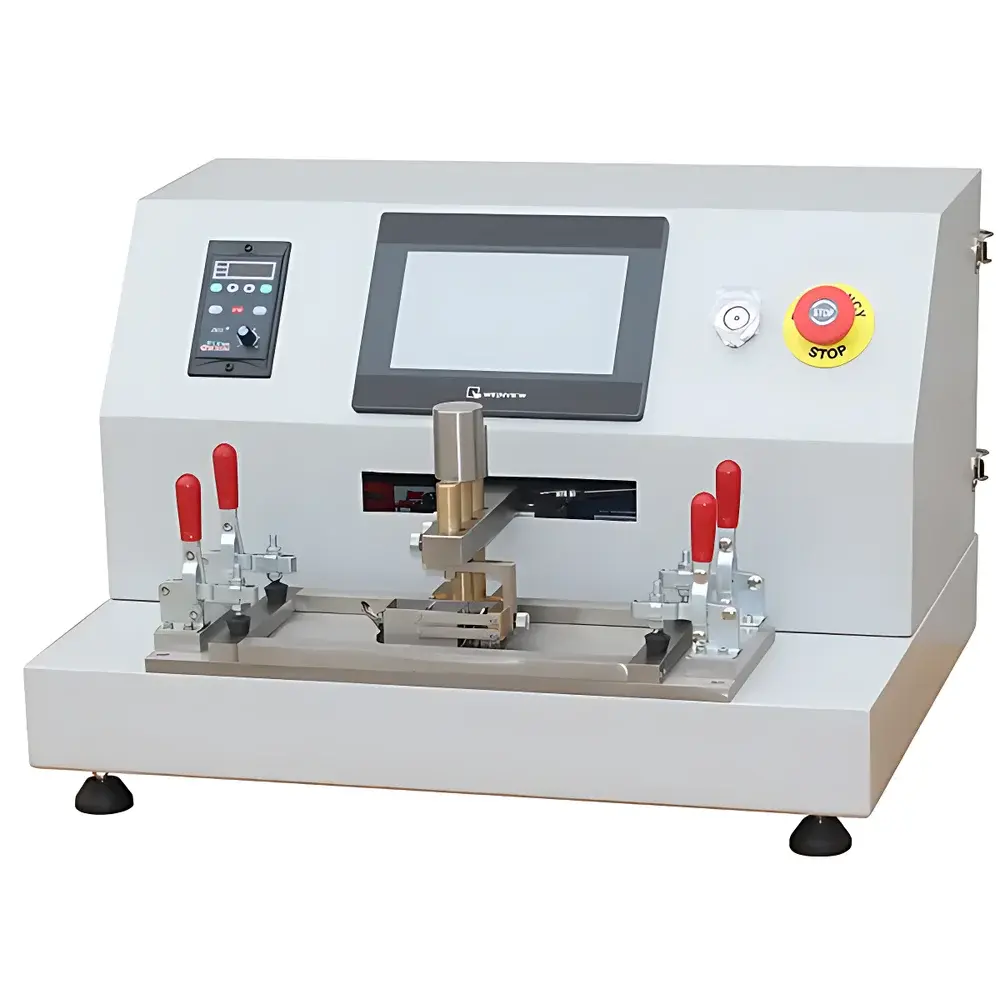
HY-767 Wallpaper Wipe and Wash Resistance Tester
| Origin | Tianjin, China |
|---|---|
| Manufacturer Type | Authorized Distributor |
| Origin Category | Domestic (PRC) |
| Model | HY-767 |
| Price | USD 2,800 (FOB Tianjin) |
| Compliance | QB/T 4034–2010, QB/T 3805–1999 |
| Friction Head Dimensions | 50 mm × 29 mm |
| Mass Configurations | Wipe Test: 100 ± 5 g (foam + head) |
| Wash Test | 550 ± 10 g (felt + head) |
| Extra Wash Test | 100 ± 10 g |
| Brushing Test | 600 ± 10 g (brush + head) |
| Stroke Frequency | Wipe/Brushing: 30 ± 3 cycles/min |
| Wash | 120 ± 10 cycles/min |
| Extra Wash | 100 ± 10 cycles/min |
| Accessories | 2 friction heads with calibrated weights, 1 nylon-bristle brushing unit, 10 polyurethane foam pads (50 × 29 × 12 mm), 10 felt pads (50 × 29 × 6 mm), full technical manual |
Overview
The HY-767 Wallpaper Wipe and Wash Resistance Tester is a precision-engineered mechanical abrasion instrument designed specifically for evaluating the surface durability of decorative wallcoverings under standardized cleaning conditions. It operates on the principle of controlled reciprocating motion, applying defined normal force and cyclic friction to simulate real-world wiping, rinsing, scrubbing, and brushing actions encountered during routine maintenance or commercial cleaning protocols. Unlike generic abrasion testers, the HY-767 implements mode-specific mass loading and stroke frequency regulation—critical parameters mandated by Chinese national standards QB/T 4034–2010 (Wallpaper — Technical Requirements and Test Methods) and QB/T 3805–1999 (Methods of Testing for Wipe and Wash Resistance of Wallpapers). Its architecture ensures repeatable contact geometry, consistent dwell time per cycle, and traceable force application—enabling laboratories to generate data compliant with internal quality control benchmarks and third-party certification requirements.
Key Features
- Four distinct test modes—Wipe, Wash, Extra Wash, and Brushing—each with dedicated mass configurations and programmable stroke frequencies aligned to QB/T 4034–2010 Annex A.
- Interchangeable friction assemblies: dual precision-machined stainless-steel friction heads (50 mm × 29 mm contact face), one nylon-bristle brush unit (ISO 11998-compliant bristle density and stiffness), ten polyurethane foam pads (density 25 kg/m³, compression set ≤15% after 24 h), and ten industrial-grade wool-blend felt pads (thickness 6 mm, nominal density 0.35 g/cm³).
- Calibrated mass system: integrated counterweight slots accommodate certified stainless-steel weights (±0.5 g tolerance) to achieve exact total masses—100 ± 5 g for wipe testing, 550 ± 10 g for wash, and 600 ± 10 g for brushing—verified per JJG 99–2006 (National Verification Regulation for Weights).
- Electromechanical drive with adjustable cam mechanism ensures stable stroke amplitude (25 mm ± 1 mm) and precise cycle timing, minimizing harmonic vibration and edge-effect artifacts during prolonged testing.
- Front-access service panel with tool-free fasteners facilitates rapid pad/felt/brush replacement and friction head calibration verification without disassembly.
Sample Compatibility & Compliance
The HY-767 accepts standard wallpaper specimens measuring 100 mm × 100 mm (minimum), mounted tautly on rigid aluminum backing plates (supplied). It accommodates vinyl-coated, non-woven, fabric-backed, and paper-based wallcoverings—including embossed, metallic-finish, and textured surfaces—provided specimen thickness does not exceed 1.2 mm. All test procedures adhere strictly to QB/T 4034–2010 Sections 6.8–6.11 and QB/T 3805–1999 Clause 4, with explicit alignment to ISO 11998:2014 (Paints and varnishes — Determination of resistance to wet abrasion) for methodological rigor in aqueous exposure simulation. While not certified to ASTM D2486 or EN 13300, its operational parameters are functionally equivalent for comparative pass/fail assessment in QC environments operating under GB/T 1.1–2020 standardization frameworks.
Software & Data Management
The HY-767 is a manually operated, non-digital instrument requiring no embedded firmware or software. Cycle counting is performed via a mechanical tally counter (0–9999 cycles, resettable), with all test parameters documented manually in accordance with GLP-aligned laboratory notebooks. Raw output consists of visual evaluation (per QB/T 4034–2010 Table 3 grading scale: 0 = no change, 5 = complete substrate exposure) and optional digital microscopy imaging (e.g., Keyence VHX-7000) for post-test surface topography analysis. For regulated environments, users may integrate the device into LIMS workflows using external barcode-scanned test logs, ensuring audit trails meet GB/T 27025–2019 (equivalent to ISO/IEC 17025:2017) documentation requirements.
Applications
- Quality assurance of domestically manufactured wallpapers prior to export clearance or domestic distribution.
- Formulation validation for water-based acrylic coatings, PVC plastisols, and pigment dispersion systems used in decorative surfacing.
- Benchmarking comparative resistance between solvent-based vs. waterborne topcoats under identical mechanical stress profiles.
- Supporting R&D of antimicrobial or stain-resistant functional finishes where cleanability must be preserved without compromising biocidal efficacy.
- Third-party certification testing for China Compulsory Certification (CCC) and Green Building Material Evaluation (GB/T 50378) compliance pathways.
FAQ
Does the HY-767 comply with international standards such as ASTM or ISO?
The HY-767 is engineered to meet QB/T 4034–2010 and QB/T 3805–1999, China’s nationally recognized wallpaper performance standards. While its mechanical configuration aligns functionally with ISO 11998:2014 for wet abrasion methodology, it is not independently certified to ASTM D2486 or EN 13300.
Can the tester accommodate specimens thicker than 1.2 mm?
No—exceeding 1.2 mm risks inconsistent normal force transmission and non-uniform friction contact. Specimens exceeding this thickness require substrate planarization or alternative test methods per QB/T 4034–2010 Section 6.1.
Are replacement foam and felt pads supplied with NIST-traceable certification?
Polyurethane foam and wool-blend felt pads are supplied with batch-specific dimensional and density verification reports (per GB/T 6343–2022), but not NIST-traceable mass calibration. Users requiring metrological traceability may procure certified reference pads from ISO/IEC 17025-accredited suppliers.
Is operator training included with purchase?
Yes—a two-hour on-site or virtual protocol training session is provided, covering QB/T 4034–2010 test sequence execution, mass verification procedures, failure mode recognition, and logbook documentation best practices.
What maintenance schedule is recommended?
Lubricate cam shaft bearings quarterly with ISO VG 32 mineral oil; inspect friction head wear every 500 cycles using 10× magnification; replace drive belt annually or after 10,000 cycles—whichever occurs first.




