
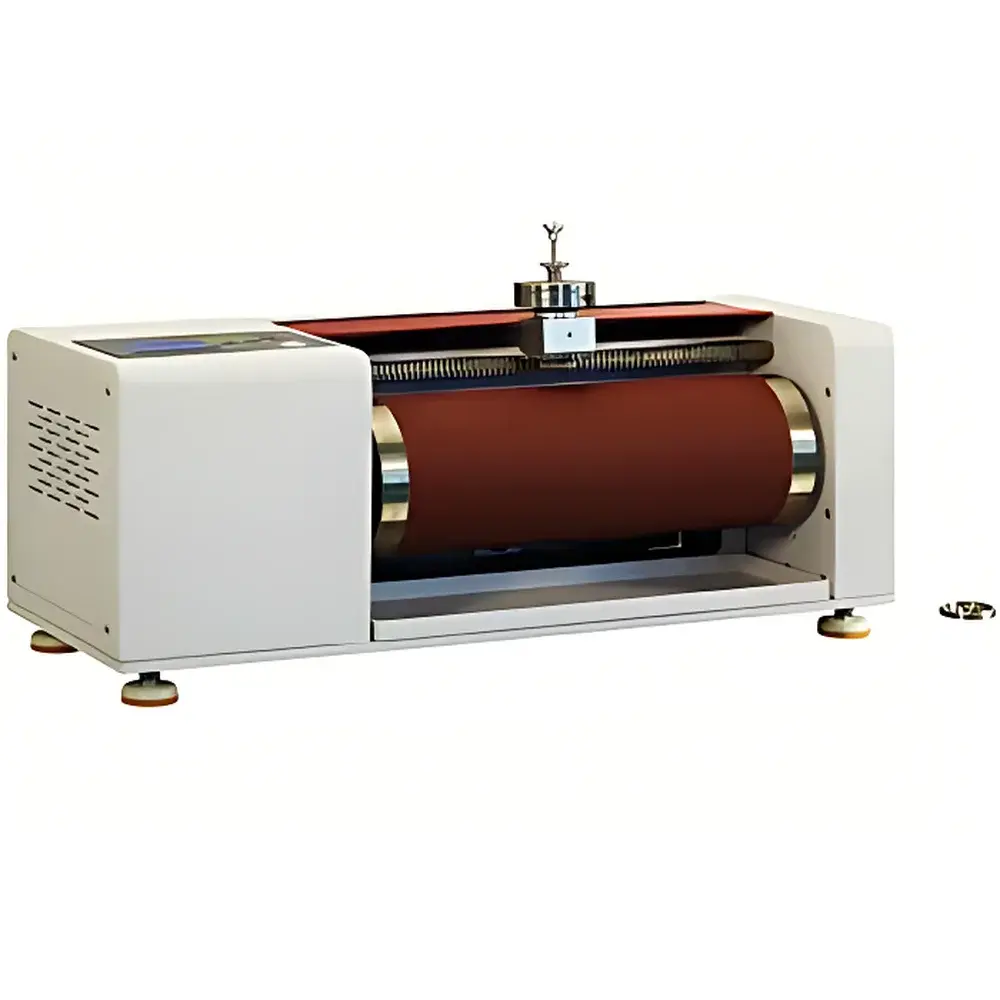
HY-766B DIN Abrasion Tester
| Origin | Tianjin, China |
|---|---|
| Manufacturer Type | Authorized Distributor |
| Origin Category | Domestic (China) |
| Model | HY-766B |
| Pricing | Available Upon Request |
| Roller Diameter | 150.0 ± 0.2 mm |
| Roller Length | ~500 mm |
| Lateral Traverse per Revolution | 4.2 ± 0.04 mm |
| Test Loads | 2.0 ± 0.1 N, 5.0 ± 0.1 N, 10.0 ± 0.2 N |
| Roller Speed | 40 ± 1 rpm (adjustable) |
| Abrasion Distance | 20.0 ± 0.1 m or 40.0 ± 0.2 m (digitally preset) |
| Display | LCD Controller |
| Sample Rotation Mode | Selectable (Self-Rotating / Non-Self-Rotating) |
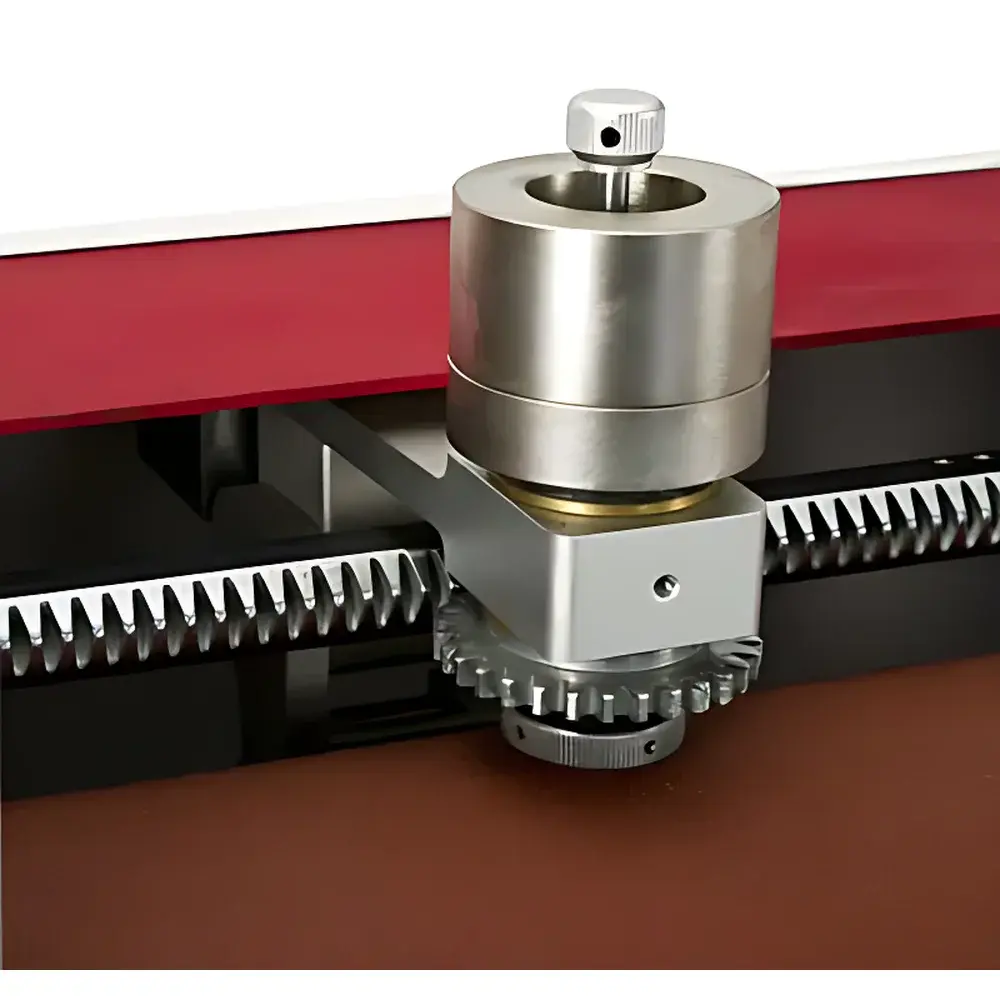
| Specimen Holder ID Range | 15.5–16.3 mm (adjustable), Projection Height: 2.0 ± 0.2 mm |
| Holder Axis Tilt | 3° from vertical |
| Holder-to-Roller Axial Offset | ±1 mm |
| Arm Stability | Vibration-free during operation |
Overview
The HY-766B DIN Abrasion Tester is an engineered precision instrument designed for quantitative assessment of abrasion resistance in elastomeric and polymeric materials under standardized sliding wear conditions. It operates on the principle of controlled two-body abrasion, where a rotating cylindrical roller—covered with calibrated abrasive paper—engages a vertically mounted, axially constrained specimen under defined normal load and lateral oscillation. This configuration replicates the dynamic contact geometry specified in DIN 53516, ISO 4649, and GB/T 20991–2007 Section 8.3, enabling reproducible determination of mass loss or volume loss after a prescribed abrasion distance. The tester is widely deployed in quality control laboratories of footwear manufacturers, rubber compounders, conveyor belt producers, and R&D centers validating material formulations against industrial durability requirements.
Key Features
- High-precision mechanical architecture: rigid cast-iron base, hardened steel roller shaft, and vibration-damped sliding arm assembly ensuring stable specimen engagement throughout testing.
- Digitally preset abrasion行程 (20 m or 40 m) with real-time counter and automatic termination—eliminating manual timing errors and improving inter-laboratory repeatability.
- Triple-load selection (2 N, 5 N, 10 N) via calibrated dead-weight loading system, compliant with ISO 4649 Class A and DIN 53516 tolerance specifications.
- Adjustable specimen holder accommodating cylindrical samples 15.5–16.3 mm in diameter, with fine-tuned projection control (2.0 ± 0.2 mm) and fixed 3° axial tilt—critical for consistent contact pressure distribution.
- LCD controller with intuitive interface for mode selection (self-rotating vs. non-self-rotating), speed confirmation, load verification, and cycle completion signaling.
- Roller geometry strictly maintained: 150.0 ± 0.2 mm diameter × ~500 mm length, manufactured to ISO 2768-mK general tolerances for rotational symmetry and surface roundness.
Sample Compatibility & Compliance
The HY-766B supports standardized test specimens cut from vulcanized rubber compounds, thermoplastic elastomers (TPE), polyurethane soles, conveyor belt cover compounds, and molded polymer sheets. Specimens must be cylindrical, flat-ended, and free of surface defects per ASTM D394 and ISO 4649 preparation guidelines. The instrument fulfills metrological and procedural requirements of multiple international standards: DIN 53516 (German standard for rubber abrasion), ISO 4649:2010 (Rubber—Determination of abrasion resistance using the DIN abrader), GB/T 9867–2013 (Chinese equivalent of ISO 4649), GB/T 20991–2007 Section 8.3 (Footwear sole abrasion), and QB/T 2884–2007 (Light industry standard for rubber footwear). Optional CNAS-accredited calibration report provides traceability to national measurement standards (e.g., NIM, China).
Software & Data Management
While the HY-766B operates via embedded LCD controller without PC connectivity, its deterministic mechanical design ensures full compatibility with external laboratory data management systems. Users routinely integrate test logs—including load, distance, speed, and ambient temperature/humidity—into LIMS platforms via manual entry or spreadsheet import. For GLP/GMP-regulated environments, the instrument supports audit-ready documentation when paired with certified analytical balances (e.g., 120D electronic density balance, readability 0.1 mg) and reference standards such as BAM E001 reference rubber (certified by Bundesanstalt für Materialforschung und -prüfung). All test parameters are manually recorded in accordance with ISO/IEC 17025 clause 7.8 on reporting, and calibration intervals align with manufacturer-recommended maintenance schedules (typically every 12 months or 500 operational hours).
Applications
- Quality assurance of polyurethane and rubber shoe outsoles per GB/T 20991–2007 and EN ISO 20344.
- Comparative ranking of tread compound formulations in tire and conveyor belt development.
- Validation of anti-abrasion additives (e.g., silica, carbon black dispersion quality) in synthetic rubber compounds.
- Regulatory submission testing for medical-grade elastomers requiring ISO 10993-6 biocompatibility screening via wear debris generation analysis.
- Supplier qualification audits where DIN 53516 compliance is contractually mandated.
FAQ
What abrasive paper grades are compatible with the HY-766B?
The instrument is validated for use with VSM P60 grit abrasive paper (equivalent to FEPA P60), conforming to ISO 6344 and DIN 69150. Alternative grits may be used for research purposes but require revalidation against reference standards.
Is the roller speed adjustable beyond 40 rpm?
Yes—the drive system permits continuous speed adjustment within a range of 30–50 rpm; however, only 40 ± 1 rpm is certified for conformance to DIN 53516 and ISO 4649 reporting.
Can the HY-766B be used for non-cylindrical specimens?
No. The fixture geometry and alignment constraints are designed exclusively for cylindrical specimens meeting ISO 4649 dimensional tolerances (diameter 16.0 ± 0.2 mm, height ≥12 mm).
Does the instrument include traceable calibration documentation?
A CNAS-accredited calibration report (optional at time of purchase) certifies dimensional, load, and distance accuracy against national standards; annual recalibration is recommended for ISO/IEC 17025 compliance.
How is specimen mass loss measured post-test?
Mass loss is determined using an external analytical balance (e.g., 120D model, readability 0.1 mg) before and after conditioning per ISO 23529—no integrated weighing function is provided.



