
NYX IPT200A Computer-Controlled Drop-Weight Impact Protection Tester
| Brand | NYX |
|---|---|
| Origin | Tianjin, China |
| Manufacturer Type | Direct Manufacturer |
| Instrument Type | Drop-Weight Impact Tester |
| Nominal Impact Energy | 50 J |
| Load Cell Range | 50 kN / 100 kN |
| Compliance Standard | GB 24541 (Hand Protection – Impact Resistance) |
| Sample Positioning Accuracy | ±0.5 mm |
| Data Acquisition Rate | ≥10 kHz |
| Force Resolution | ≤0.01 kN |
| Test Report Output | PDF/CSV with Timestamp, Operator ID, and Audit Trail Metadata |
Overview
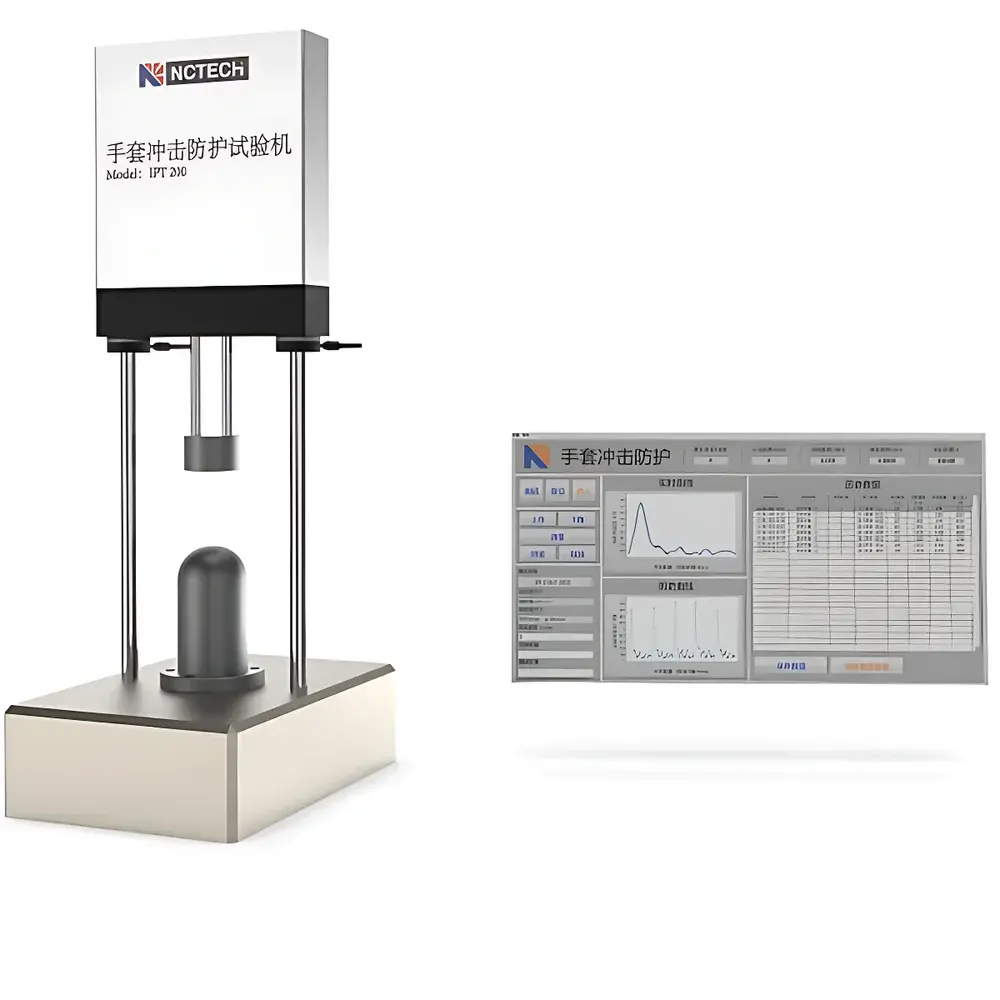
The NYX IPT200A Computer-Controlled Drop-Weight Impact Protection Tester is a precision-engineered system designed for quantitative evaluation of impact energy absorption and force transmission characteristics in personal protective equipment (PPE), specifically gloves intended for mechanical risk environments. It operates on the fundamental principle of controlled gravitational impact: a calibrated mass (2.5 kg) is elevated to a defined height corresponding to a nominal impact energy of 50 J, then released onto a standardized anvil configuration. The system captures real-time dynamic force response via high-fidelity load cells mounted beneath the anvil, enabling precise measurement of peak transmitted force (kN) and impulse profile. Its design strictly adheres to the mechanical test methodology specified in GB 24541–2009, the Chinese national standard for hand protection against impact, which aligns structurally with ISO 13998 and serves as a functional equivalent to EN 388:2016 Annex A (impact resistance). The IPT200A is not a general-purpose impact tester; it is purpose-built for standardized PPE certification workflows requiring traceable, repeatable, and auditable force-time data under defined environmental conditioning protocols.
Key Features
- Computer-controlled drop-height adjustment with digital encoder feedback ensures consistent impact energy delivery (±0.1 J tolerance at 5 J reference point per GB 24541 §6.3)
- Dual-range high-stiffness load cell assembly (50 kN / 100 kN selectable) with integrated temperature compensation and linearity error < ±0.5% FS
- Standardized anvil geometry: 100 mm radius hemispherical steel dome, pre-fitted with two-layer split leather overlay (0.8–1.0 mm thickness, e.g., suede), replicating the biomechanical interface specified in GB 24541 §6.4
- Automated sample positioning stage with optical alignment aid and ±0.5 mm repeatability for centering marked test points
- Real-time force acquisition at ≥10 kHz sampling rate, synchronized with drop trigger and timestamped to microsecond resolution
- Integrated environmental conditioning timer: automatic 3-minute countdown from sample removal (per GB 24541 §6.2) before test initiation
- Robust structural frame with vibration-damping base and ISO 14644-1 Class 8 cleanroom-compatible enclosure options
Sample Compatibility & Compliance
The IPT200A accepts flat-cut glove specimens prepared per GB 24541 §5.1–5.2, including palm-back seam separation and standardized conditioning (23 ± 2 °C, 50 ± 5% RH for ≥4 h). It supports manual or semi-automated placement of up to four specimens per test sequence. All hardware interfaces—including anvil mounting, load cell housing, and drop guide columns—conform to dimensional tolerances mandated by GB 24541 Annex B. The system generates test records compliant with GLP (Good Laboratory Practice) requirements: each report includes operator ID, environmental chamber log data (if integrated), raw force-time waveform (.csv), summary statistics (max and mean transmitted force across four specimens, reported to 0.1 kN), and pass/fail determination per GB 24541 §7.2 (peak force ≤ 14 kN for Level 1, ≤ 9 kN for Level 2). Optional firmware modules support FDA 21 CFR Part 11-compliant electronic signatures and audit trails.
Software & Data Management
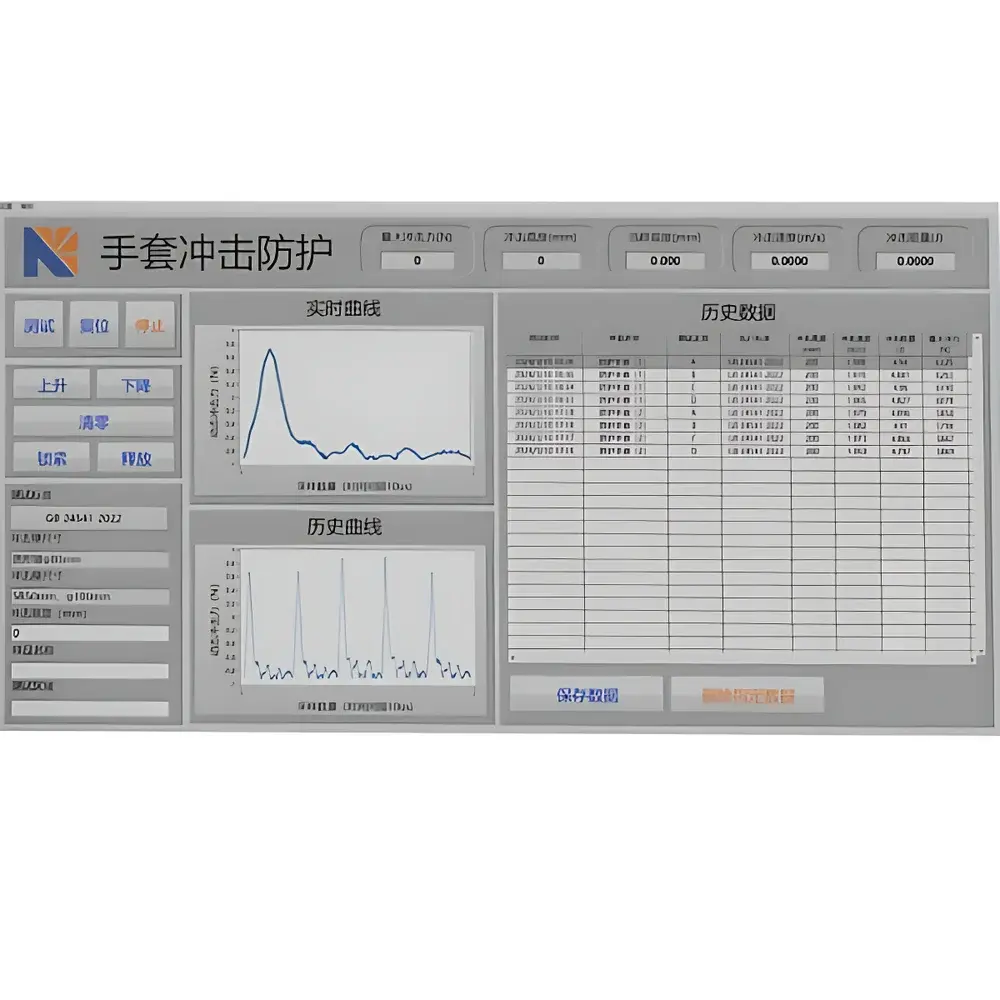
The proprietary IPT-Soft v3.2 control and analysis suite runs on Windows 10/11 (64-bit) and provides full IEC 62304 Class B medical device software compliance documentation. It features dual-mode operation: guided workflow mode (enforcing GB 24541 step sequencing) and advanced mode (for method development and parameter override with supervisor password). Data export supports ASTM E1447-compliant .csv format, ISO/IEC 17025 traceable calibration certificate embedding, and PDF reports with embedded digital signatures. All raw waveforms are stored in HDF5 format with metadata tags (test ID, instrument serial, firmware version, calibration expiry). Local database (SQLite) retains ≥10,000 test records with configurable auto-archive to network drives; optional cloud sync enables multi-site QA dashboard integration.
Applications
- Certification testing of industrial, construction, and automotive gloves for GB 24541, ISO 13998, and EN 388 impact resistance classification
- R&D validation of novel impact-absorbing materials (e.g., shear-thickening fluids, microcellular foams, hybrid composites) under standardized loading conditions
- Quality control screening in glove manufacturing facilities to monitor batch-to-batch consistency of force attenuation performance
- Comparative assessment of ergonomic trade-offs between impact protection and dexterity retention across glove designs
- Supporting technical documentation for CE marking, CCC certification, and third-party laboratory accreditation (CNAS, ILAC-MRA)
FAQ
Does the IPT200A meet international standards beyond GB 24541?
Yes — its mechanical configuration and test protocol are functionally aligned with ISO 13998:2019 and EN 388:2016 Annex A. Calibration certificates include cross-referenced uncertainty budgets traceable to NIM (National Institute of Metrology, China) and UKAS-accredited labs.
Can the system be used for non-glove specimens, such as elbow/knee pads?
Not without validated method adaptation. The anvil geometry, drop mass, and energy threshold are optimized for flat, flexible glove membranes. Testing rigid or curved PPE requires custom fixtures and re-validation per ISO/IEC 17025 clause 7.2.2.
Is the 50 kN / 100 kN load cell range user-switchable during operation?
Yes — range selection is software-commanded and automatically recalibrates zero offset and sensitivity coefficients using NIST-traceable internal shunt calibration.
How is environmental conditioning integrated into the test workflow?
The software triggers a 3-minute countdown upon “sample loaded” confirmation, enforcing the GB 24541 §6.2 time limit. Optional external climate chamber integration provides real-time RH/T telemetry logged alongside force data.
What maintenance intervals are recommended for long-term metrological stability?
Annual verification of drop-height encoder accuracy, load cell linearity, and anvil surface roughness (Ra ≤ 0.8 µm) per ISO 17025 internal procedure IPT-MNT-001. Daily visual inspection of guide rails and leather overlay integrity is mandatory.
Related Products



