
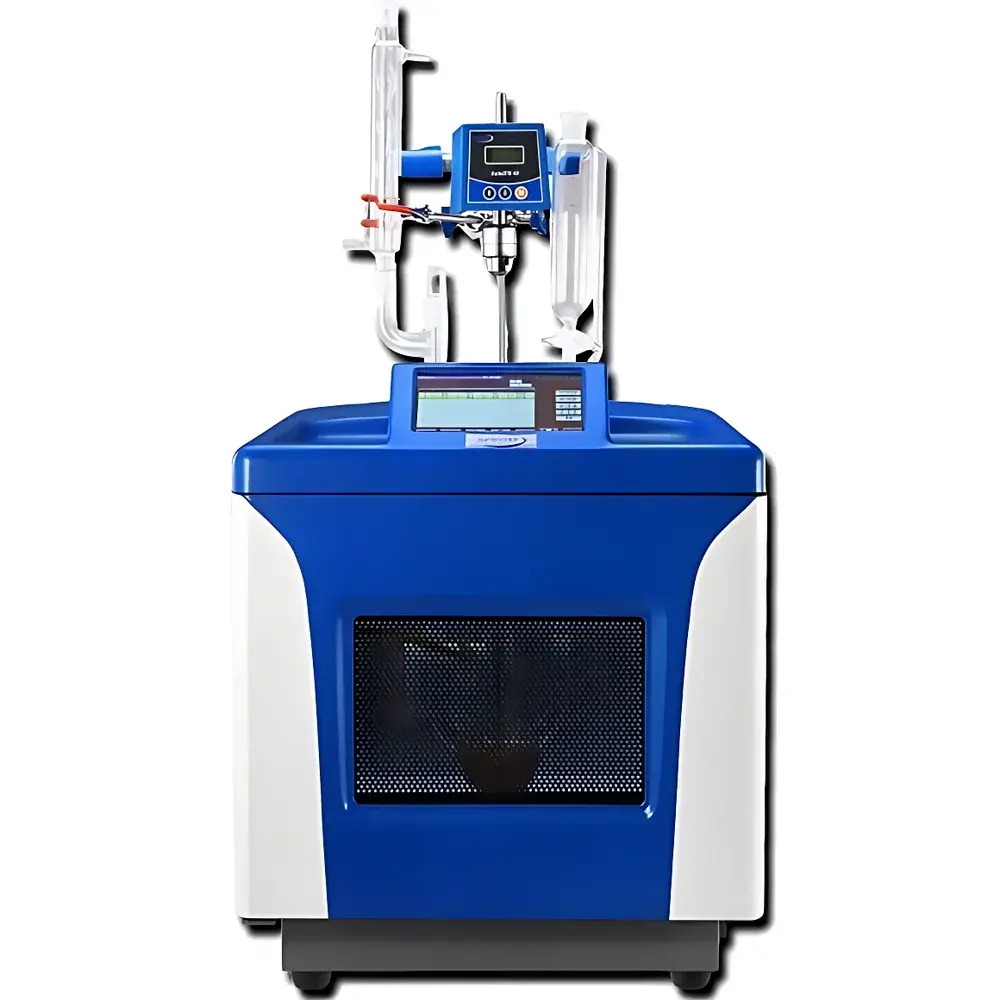
Hanon UWave-2000 Multifunctional Microwave Synthesis and Extraction Platform
| Brand | Hanon |
|---|---|
| Origin | Shanghai, China |
| Model | UWave-2000 |
| Microwave Power | 0–1000 W (PID-controlled, non-pulsed continuous output) |
| Frequency | 2450 MHz (magnetron) |
| Temperature Control | Dual-mode (infrared: 0–300 °C, ±1 °C |
| Pt100 resistance probe | 0–250 °C, ±1 °C) |
| Pressure Control (sealed mode) | Piezoelectric sensor, 0–5 MPa, ±0.01 MPa |
| Max. Atmospheric Reaction Volume | 2000 mL (glass) |
| Max. Sealed Reaction Volume | 500 mL (stainless steel + PEEK/Quartz vessels) |
| Max. Sealed Operating Conditions | 230 °C, 2 MPa |
| Ultrasonic Module | Immersion-type, 0–800 W, 28 kHz, auto-sweep & frequency lock |
| UV Irradiation | Dual-source — standard 300 W @ 365 nm, optional 100 W @ 254 nm |
| Stirring | Dual-mode — magnetic (0–800 rpm), mechanical (30–1600 rpm, torque 300 N·m, PEEK or quartz shaft) |
| Safety Certification | ISO 9001:2008, CE compliant |
| Software | Windows-based PC interface with full parameter logging, real-time remote control, video capture, and audit-trail-capable data export |
Overview
The Hanon UWave-2000 Multifunctional Microwave Synthesis and Extraction Platform is an engineered solution for advanced reaction chemistry requiring precise, reproducible, and multimodal energy input. Built upon two decades of microwave chemical instrumentation expertise and refined through extensive academic and industrial collaboration, the UWave-2000 integrates microwave irradiation (2450 MHz), immersion ultrasonication (28 kHz), and dual-wavelength UV irradiation (365 nm and 254 nm) within a single, unified platform. Unlike conventional single-energy reactors, it enables true synergistic activation—where microwave thermal effects, acoustic cavitation, and photochemical excitation operate in concert or sequentially under programmable conditions. Its architecture supports both open-vessel (atmospheric) synthesis—up to 2000 mL—and sealed high-pressure reactions—up to 500 mL at 230 °C and 2 MPa—making it suitable for method development, scalability assessment, and process optimization across R&D and pilot-scale environments.
Key Features
- Multimodal Energy Integration: Independent, software-synchronized control of microwave power (0–1000 W, non-pulsed, PID-regulated), ultrasonic output (0–800 W, auto-frequency locked), and UV irradiation (dual-band, intensity- and timing-programmable).
- Dual-Mode Temperature Monitoring: Automatic switching between high-speed infrared pyrometry (0–300 °C, ±1 °C) and contact-based Pt100 resistance sensing (0–250 °C, ±1 °C) ensures accuracy across atmospheric and pressurized regimes.
- High-Fidelity Pressure Management: Piezoelectric pressure transducer (0–5 MPa, ±0.01 MPa resolution) coupled with real-time overpressure alarm and active pressure-limiting venting—integrated with aerospace-grade fiber-reinforced outer vessels and rigid metal containment frame.
- Adaptive Stirring System: Simultaneous magnetic stirring (0–800 rpm) and high-torque mechanical stirring (30–1600 rpm, 300 N·m, reversible direction, PEEK or quartz shaft)—optimized for viscous, heterogeneous, or gas-evolving reactions.
- Industrial-Grade Reaction Chamber: 316L stainless steel cavity with multi-layer PTFE coating; forced-air cooling (3 m³/min, 3-speed auto-regulation); integrated ports for inert gas purging, reflux condensation, dropping funnel, and Dean-Stark water separation.
- Full-Digital Workflow Interface: 7-inch capacitive touchscreen with real-time parameter visualization, live color video feed (onboard CMOS imaging system), and synchronized curve plotting; fully compatible with Windows-based host software for remote operation, parameter archiving, and GLP-compliant data export.
Sample Compatibility & Compliance
The UWave-2000 accommodates a broad range of vessel materials and configurations to meet diverse chemical compatibility and regulatory requirements. Standard borosilicate glass vessels (50–2000 mL) support atmospheric organic synthesis, extraction, and hydrolysis. Optional quartz vessels enable UV-transparent photochemistry under 254 nm or 365 nm irradiation. For sealed high-pressure work, chemically resistant PEEK-lined stainless steel vessels (100, 200, and 500 mL) are certified for sustained operation at ≤230 °C and ≤2 MPa. All reaction vessels comply with ISO 9001:2008 manufacturing standards and CE safety directives (2014/30/EU EMC, 2014/35/EU LVD). The system’s pressure and temperature logging functions—including timestamped event records, setpoint deviations, and energy delivery profiles—support alignment with GLP and GMP documentation practices. While not pre-certified for FDA 21 CFR Part 11, its software architecture permits configuration for electronic signature readiness and audit-trail generation per user-defined SOPs.
Software & Data Management
The UWave-2000 is operated via a dedicated Windows application that establishes bidirectional communication with the instrument via USB or Ethernet. This software provides complete programmatic control over all energy sources, sensors, and actuators—including ramp/hold temperature profiles, stepped power sequences, timed UV-on/off cycles, and synchronized ultrasonic burst modes. Each run generates a timestamped binary log file containing raw sensor values (T, P, W, rpm, image frames), along with metadata (user ID, method name, vessel ID, calibration status). Export options include CSV (for statistical analysis in MATLAB or JMP), PDF (formatted report with curves and annotations), and AVI (time-stamped video synchronized with parameter traces). The software supports method library management, user role-based access levels, and configurable data retention policies—facilitating compliance with internal QA protocols and external audit requirements.
Applications
- Organic & Medicinal Chemistry: Accelerated Suzuki, Heck, and Buchwald-Hartwig couplings; solvent-free esterifications; microwave-assisted peptide synthesis under inert atmosphere.
- Natural Product Extraction: Simultaneous microwave-ultrasonic assisted extraction (MUAE) of polyphenols, alkaloids, and terpenoids from botanical matrices—reducing solvent volume and cycle time vs. Soxhlet or ASE.
- Materials Science: Rapid solvothermal synthesis of MOFs, perovskites, and metal oxide nanoparticles; graphene oxide reduction; polymer grafting under controlled UV/microwave synergy.
- Protein & Biomolecule Modification: Controlled microwave heating for enzymatic digestion enhancement; photo-crosslinking of bioconjugates using 365 nm UV in combination with mild thermal activation.
- Process Development & Scale-up Studies: Direct translation from 50 mL sealed vials to 500 mL reactors using identical kinetic profiles—enabling reliable reaction calorimetry, safety screening (e.g., adiabatic temperature rise), and DOE-driven optimization.
FAQ
What safety certifications does the UWave-2000 hold?
The system complies with ISO 9001:2008 quality management standards and carries CE marking per EU Electromagnetic Compatibility (2014/30/EU) and Low Voltage (2014/35/EU) directives. Vessel designs adhere to PED 2014/68/EU principles for pressure equipment classification.
Can the UWave-2000 be validated for regulated pharmaceutical use?
While the base hardware meets foundational safety and traceability requirements, formal 21 CFR Part 11 validation requires site-specific IQ/OQ/PQ protocols, third-party calibration, and documented configuration management—services supported by Hanon’s global service network.
Is remote monitoring possible during unattended operation?
Yes. The Windows software supports secure remote desktop access and real-time parameter streaming. Video and sensor data can be logged locally or streamed to a network-attached storage device with configurable alert thresholds.
How is ultrasonic energy delivered and monitored?
An immersion-type transducer delivers 28 kHz acoustic energy directly into the reaction medium. Output is continuously adjusted via closed-loop feedback using amplitude and current sensing—not just timer-based duty cycling—ensuring consistent cavitation intensity across viscosity changes.
What level of temperature uniformity is achieved in the 2000 mL atmospheric mode?
Under standard glass vessel configurations and optimized stirrer positioning, radial temperature gradients remain ≤±3 °C across the liquid phase during steady-state operation at 150 °C—verified using calibrated fiber-optic probes at multiple spatial coordinates.



