
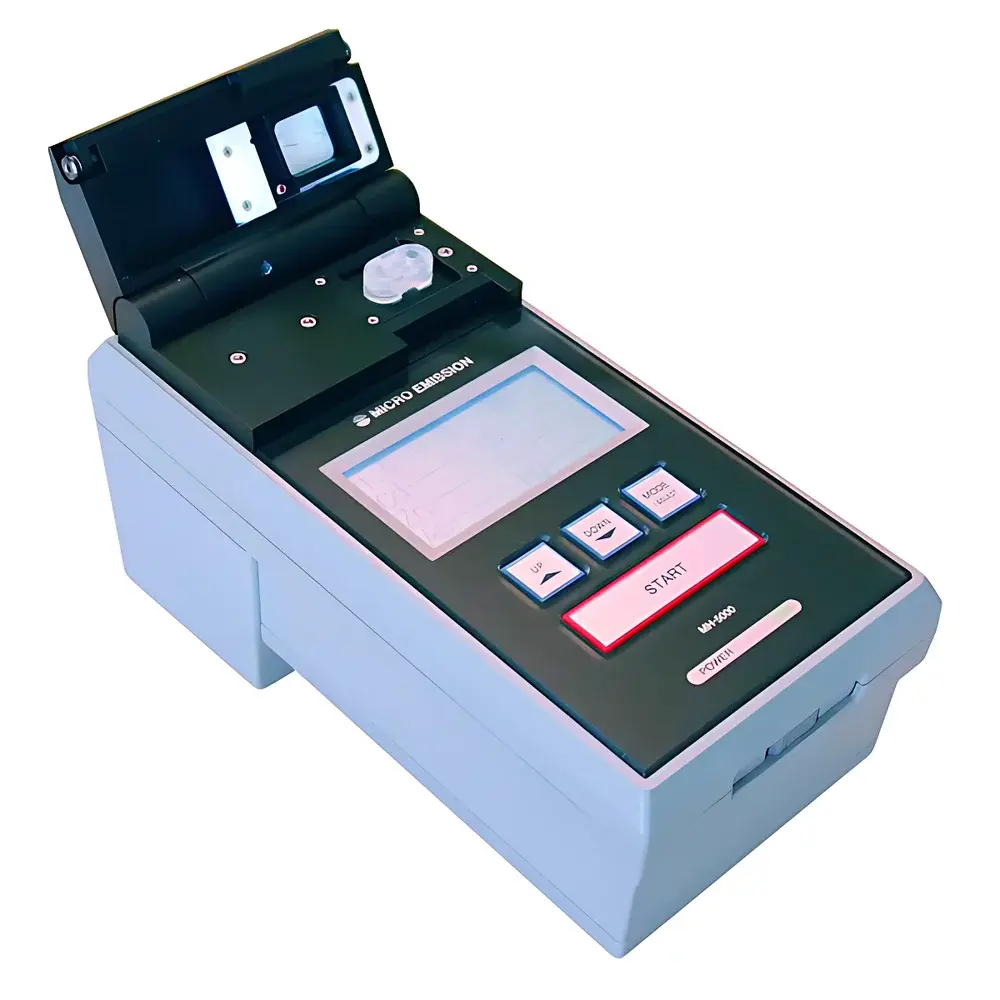
Micro Emission MH-5000 Portable LECP-OES Elemental Analyzer
| Brand | Micro Emission |
|---|---|
| Origin | Japan |
| Model | MH-5000 |
| Instrument Type | Portable |
| Detection Principle | Liquid Electrode Capillary Plasma Optical Emission Spectrometry (LECP-OES) |
| Target Analytes | Multi-element (≥40 metals, including As, Cd, Cr, Cu, Fe, Pb, Mn, Ni, Zn, etc.) |
| Analysis Time | ≤5 s per sample |
| Sample Volume | 40 µL |
| Power Supply | 6 × AA batteries or AC adapter |
| Weight | 1.4 kg (including battery) |
| Dimensions | 20 × 10 × 11 cm |
| Gas Requirement | None |
| Cooling | Air-cooled, no water circulation |
| Exhaust | No dedicated fume hood required |
| Compliance | Designed for field-deployable environmental testing in accordance with EPA Method 200.7–derived protocols and ISO 17294-2:2016 principles |
Overview
The Micro Emission MH-5000 Portable LECP-OES Elemental Analyzer is a field-deployable optical emission spectrometer engineered for rapid, multi-element quantification in aqueous matrices without laboratory infrastructure. Unlike conventional ICP-OES systems that rely on high-power RF generators, argon plasma, and complex cooling and exhaust systems, the MH-5000 employs Liquid Electrode Capillary Plasma (LECP) technology—a compact, low-energy plasma excitation method where sample solution itself serves as the electrode and plasma medium within a micro-capillary discharge zone. This principle enables stable, repeatable atomic emission generation directly from liquid samples at ambient pressure, eliminating the need for inert gas supply, water chillers, or dedicated ventilation. The instrument delivers full-spectrum detection across the UV-Vis range (190–800 nm), supporting simultaneous qualitative and quantitative analysis of over 40 metallic elements—including regulated heavy metals such as As, Cd, Cr(VI), Cu, Fe, Pb, Mn, Ni, and Zn—at detection limits in the sub-ppm to ppm range. Its design targets compliance with core principles of EPA Method 200.7 (for metals by ICP-OES) and ISO 17294-2:2016 (water quality—determination of elements by ICP-OES), adapted for portable implementation under field conditions.
Key Features
- True field-portability: Weighing only 1.4 kg with integrated rechargeable battery support (6 × AA or optional AC adapter), the MH-5000 operates independently of mains power, compressed gas, or exhaust infrastructure.
- Micro-volume analysis: Requires just 40 µL of unacidified or minimally pretreated aqueous sample—ideal for on-site screening of drinking water, wastewater effluents, surface water, and leachates.
- LECP plasma source: Solid-state, capillary-based plasma generation eliminates consumables such as torches, nebulizers, spray chambers, or peristaltic pump tubing—reducing operational cost and failure points.
- Full-spectrum CCD detection: High-resolution linear array CCD captures emission spectra across 190–800 nm in a single exposure, enabling retrospective re-analysis and interference correction without re-sampling.
- Ruggedized optical architecture: Sealed, temperature-stabilized optical bench ensures spectral stability across ambient operating temperatures (5–40 °C) and moderate humidity (up to 80% RH non-condensing).
- Embedded touchscreen interface: Onboard Linux-based OS supports method selection, calibration curve management, QA/QC flagging, and real-time concentration reporting with configurable units (mg/L, µg/L, ppb).
Sample Compatibility & Compliance
The MH-5000 is validated for direct analysis of clarified aqueous samples—including tap water, groundwater, river/lake water, treated wastewater, and acid-digested extracts from soils or sediments (per EPA Method 3050B/3051A). It accommodates total dissolved solids (TDS) up to 2,000 mg/L without clogging or signal drift. While not certified to ISO/IEC 17025 as a standalone accredited system, its measurement traceability aligns with NIST-traceable standards (e.g., CRM 1643e, 1640a) and supports GLP-aligned data integrity when used with audit-trail-enabled software. The analyzer meets functional equivalency requirements for Tier 1 field screening under US EPA Region 10 Field Screening Guidance and EU WFD Annex V monitoring frameworks for priority hazardous substances.
Software & Data Management
The MH-5000 integrates with Micro Emission’s EM-Link Desktop Suite (v3.2+), a Windows-based application compliant with FDA 21 CFR Part 11 for electronic records and signatures. Software features include automated calibration verification (CCV/CSB), multi-point standard addition, spectral deconvolution for overlapping lines (e.g., Fe 238.204 nm / Cr 238.203 nm), and customizable report templates exportable as PDF, CSV, or XML. All raw spectra, metadata (operator ID, GPS coordinates, timestamp, ambient T/RH), and processing logs are stored with SHA-256 hashing for tamper-evident archiving. Data export supports LIMS integration via ASTM E1384-compliant HL7 messaging.
Applications
- Real-time regulatory screening of drinking water sources for lead, arsenic, and cadmium per WHO Guidelines and EU Directive 98/83/EC.
- Rapid assessment of industrial effluent compliance with local discharge permits (e.g., NPDES limits for Cu, Ni, Zn).
- Field validation of remediation endpoints at brownfield sites using soil pore water or sequential extraction fractions.
- Emergency response deployment during spill events—quantifying metal plumes in surface runoff or floodwaters within minutes.
- QA/QC support for centralized labs: pre-screening samples to prioritize ICP-MS or ICP-OES lab analysis based on exceedance thresholds.
FAQ
Does the MH-5000 require daily calibration or performance verification?
No. A single calibration curve remains valid for ≥72 hours under stable ambient conditions; however, users must run a continuing calibration verification (CCV) standard every 10 samples or at shift start/end per EPA 200.7 recommendations.
Can the MH-5000 analyze turbid or suspended samples?
No. Samples must be filtered through 0.45 µm membrane filters prior to analysis to prevent capillary blockage and plasma instability.
Is method validation documentation available for regulatory submission?
Yes. Micro Emission provides a Technical Validation Package (TVP) including precision/recovery studies (n=30), matrix spike data for 12 water types, and interlaboratory comparison reports aligned with ISO 5725-2.
What maintenance is required beyond routine cleaning?
None. The LECP source has no replaceable electrodes or consumable plasma components; only weekly ultrasonic cleaning of the sample introduction capillary with 5% HNO₃ is recommended.
How is data integrity ensured during offline field operation?
All measurements are timestamped, geotagged (via optional Bluetooth GNSS module), and cryptographically signed onboard. Raw spectral files are write-once, read-many (WORM) archived to internal eMMC storage with automatic backup to encrypted USB drives.







