
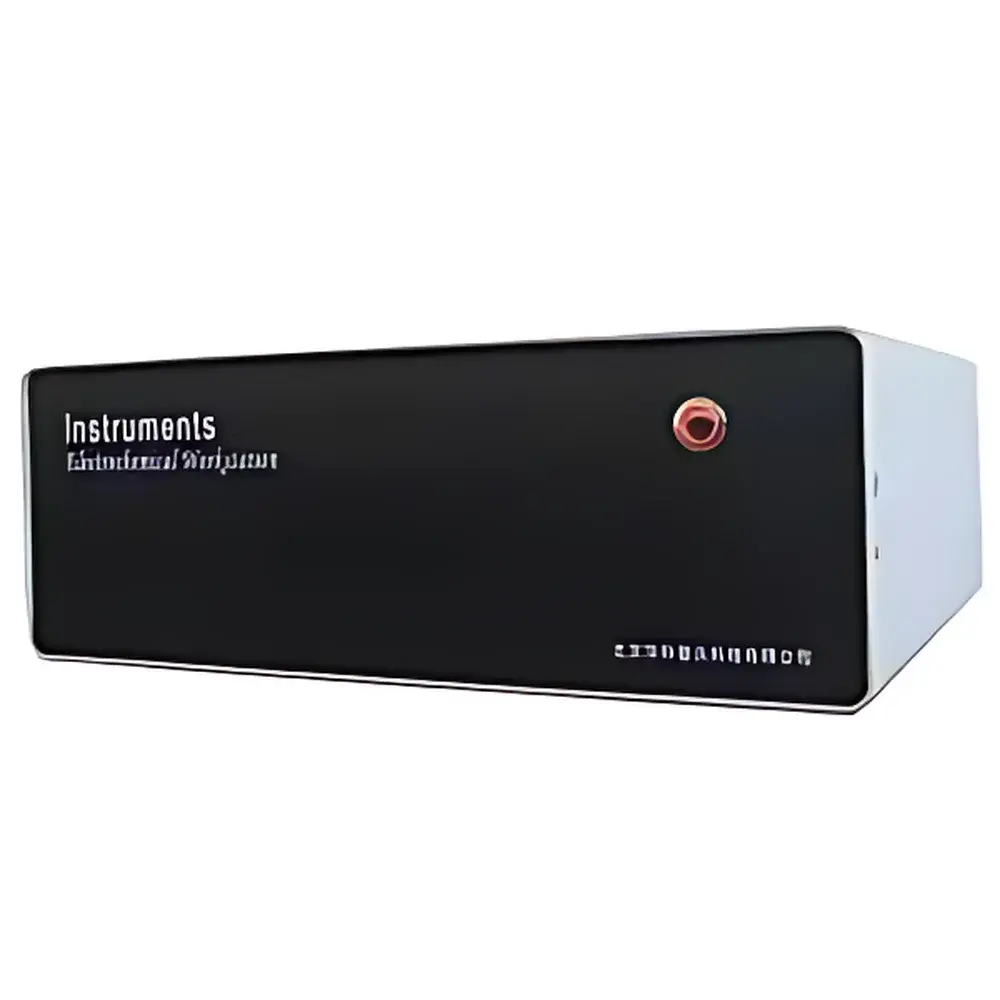
CH Instruments CHI900D Scanning Electrochemical Microscope (SECM)
| Origin | Beijing, China |
|---|---|
| Manufacturer Type | Authorized Distributor |
| Origin Category | Domestic (PRC) |
| Model | CHI900D |
| Price Range | USD 42,000 – 70,000 (FOB) |
| Instrument Type | Bipotentiostatic Electrochemical Workstation |
| Channel Count | Single-Channel Bipotentiostat |
| Current Range | ±250 mA continuous (sum of two channels), ±350 mA peak |
| Current Accuracy | ±0.2% of reading |
| Potential Accuracy | ±1 mV or ±0.01% of full scale |
| Potentiostatic Range | ±10 V |
| EIS Frequency Range | 10 µHz to 1 MHz |
| XYZ Positioning System | Stepper-motor-driven |
| resolution | 8 µm (CHI900D), travel: 50 mm per axis |
| Optional High-Resolution Mode | Closed-loop piezoelectric stage (CHI920D variant) |
| resolution | 1.6 nm |
| Core Functionality | Dual-potentiostat with zero-resistance ammeter (ZRA) mode for feedback-mode SECM, generation-collection (G/C) mode, and redox competition (RC-SECM) experiments |
Overview
The CH Instruments CHI900D Scanning Electrochemical Microscope (SECM) is a precision bipotentiostatic electrochemical workstation engineered for high-spatial-resolution electrochemical imaging and localized kinetic analysis at solid/liquid interfaces. Unlike conventional electrochemical cells, the CHI900D integrates a computer-controlled, motorized XYZ positioning system with a dual-potentiostat architecture to enable real-time scanning of ultramicroelectrode (UME) probes across sample surfaces in aqueous or non-aqueous electrolytes. Its operational principle relies on feedback-mode current modulation—where tip current is governed by local solution conductivity and surface reactivity—or generation-collection configurations that quantify reaction intermediates with sub-micrometer spatial fidelity. Designed for fundamental electrocatalysis research, corrosion mapping, biosensor development, and single-entity electrochemistry, the CHI900D delivers reproducible quantitative data under controlled mass transport and potential conditions, supporting both steady-state and transient measurements.
Key Features
- Bipotentiostatic architecture enabling independent control of tip and substrate potentials—critical for redox competition (RC-SECM), substrate generation/tip collection (SG/TC), and tip generation/substrate collection (TG/SC) modes.
- Zero-resistance ammeter (ZRA) circuitry integrated into the second channel, allowing precise measurement of galvanic currents between dissimilar electrodes without introducing series resistance artifacts.
- High-stability potentiostat with ±10 V compliance range, ±250 mA continuous current output (dual-channel sum), and ±350 mA peak capability—suitable for fast-scan voltammetry and resistive sample interrogation.
- Motorized XYZ stage with 50 mm travel per axis and 8 µm step resolution (CHI900D base configuration); optional closed-loop piezoelectric stage upgrade (CHI920D) provides 1.6 nm resolution for nanoscale topographic-electrochemical correlation.
- Electrochemical impedance spectroscopy (EIS) support from 10 µHz to 1 MHz with four-point probe compatibility and Kramers–Kronig validation routines for data integrity assessment.
- Current accuracy of ±0.2% and potential accuracy of ±1 mV (or ±0.01% of full scale), traceable to NIST-calibrated reference standards and validated per ASTM E2139 and ISO 13826 guidelines.
Sample Compatibility & Compliance
The CHI900D accommodates conductive, semiconductive, and insulating substrates—including ITO/glass, Au/Si, carbon-based materials, biological membranes, and polymer films—via adjustable immersion depth and vibration-isolated mounting. Compatible with standard three-electrode electrochemical cells and custom microfluidic SECM cells. All hardware and firmware comply with CE electromagnetic compatibility (EMC) Directive 2014/30/EU and Low Voltage Directive 2014/35/EU. Data acquisition meets GLP audit requirements with timestamped metadata logging, user-access logs, and electronic signature support. Optional 21 CFR Part 11-compliant software modules are available for regulated environments requiring FDA-submission-ready documentation.
Software & Data Management
CHI’s proprietary ChronoSoft v12.1 platform provides integrated instrument control, real-time SECM image reconstruction, and multi-parameter curve fitting. The software supports batch acquisition of topographic and electrochemical datasets, automated Z-height feedback loops using approach curves, and export of 3D current maps in ASCII, CSV, and HDF5 formats. Built-in scripting (Python API) enables custom scan protocols and machine-learning-assisted feature extraction. Raw data files include embedded calibration parameters, environmental metadata (temperature, humidity, electrolyte composition), and full audit trails compliant with ISO/IEC 17025:2017 clause 7.7 on result reporting.
Applications
- Quantitative mapping of local electron-transfer kinetics on heterogeneous catalysts (e.g., Pt nanoparticles on carbon supports).
- In situ monitoring of passive film breakdown and localized anodic dissolution during early-stage pitting corrosion.
- Subcellular electrochemical imaging of redox-active species (e.g., H2O2, NO) released from live neurons or epithelial monolayers.
- Characterization of ion-selective membrane permeability and interfacial charge transfer at solid–polymer electrolyte interfaces.
- High-throughput screening of electrodeposited materials via automated grid-based SECM surveys with statistical outlier detection.
FAQ
Is the CHI900D compatible with commercial ultramicroelectrodes (UMEs)?
Yes—it accepts standard 10–25 µm diameter Pt, Au, or carbon UMEs mounted in glass capillaries or commercial holders (e.g., BASi MF-2010), with configurable input impedance and filtering settings optimized for low-noise current detection.
Can the CHI900D perform simultaneous topography and electrochemical imaging?
Yes—when equipped with the optional piezoelectric Z-feedback module (CHI920D), it enables true co-registered topographic–electrochemical imaging with <2 nm vertical resolution and sub-second pixel dwell times.
Does the system support third-party data analysis tools?
All exported datasets conform to open scientific data standards (HDF5, CSV) and are fully importable into Igor Pro, MATLAB, Python (SciPy/NumPy), and OriginLab for advanced deconvolution, principal component analysis (PCA), or finite-element modeling (FEM).





