
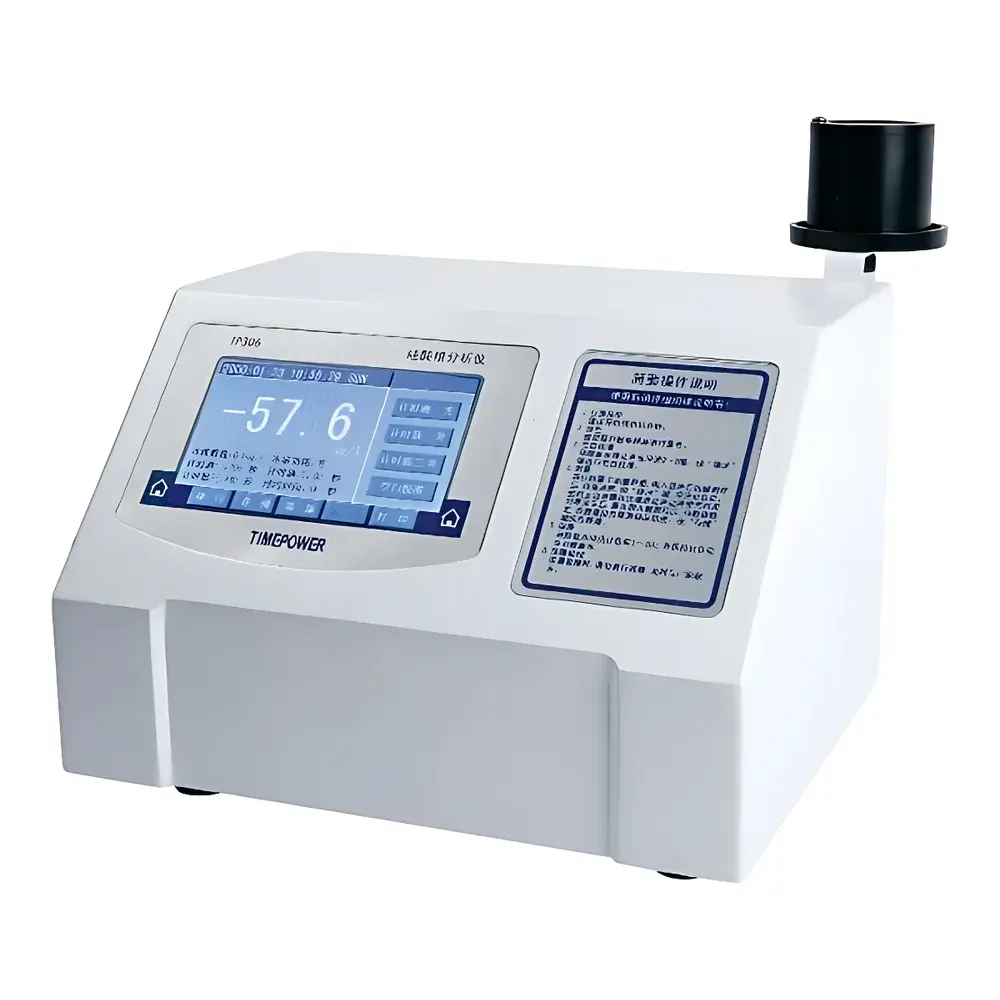
Timepower TP306 Silicate Analyzer
| Brand | Timepower |
|---|---|
| Model | TP306 |
| Type | Benchtop Laboratory Silicate Analyzer |
| Origin | Beijing, China |
| Manufacturer | Timepower (Beijing) Technology Co., Ltd. |
| Application | Soluble silica and silicate quantification in ultrapure water, condensate, boiler feedwater, and process streams for power generation, pharmaceuticals, semiconductor manufacturing, and chemical processing |
| Measurement Principle | Colorimetric photometry based on molybdenum blue reduction method (ASTM D859, ISO 10523, USP <643>) |
| Display | 5.0-inch capacitive touchscreen LCD (Chinese interface) |
| Range | 0.0–200.0 µg/L or 0.0–2000 µg/L (user-selectable) |
| Accuracy | ±2% of full scale |
| Resolution | 0.1 µg/L |
| Repeatability | ≤1% RSD |
| Stability | ±1% F.S./4 h |
| Operating Environment | 5–45 °C, ≤90% RH (non-condensing) |
| Dimensions | 260 × 200 × 180 mm |
| Weight | 3.2 kg |
| Power Supply | AC 85–265 V, 45–65 Hz |
| Power Consumption | ≤30 W |
| Data Storage | Cyclic memory for up to 256 measurements with auto-overflow overwrite |
| Key Features | Integrated optical path design, imported monochromatic cold-light source, onboard blank calibration, automatic timing prompt, baseline compensation algorithm, low-power MCU architecture, surface-mount PCB assembly |
Overview
The Timepower TP306 Silicate Analyzer is a benchtop laboratory instrument engineered for precise, trace-level quantification of soluble silica (SiO₂) and silicate species in high-purity aqueous matrices. It operates on the standardized colorimetric molybdenum blue reduction method—compliant with ASTM D859 (Standard Test Method for Silica in Water), ISO 10523 (Water quality — Determination of pH), and USP (Silicon Determination in Water for Pharmaceutical Use). In acidic medium (pH 1.1–1.3), orthosilicic acid reacts with ammonium molybdate to form a yellow heteropolyacid complex; subsequent reduction by 1-amino-2-naphthol-4-sulfonic acid (1-2-4 acid) yields a stable blue chromophore proportional to silicate concentration. Absorbance is measured at 630–650 nm via dual-beam photometric detection, applying the Lambert–Beer law (A = ε·c·l) to compute concentration. The system is optimized for ultralow-range analysis in critical water loops where silica deposition threatens turbine efficiency, heat exchanger integrity, and semiconductor wafer cleanliness.
Key Features
- High-stability monochromatic cold-light source with >10,000-hour operational lifetime and minimal thermal drift
- Integrated optical path design with precision cuvette holder and zero-background compensation circuitry to suppress stray light and baseline offset
- Onboard blank calibration routine to correct for electronic zero drift, photodetector aging, and reagent blank variability
- Intelligent timing module with audible/visual prompts for reaction incubation (e.g., 10-min color development period), ensuring protocol adherence
- Embedded microcontroller unit (MCU) architecture featuring low-power consumption (<30 W), robust EMI shielding, and industrial-grade surface-mount components
- 5.0-inch capacitive touchscreen interface with Chinese-language menu navigation, intuitive parameter configuration, and real-time measurement visualization
- Cyclic data storage (up to 256 entries) with timestamp, sample ID, range setting, and calibration status—no external PC required for basic operation
Sample Compatibility & Compliance
The TP306 is validated for use with Type I ultrapure water (resistivity ≥18.2 MΩ·cm), condensate, demineralized feedwater, boiler drum water, and process rinse waters from semiconductor fab wet benches. Sample matrix compatibility extends to low-conductivity streams (<0.1 µS/cm) containing trace cations (Na⁺, Ca²⁺, Mg²⁺) and anions (Cl⁻, SO₄²⁻) within typical power plant or pharma utility specifications. All internal fluid pathways are constructed from inert polypropylene and PTFE to prevent adsorption or leaching. The analyzer supports GLP-compliant operation through manual audit trail documentation; while it does not provide FDA 21 CFR Part 11–compliant electronic signatures or encrypted audit logs, its calibration history, blank values, and measurement timestamps are fully traceable within stored records.
Software & Data Management
Data acquisition and display are handled entirely by embedded firmware—no proprietary desktop software is required. Measurement results appear instantly on the touchscreen with selectable units (µg/L SiO₂), range mode, and pass/fail indicators relative to user-defined action limits. Stored datasets include date/time stamp, operator ID field (manually entered), calibration reference value, and raw absorbance reading. Export is limited to manual transcription or screen capture; for integration into LIMS or SCADA systems, analog 4–20 mA output (optional accessory) or RS-232 serial interface (available upon request) may be configured. Firmware updates are performed via USB flash drive using signed binary files provided by Timepower technical support.
Applications
- Power generation: Monitoring silica breakthrough in mixed-bed ion exchange effluent, condensate polishing units, and steam cycle sampling points per EPRI guidelines
- Semiconductor manufacturing: Verifying silica levels in UPW distribution loops to prevent microparticle formation and wafer surface defects during cleaning and etching
- Pharmaceutical water systems: Supporting compliance with USP and EU GMP Annex 1 for purified water and water-for-injection (WFI) quality control
- Chemical and fiber production: Quantifying silicate carryover in caustic soda recovery streams and polymerization coolant circuits
- Research laboratories: Serving as a reference method for method validation studies against ICP-MS or IC-ICP-OES techniques
FAQ
What reagents are required for daily operation?
Ammonium molybdate solution (analytical grade), 1-2-4 acid reducing agent (stabilized aqueous formulation), sulfuric acid (≥95.5%), and high-purity Type I water (resistivity ≥18.2 MΩ·cm) for blanks and dilutions.
Is the instrument suitable for field deployment?
No—the TP306 is designed exclusively for controlled laboratory environments. Its optical alignment, temperature sensitivity, and reliance on precise reagent addition preclude ruggedized or portable use.
How often must calibration curves be verified?
Timepower recommends daily blank calibration and biweekly full-range calibration using NIST-traceable silica standards (e.g., 50 µg/L and 150 µg/L SiO₂) to maintain metrological integrity under ISO/IEC 17025–aligned QA practices.
Can the TP306 measure total silicon (including colloidal or particulate forms)?
No—it measures only dissolved, filterable (0.45 µm) orthosilicic acid and reactive silicates. Total silicon requires acid digestion pretreatment, which is outside the instrument’s scope.
Does the analyzer comply with EPA methods?
While not certified under EPA Method 375.4, the TP306 implements the same core chemistry and photometric detection principles; users must validate method equivalence per 40 CFR Part 136 requirements prior to regulatory submission.







