
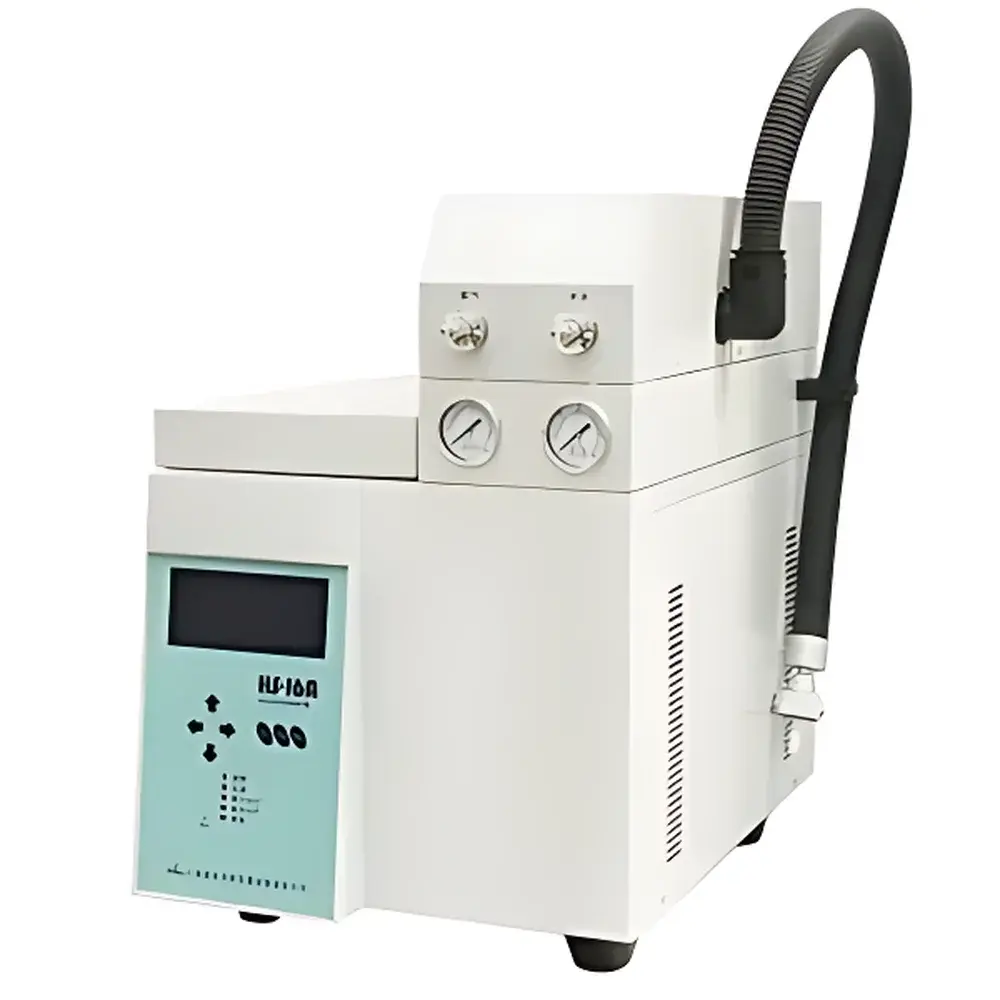
Sida HS-16A Fully Automated Static Headspace Sampler
| Brand | Sida |
|---|---|
| Origin | Shanghai, China |
| Manufacturer Type | Original Equipment Manufacturer (OEM) |
| Instrument Type | Static Headspace Sampler |
| Automation Level | Fully Automated |
| Sample Vial Capacity | 16 positions |
| Compatible Vial Sizes | 10 mL and 20 mL |
| Control Interface | Microprocessor-based with LCD display (English/Chinese toggle), membrane keypad, digital input |
| System Purge | Inert gas (e.g., nitrogen or argon) purge of sampling needle, loop, and transfer line after each injection |
| Sample Path Configuration | Heated, inert flow path from vial to GC inlet (no cold spots) |
| Diagnostic Features | Power-on self-test, auto-positioning sample tray, real-time status monitoring, comprehensive fault detection and on-screen alerts |
| Method Storage | Default method preloaded |
| GC Integration | Universal interface compatible with all major gas chromatographs (Agilent, Thermo Fisher, Shimadzu, PerkinElmer, etc.) |
Overview
The Sida HS-16A Fully Automated Static Headspace Sampler is an OEM-engineered, benchtop analytical accessory designed for precise, reproducible volatile organic compound (VOC) and residual solvent analysis in compliance with static headspace gas chromatography (HS-GC) methodology. It operates on the principle of phase equilibrium partitioning: a sealed sample vial is heated to a defined temperature, allowing analytes to volatilize and establish equilibrium between the liquid/solid matrix and the headspace gas phase. A precisely metered volume of this equilibrated vapor is then transferred—via a heated, inert, syringe-based sampling system—directly into the injection port of a coupled gas chromatograph. Engineered for laboratory environments requiring unattended operation, the HS-16A supports ISO 17025-aligned workflows and is routinely deployed in QC/QA laboratories across pharmaceuticals (per USP , ICH Q3C), environmental testing (EPA Methods 502.2, 524.4), food safety (AOAC 998.12), and polymer manufacturing.
Key Features
- Fully automated 16-position sample carousel with automatic vial indexing and positional repeatability ±0.1 mm
- Heated, chemically inert sampling pathway: stainless steel needle, fused silica transfer line, and quantitative loop—all maintained at user-selectable temperatures up to 220 °C to prevent condensation and adsorption losses
- Post-injection inert gas (N₂ or Ar) purge cycle for needle, loop, and transfer line—reducing carryover to < 0.05% RSD across consecutive injections
- Microprocessor-controlled thermal management with independent heating zones for oven, vial tray, and transfer line; temperature stability ±0.5 °C over full operating range (30–220 °C)
- Integrated diagnostics: power-on self-test sequence, real-time hardware status monitoring, audible/visual fault alerts with descriptive error codes (e.g., “Vial Not Detected”, “Loop Overpressure”, “Heater Fault”)
- Flexible method programming via front-panel LCD interface: customizable equilibration time (0.1–99.9 min), incubation temperature (30–220 °C), pressurization time, fill time, and injection volume (0.1–2.0 mL)
Sample Compatibility & Compliance
The HS-16A accommodates standard crimp-top or screw-cap headspace vials of 10 mL and 20 mL volumes (including ASTM D3699-compliant vials). Its inert flow path—passivated stainless steel and silanized glass components—ensures compatibility with acidic, basic, and sulfur-containing analytes. The system meets essential regulatory expectations for data integrity: audit-trail-capable method storage (with timestamped version history), non-erasable run logs, and deterministic sequence execution. While not FDA 21 CFR Part 11–certified out-of-the-box, its operational logic and logging architecture support validation under GLP/GMP frameworks when integrated with compliant chromatography data systems (CDS).
Software & Data Management
Operation is managed locally via the embedded microcontroller interface—no external PC required. The LCD display supports dual-language operation (English/Chinese) and presents live parameters including elapsed equilibration time, current oven temperature, vial position, and remaining sequence steps. All method parameters are stored in non-volatile memory with checksum validation. Users may define, name, save, recall, and queue up to 100 distinct methods—including mixed-sequence protocols where different vials execute different equilibration profiles within one run. Export of run metadata (start time, method ID, vial ID, temperature setpoints) is supported via RS-232 serial output for integration into LIMS or custom QA databases.
Applications
- Residual solvent quantification in active pharmaceutical ingredients (APIs) and excipients per ICH Q3C guidelines
- VOC profiling in drinking water, wastewater, and soil extracts (EPA 502.2, 524.4, 8260D)
- Flavor and fragrance compound analysis in beverages, dairy, and confectionery products
- Monomer and catalyst residue testing in synthetic polymers and adhesives
- Head-space analysis of ethanol in forensic blood samples (forensic toxicology workflows)
- Quality control of packaged goods for leachable/extractable compounds (e.g., packaging migration studies)
FAQ
Is the HS-16A compatible with third-party gas chromatographs?
Yes—the instrument uses industry-standard TTL-level trigger signals and analog voltage outputs for GC start synchronization, enabling seamless integration with Agilent 7890/8890, Thermo ISQ, Shimadzu GC-2030, and PerkinElmer Clarus series instruments.
What maintenance intervals are recommended for long-term reliability?
We recommend quarterly inspection of the septum seal on the vial pressurization manifold, biannual replacement of the transfer line O-rings, and annual calibration verification using certified headspace standards (e.g., benzene in water at 10 ppm).
Can the system be validated for regulated environments?
Yes—its deterministic behavior, method traceability, hardware self-tests, and consistent thermal performance provide a foundation for IQ/OQ/PQ protocol development in accordance with ASTM E2500 and EU Annex 11 principles.
Does it support dynamic headspace (purge-and-trap) mode?
No—the HS-16A is engineered exclusively for static headspace sampling; it does not include trapping columns, cryo-focusing, or carrier gas purging modules required for dynamic applications.
What is the typical carryover performance for high-concentration standards?
When operated with the default post-injection inert gas purge (15 s, 30 mL/min), carryover remains below 0.05% for analytes such as chloroform, toluene, and ethyl acetate at concentrations up to 1000 ppm in aqueous matrix.




