
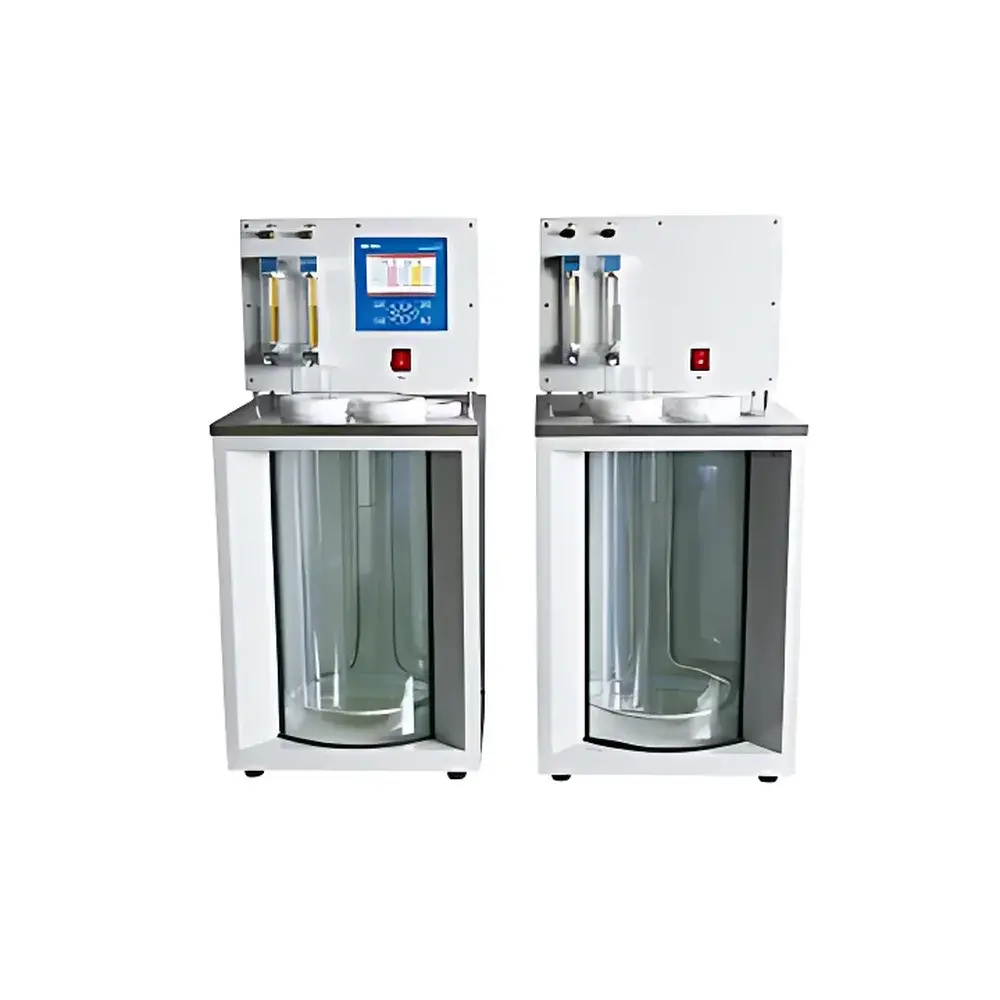
Timepower TP652 Foam Characteristics Tester (Compliant with GB/T 12579, ISO 6247 & ASTM D892)
| Brand | Timepower |
|---|---|
| Origin | Beijing, China |
| Manufacturer Type | Direct Manufacturer |
| Product Origin | Domestic (China) |
| Model | TP652 |
| Pricing | Upon Request |
| Temperature Control Range | 0–100 °C (with optional immersion chiller) |
| Temperature Accuracy | ±0.5 °C |
| Air Flow Rate | 16–160 mL/min (adjustable via rotameter) |
| Air Source | Integrated silent air pump (3 L/min) |
| Gas Diffusion Head Capacity | 3000–6000 mL/min at 2.45 kPa |
| Timing Resolution | ±1 s (automated) |
| Display | LCD interface |
| Power Supply | AC 220 V ±10%, 50 Hz ±10% |
| Max. Power Consumption | ≤2300 W |
| Dimensions | 340 × 340 × 740 mm |
| Net Weight | 23 kg |
| Operating Ambient | 5–40 °C, ≤85% RH |
| Printer | Thermal, 36-character Chinese/English output |
Overview
The Timepower TP652 Foam Characteristics Tester is an engineered solution for the quantitative evaluation of foam tendency and foam stability in lubricating oils and related petroleum-based fluids under standardized thermal and aeration conditions. Based on the Couette-type aeration principle—where a controlled stream of clean, dry air is introduced through a calibrated diffusion head into a precisely temperature-regulated oil sample—the instrument replicates the mechanical agitation and interfacial phenomena responsible for foam formation in real-world systems such as gearboxes, hydraulic reservoirs, and turbine sumps. Designed to comply strictly with GB/T 12579 (Chinese National Standard), ISO 6247 (International Organization for Standardization), and ASTM D892 (American Society for Testing and Materials), the TP652 delivers repeatable, auditable test sequences essential for quality control laboratories operating under GLP or ISO/IEC 17025 frameworks.
Key Features
- PID-based digital temperature control system ensures stable thermal regulation across the full 0–100 °C range, with accuracy maintained at ±0.5 °C—critical for reproducible foam behavior assessment at both low (24 °C) and high (93.5 °C) test temperatures.
- Integrated, low-noise air compressor (3 L/min free air delivery) coupled with four independent, fine-tuned rotameters (16–160 mL/min range) enables precise, simultaneous or sequential aeration of up to four samples under identical flow conditions.
- Dual-temperature bath architecture supports sequential testing: initial measurement at ambient-equivalent 24 °C, followed by high-temperature conditioning at 93.5 °C, then return to 24 °C for post-degradation foam stability evaluation—fully aligned with ASTM D892 Procedure A and GB/T 12579 Clause 6.
- Microprocessor-controlled operation with backlit LCD display provides intuitive navigation, real-time parameter monitoring (temperature, elapsed time, airflow), and automatic timing synchronization to ±1 second per 5-minute aeration cycle.
- Thermal management flexibility: optional immersion chiller accessory allows sub-ambient stabilization when ambient lab temperature exceeds 24 °C—ensuring strict adherence to standard-specified test initiation conditions.
- Onboard thermal printer outputs test records with date/time stamp, temperature setpoint, airflow value, foam volume readings (in mL), and operator ID—supporting traceability requirements under FDA 21 CFR Part 11 when paired with appropriate procedural controls.
Sample Compatibility & Compliance
The TP652 accommodates standard 100-mL graduated glass cylinders (included) and accepts all mineral-, synthetic-, and semi-synthetic-based lubricants within viscosity ranges typical of engine oils, hydraulic fluids, and turbine oils (ISO VG 32–220). Its diffusion head—designed to generate uniform bubble dispersion at 2.45 kPa differential pressure—meets dimensional and porosity specifications defined in Annex A of ASTM D892. All wetted components are chemically inert (borosilicate glass, stainless steel, PTFE-sealed valves), minimizing adsorption or catalytic degradation during repeated use. The instrument’s calibration protocol supports verification using NIST-traceable reference thermometers and certified flow meters, facilitating internal audit readiness and third-party accreditation (e.g., CNAS, UKAS).
Software & Data Management
While the TP652 operates as a standalone benchtop unit with embedded firmware, its data output structure is compatible with laboratory information management systems (LIMS) via manual entry or CSV import. The thermal printer log includes mandatory fields required for ISO/IEC 17025 clause 7.7 record retention: test method identifier (e.g., “GB/T 12579-2021”), instrument ID, analyst initials, raw foam volume (mL) at 0, 5, and 10 minutes post-aeration, and environmental conditions (lab temp/humidity). Optional RS-232 or USB-to-serial adapters enable automated data capture into validated spreadsheet templates used in GMP environments.
Applications
- Quality release testing of new lubricant batches against foam specification limits (e.g., max 50 mL foam tendency at 24 °C; max 20 mL foam stability after 10 min drain time).
- Formulation development support: evaluating antifoam additive efficacy, base oil compatibility, and shear-induced foam collapse kinetics.
- Troubleshooting field failures linked to foaming—correlating lab-measured foam parameters with equipment symptoms (cavitation, poor heat transfer, lubricant starvation).
- Regulatory submission packages for API, OEM, or military specifications requiring documented conformance to ASTM D892 or equivalent.
- Teaching laboratories: demonstrating colloidal gas dispersion thermodynamics and surfactant depletion mechanisms in petroleum science curricula.
FAQ
What standards does the TP652 fully support?
The instrument implements test procedures and hardware specifications required by GB/T 12579–2021, ISO 6247:2019, and ASTM D892–22 (Procedure A), including temperature ramp profiles, airflow tolerances, cylinder geometry, and timing protocols.
Is external air drying required?
No—the system integrates a desiccant drying tower filled with indicator-grade silica gel (blue when active; replace when pink), ensuring inlet air dew point remains below −20 °C per ISO 8573-3 Class 4 requirements.
How is temperature calibration verified?
Users must validate displayed bath temperature against a certified reference thermometer (±0.1 °C accuracy) immersed at the same depth as the sample cylinder prior to each test series, per GB/T 12579 Section 5.2.
Can the TP652 be used for non-lubricant fluids?
While optimized for petroleum distillates, it may be adapted for aqueous surfactant solutions or bio-based lubricants—provided viscosity, surface tension, and thermal stability fall within the operational envelope defined in the user manual.
What maintenance intervals are recommended?
Diffusion heads require ultrasonic cleaning after every 10 tests; silica gel must be replaced when >30% color-changed; annual verification of PID controller linearity and flowmeter drift is advised per ISO/IEC 17025 Clause 6.4.
Related Products





