
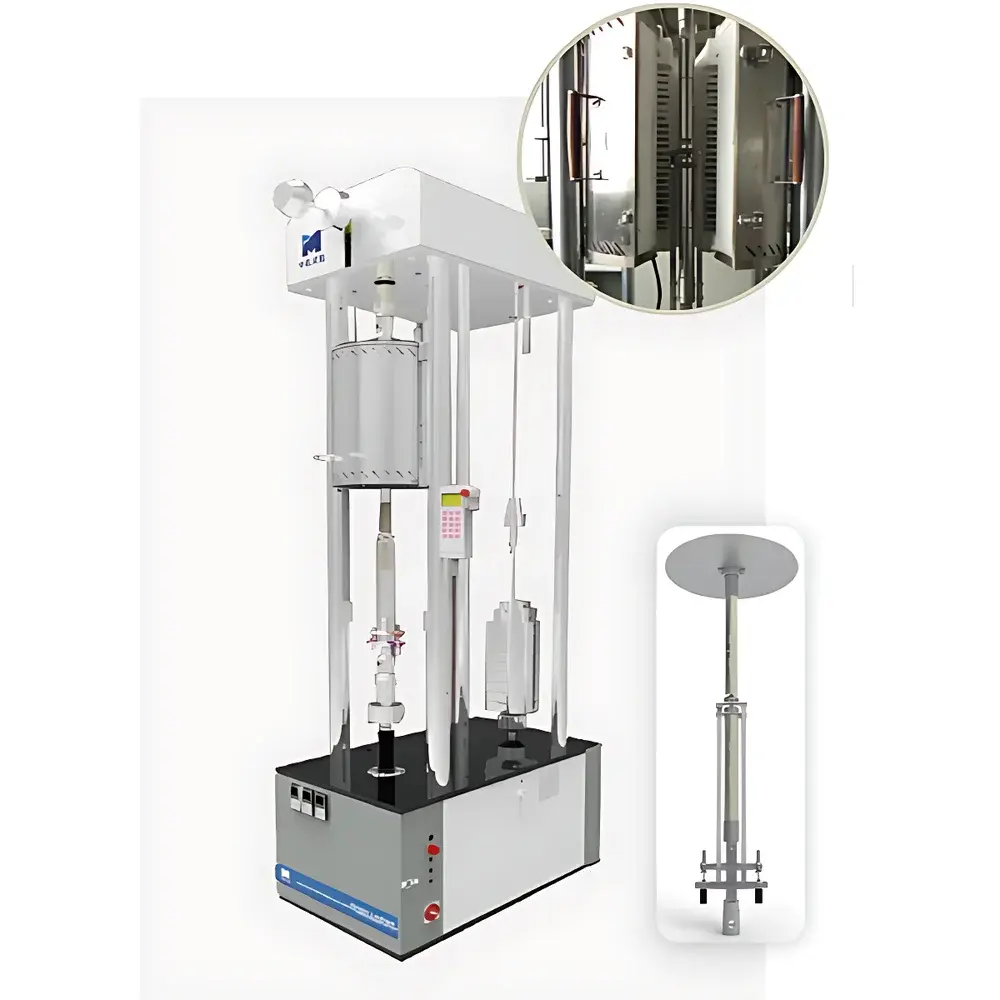
SINOTEST RDJ Series Mechanical High-Temperature Creep and Stress Rupture Testing Machine
| Brand | SINOTEST |
|---|---|
| Origin | Jilin, China |
| Manufacturer Type | Direct Manufacturer |
| Equipment Type | Mechanical Loading (Dead-Weight System) |
| Model | RDJ Series |
| Max Test Load | 600 kN |
| Maximum Crosshead Travel | >200 mm |
| Overall Dimensions (W×D) | 2300 × 950 mm |
| Machine Weight | 500–1200 kg |
| Compliance | GB/T 2039–2012, ASTM E139–11, ISO 204, EN 10002-5, JJG 276–2009, GB/T 10120–2013, ASTM E328–2013, ASTM E2714–2013, GB/T 15248–2008 |
Overview
The SINOTEST RDJ Series Mechanical High-Temperature Creep and Stress Rupture Testing Machine is a precision-engineered, long-term mechanical testing system designed for evaluating time-dependent deformation and failure behavior of metallic and non-metallic materials under sustained load at elevated temperatures. Based on classical lever-and-weight loading architecture, the RDJ series implements a dead-weight force application method—ensuring exceptional long-term stability, minimal drift, and intrinsic traceability without reliance on servo-hydraulic or electromechanical actuation. This principle makes it particularly suitable for creep tests lasting thousands of hours (up to 10,000+ h), stress rupture evaluations, and sustained-load relaxation studies where measurement fidelity over extended durations is critical. The system integrates furnace control directly into the structural frame, minimizing thermal gradient effects on load train components and enabling precise temperature uniformity across the gauge section per ISO 204 and ASTM E139 requirements.
Key Features
- Mechanical dead-weight loading system with calibrated masses—provides inherently stable, drift-free force application compliant with JJG 276–2009 calibration standards;
- Integrated high-temperature furnace (up to 1200 °C, configurable) mounted within the rigid mainframe—reduces axial thermal expansion mismatch and improves dimensional stability of the load train;
- Dual-channel optical leveling system using through-beam slot-type photoelectric sensors—ensures real-time, redundant monitoring of lever balance state;
- Auto-leveling mechanism with dual fiber-optic displacement sensors and fault-tolerant control logic—maintains ≤ ±0.02° angular deviation during multi-day tests;
- Ethernet-based distributed control architecture—enables synchronized acquisition of load, displacement, temperature, and extensometry data at ≥1 Hz sampling rate;
- LCD touchscreen hand controller with network interface—supports local operation, parameter configuration, and emergency stop independent of PC host;
- One-click power-failure recovery function—automatically restores test conditions (load setpoint, temperature ramp profile, data logging state) upon system reboot;
- Knife-edge/knife-edge bearing joints at all lever fulcrums—minimizes friction hysteresis and ensures high sensitivity in low-load regimes (e.g., sub-10 kN relaxation testing).
Sample Compatibility & Compliance
The RDJ series accommodates standard cylindrical and flat-sheet specimens per ASTM E139, GB/T 2039, and ISO 204 geometries—including threaded-end, shoulder-type, and reduced-gauge configurations. Optional extensometers (capacitive or clip-on LVDT types) support strain measurement down to ±0.1 µm resolution. Furnace zones are certified for temperature uniformity ±3 °C over 100 mm gauge length (per ASTM E220). All software-generated reports include full audit trails compliant with GLP and GMP documentation requirements. Data files are timestamped, digitally signed, and exportable in CSV, XML, and ASTM E1434-compliant formats. System validation documentation supports FDA 21 CFR Part 11 readiness when paired with SINOTEST’s optional electronic signature module.
Software & Data Management
SINOTEST CreepTest Suite v4.x provides full lifecycle management—from test method definition (pre-configured templates for creep, stress rupture, relaxation, and creep-fatigue cycling) to real-time visualization, automated pass/fail evaluation against acceptance criteria (e.g., minimum rupture time, creep rate thresholds), and statistical analysis of batch data. The software supports multi-user role-based access control (administrator, operator, reviewer), change history logging, and encrypted database storage. Raw data streams are buffered locally during network outages and auto-synced upon restoration. Export modules generate compliant test certificates referencing applicable clauses from GB, ASTM, ISO, and EN standards—including automatic citation of test method revision dates and uncertainty statements per ISO/IEC 17025 Annex A.3.
Applications
- High-temperature creep property characterization of turbine disk alloys (e.g., Inconel 718, GH4169), superalloy weldments, and Ni-based single-crystal blades;
- Stress rupture life prediction for pressure vessel steels (e.g., P91, P92) operating in ultra-supercritical power plants;
- Long-term relaxation behavior of bolted flange assemblies in petrochemical reactors (ASME BPVC Section VIII Div. 2 compliance verification);
- Creep-fatigue interaction studies under programmed thermal-mechanical cycling (ASTM E2714);
- Time-dependent modulus evolution in carbon-fiber-reinforced polymer composites at 150–250 °C;
- Validation of constitutive models (e.g., Norton-Bailey, Garofalo, Kachanov-Rabotnov) used in finite element life prediction tools.
FAQ
What is the maximum allowable test duration for RDJ-series systems?
Standard configurations support continuous operation up to 12,000 hours (≈1.4 years) with scheduled maintenance intervals every 3,000 hours. Extended-duration packages include enhanced furnace insulation, redundant thermocouple monitoring, and automated mass inspection routines.
Can the system perform creep-fatigue cycling?
Yes—when equipped with optional servo-controlled thermal cycling module and synchronized load modulation firmware, the RDJ platform executes ASTM E2714-compliant creep-fatigue sequences with programmable hold times, ramp rates, and dwell symmetry.
Is third-party calibration certification available?
SINOTEST provides NIST-traceable calibration certificates issued by CNAS-accredited laboratories (ISO/IEC 17025), including force verification per ISO 376 Class 0.5, temperature uniformity mapping, and displacement linearity assessment.
How is data integrity ensured during extended unattended tests?
Local SSD-based data buffering (≥128 GB), hardware watchdog timers, cyclic redundancy checksums on all transmitted frames, and dual-path Ethernet connectivity ensure zero data loss—even during 72-hour power interruptions followed by autonomous recovery.



