
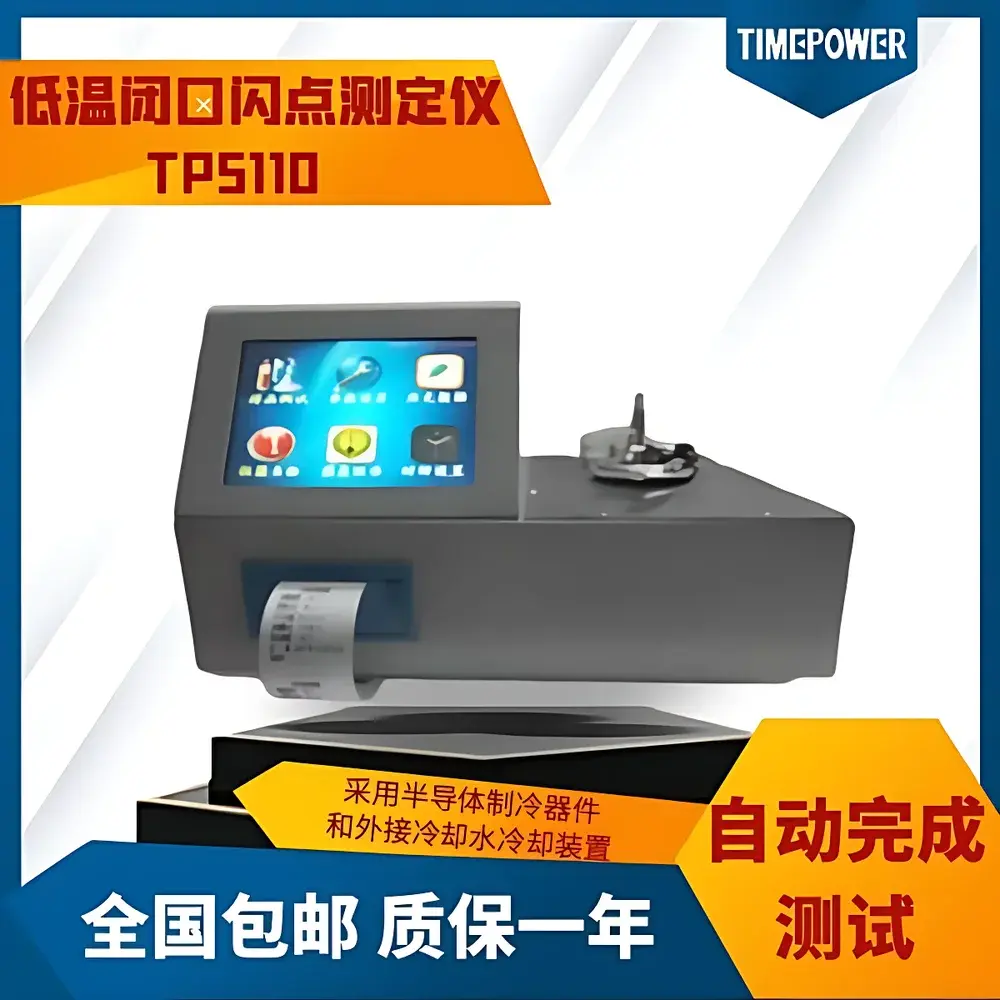
TimePower TP5110 Low-Temperature Closed-Cup Flash Point Tester
| Brand | TimePower |
|---|---|
| Origin | Beijing, China |
| Manufacturer Type | OEM Manufacturer |
| Country of Origin | China |
| Model | TP5110 |
| Detection Method | Closed-Cup (Pensky-Martens / Rapid Equilibrium) |
| Operation Mode | Fully Automatic |
| Applicable Standards | GB/T 261, GB/T 3536, ASTM D92, ASTM D93, GB/T 5208, ISO 1523, ISO 3679 |
| Repeatability | ≤4 °C |
| Ignition Methods | Auto-ignition, Manual Ignition, Electronic Spark, Gas Flame, Arc Ignition, Electric Spark, Gas Source Ignition, Pistol-Type Igniter |
| Temperature Range | –25 °C to 200 °C |
| Display | 8-inch industrial-grade true-color touchscreen (bilingual: English/Chinese) |
| Data Storage | 120 test records locally |
| Atmospheric Pressure Compensation | Automatic real-time correction with algorithmic flash point adjustment |
| Sensor | German PT1000 high-precision RTD temperature sensor + proprietary millisecond-response flash detection sensor |
| Cooling System | Integrated semiconductor cooler + optional external water chiller |
| Sample Volume | 2 mL (liquids), 4 mL (solids or semi-solids) |
| Control Core | Renesas microcontroller unit (MCU) |
Overview
The TimePower TP5110 Low-Temperature Closed-Cup Flash Point Tester is an engineered solution for precise, repeatable flash point determination of volatile petroleum products, solvents, lubricants, and industrial fluids in accordance with internationally recognized closed-cup test methodologies. Based on the rapid equilibrium closed-cup principle defined in GB/T 5208 and aligned with ISO 1523 and ISO 3679, the instrument operates by heating a sealed sample cup under controlled conditions while introducing an ignition source at predetermined temperature intervals. Flash point is identified as the lowest temperature at which vapors above the sample ignite momentarily upon exposure to the ignition source—without sustained combustion. Designed specifically for low-temperature applications down to –25 °C, the TP5110 enables accurate characterization of light distillates, biofuels, aviation turbine fuels, and cold-climate formulations where conventional flash testers may lack sensitivity or thermal stability.
Key Features
- Fully automated operation from sample loading to final report generation—including temperature ramping, vapor concentration equilibration, ignition sequence execution, and endpoint validation.
- High-fidelity thermal control architecture featuring a German PT1000 RTD sensor (±0.1 °C accuracy) and adaptive PID regulation to ensure stable, linear heating profiles across the full –25 °C to 200 °C range.
- Millisecond-response proprietary flash detection circuitry that captures transient ignition events with temporal resolution sufficient to meet ASTM D93 Annex A1 repeatability requirements.
- Dual-stage cooling system integrating solid-state thermoelectric modules and optional external water circulation, enabling rapid cooldown between tests and consistent baseline stabilization prior to measurement.
- Bilingual 8-inch industrial touchscreen interface supporting seamless switching between English and Chinese, with intuitive workflow navigation, parameter configuration, and real-time graphical display of temperature vs. time curves.
- Onboard atmospheric pressure compensation using integrated barometric sensing and NIST-traceable correction algorithms compliant with ASTM D93 Section 7.2.2 and ISO 3679 Annex B.
- Local non-volatile memory storing up to 120 complete test records with timestamps, operator IDs, ambient conditions, and raw thermal data—accessible via USB export for audit trail compliance.
Sample Compatibility & Compliance
The TP5110 accommodates liquid, semi-solid, and viscous samples—including crude fractions, diesel blends, jet fuels (Jet A-1, JP-8), transformer oils, hydraulic fluids, and solvent-based coatings—with minimal sample volume (2 mL for liquids; 4 mL for pastes or gels). Its design conforms to regulatory testing requirements under GB/T 261 (Pensky-Martens), GB/T 3536 (Cleveland Open Cup), ASTM D92 (COC), ASTM D93 (Tag Closed Cup and Pensky-Martens variants), and ISO 1523/ISO 3679. Instrument validation documentation supports GLP-compliant laboratory environments, and firmware architecture includes configurable user access levels and electronic signature support compatible with FDA 21 CFR Part 11 readiness when deployed with validated LIMS integration.
Software & Data Management
The embedded control software provides full traceability through timestamped test logs, automatic calibration verification prompts, and error-code diagnostics visible on-screen and exportable as CSV or PDF. Data export supports USB mass storage mode for direct transfer to laboratory information management systems (LIMS) or quality management platforms. Audit-ready features include operator login tracking, parameter change history, and immutable record archiving. Optional PC-based desktop software (TP-DataLink v3.x) extends functionality with statistical process control (SPC) charting, multi-instrument fleet monitoring, and automated report generation aligned with ISO/IEC 17025 clause 7.8.2 requirements.
Applications
- Quality assurance of refinery intermediates and finished fuels per API RP 2510 and EN 590 specifications.
- Regulatory compliance testing for transport classification (UN TDG Class 3, ADR/RID Chapter 2.2.51) and safety data sheet (SDS) authoring.
- R&D screening of alternative fuel formulations, including FAME biodiesel blends and synthetic paraffinic kerosene (SPK).
- Batch release testing in petrochemical manufacturing facilities operating under ISO 9001:2015 and IATF 16949 frameworks.
- Field-deployable verification in military logistics depots, railway maintenance yards, and offshore platform laboratories where environmental resilience and compact footprint are critical.
FAQ
What standards does the TP5110 validate against for low-temperature flash point measurement?
The instrument implements GB/T 5208 (Rapid Equilibrium Closed-Cup), ISO 1523, and ISO 3679, with hardware and firmware calibrated to reproduce reference material performance within ±2 °C per ASTM D613.
Can the TP5110 be used for open-cup flash point testing?
No—it is strictly configured for closed-cup methodologies. For Cleveland Open Cup (COC) testing per GB/T 3536 or ASTM D92, TimePower offers the TP5210 series as a dedicated platform.
Is external cooling water mandatory for operation?
Not mandatory: the built-in semiconductor cooler supports standard operation down to –25 °C. External chilled water is recommended only for high-throughput labs requiring sub-5-minute cooldown cycles between consecutive tests.
How is data integrity ensured during power interruption?
All active measurements are buffered in non-volatile RAM. Upon recovery, the system resumes from the last stable thermal checkpoint and retains all pre-interruption metadata for full chain-of-custody continuity.
Does the TP5110 support remote monitoring or network connectivity?
Yes—via optional Ethernet module (IEEE 802.3) enabling Modbus TCP communication, SNMP status polling, and secure HTTPS-based web interface access for real-time instrument health monitoring and firmware updates.




