
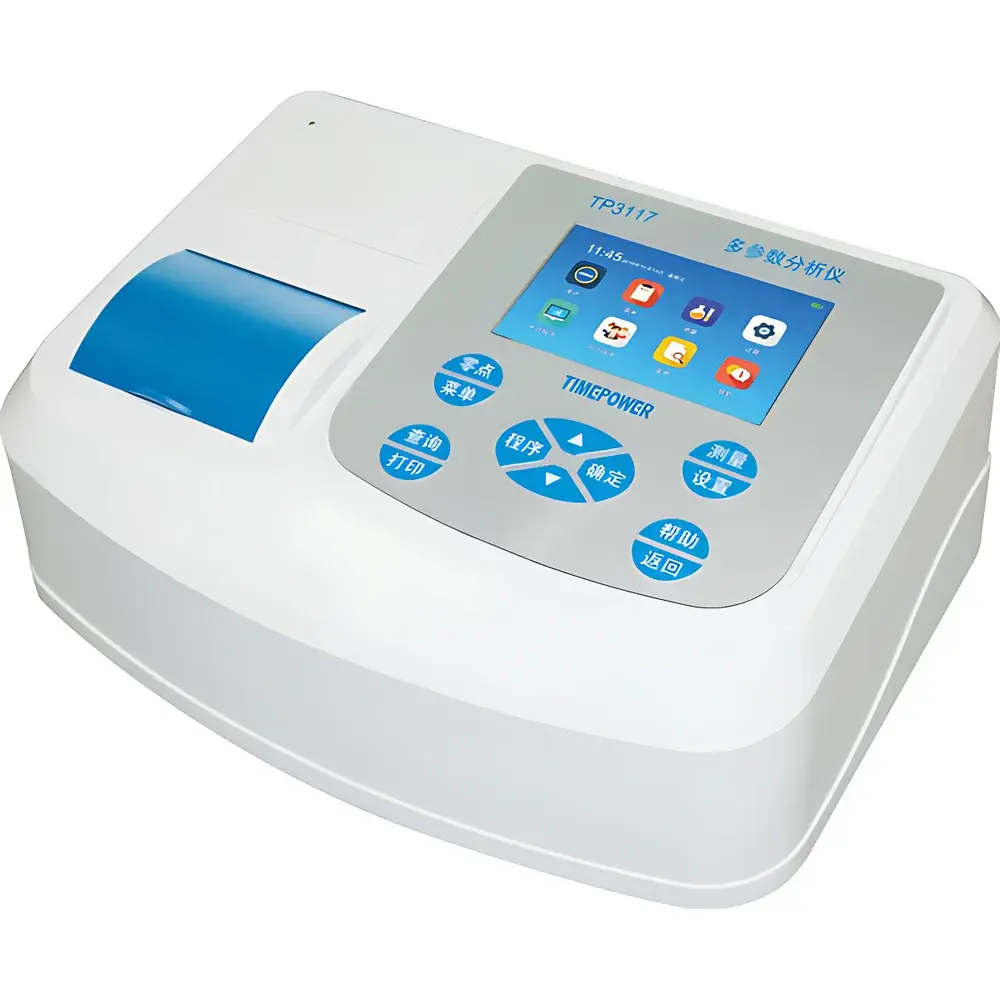
Timepower TP3117 Multi-Parameter Water Quality Analyzer
| Brand | Timepower |
|---|---|
| Origin | Beijing, China |
| Manufacturer Type | Manufacturer |
| Origin Category | Domestic |
| Model | TP3117 |
| Instrument Type | Benchtop Laboratory Water Quality Analyzer |
| Measurable Parameters | COD, Ammonia Nitrogen (NH₃-N), Total Phosphorus (TP), Total Nitrogen (TN), Turbidity, Suspended Solids (SS) |
| Measurement Principle | Photometric Colorimetry (Lambert–Beer Law) |
| Display | 5.0-inch color LCD (Chinese/English switchable) |
| Light Source | Imported cold-light LED (100,000 h lifetime) |
| Measurement Modes | Standard or Continuous |
| Data Storage | 30,000 records + 96 customizable calibration curves |
| Connectivity | USB 2.0, RJ45 Ethernet |
| Power Supply | AC 220 V ±10%, 50 Hz |
| Power Consumption | ≤5 W |
| Operating Environment | 5–40 °C, RH ≤85% (non-condensing) |
| Dimensions | 348 × 250 × 145 mm |
| Weight | 2.6 kg (main unit) |
| Digestion Conditions | COD @ 165 °C/15 min |
| Accuracy | ±5% FS |
| Repeatability | ≤5% RSD |
| Chloride Interference Tolerance (COD) | ≤2000 mg/L Cl⁻ |
| Turbidity Range | 0.5–1000 NTU |
| SS Range | 5–500 mg/L |
| COD Range | 5–10,000 mg/L |
| NH₃-N Range | 0.01–50 mg/L |
| TP Range | 0.02–20 mg/L |
| TN Range | 0.5–100 mg/L |
Overview
The Timepower TP3117 Multi-Parameter Water Quality Analyzer is a benchtop photometric instrument engineered for precise, standardized quantification of key water quality indicators in laboratory and field-deployable settings. It operates on the fundamental principle of photometric colorimetry, applying the Lambert–Beer law to correlate optical absorbance at defined wavelengths with analyte concentration in digested and reagent-reacted samples. Designed for compliance-driven environments—including municipal wastewater treatment plants, pharmaceutical manufacturing QC labs, environmental monitoring agencies, and academic research facilities—the TP3117 delivers trace-level sensitivity for ammonia nitrogen (down to 0.01 mg/L), robust dynamic range for COD (5–10,000 mg/L), and reproducible quantification of total phosphorus and total nitrogen under controlled thermal digestion protocols. Its integrated digestion–colorimetry cuvette architecture eliminates transfer errors and minimizes analyst exposure to hazardous reagents, aligning with OSHA-recommended safe handling practices for persulfate- and alkaline potassium persulfate-based oxidation systems.
Key Features
- Benchtop design with compact footprint (348 × 250 × 145 mm) and low power draw (≤5 W), suitable for shared lab benches and mobile testing units.
- 5.0-inch high-contrast color LCD interface supporting bilingual operation (English/Chinese), intuitive menu navigation, and real-time graphical display of calibration curves.
- Imported long-life cold-light LED source ensures wavelength stability and photometric repeatability across >100,000 measurement cycles without lamp replacement.
- Dual-mode operation: Standard mode (single-point measurement per sample) and continuous mode (sequential batch analysis), configurable via on-device settings.
- Digestion–colorimetry integrated cuvettes reduce procedural variability and eliminate post-digestion pipetting—critical for minimizing inter-sample contamination and chloride interference in COD assays.
- Built-in thermal printer supports immediate hardcopy output of current results, calibration logs, and full historical datasets (up to 30,000 entries).
- Onboard memory stores 96 user-definable calibration curves alongside factory-loaded standard curves compliant with ISO 6060 (COD), ISO 7150-1 (ammonia), ISO 6878 (total phosphorus), and ISO 11905-1 (total nitrogen).
- USB 2.0 and 10/100 Mbps Ethernet interfaces enable secure data export to LIMS, Excel-compatible CSV files, or networked QA/QC databases with audit-trail-ready timestamps.
Sample Compatibility & Compliance
The TP3117 accommodates aqueous samples from diverse matrices including municipal influent/effluent, industrial process streams (e.g., dyeing effluents, fermentation broths, pharmaceutical rinse waters), and surface/groundwater reference standards. Sample pretreatment follows internationally recognized digestion protocols: closed-vessel COD oxidation at 165 °C for 15 minutes (aligned with APHA 5220 D); alkaline persulfate digestion for total nitrogen and total phosphorus at 125 °C for 30 minutes (per ISO 11905-1 and ISO 6878). The system’s ±5% full-scale accuracy and ≤5% RSD meet performance criteria specified in EPA Method 410.4 (turbidity), ASTM D515-18 (phosphate), and USP (conductivity-coupled TOC estimation proxies). Its hardware architecture supports GLP-compliant workflows, including operator ID logging, electronic signature prompts, and CFR Part 11–ready data export formats when paired with validated PC software.
Software & Data Management
Data acquisition and reporting are managed through embedded firmware supporting ISO/IEC 17025-aligned metadata tagging: each stored record includes timestamp, operator ID (optional), cuvette ID, digestion temperature/duration, calibration curve ID, and raw absorbance values at primary and reference wavelengths. Exported datasets include MD5 checksums for integrity verification. USB mass-storage mode allows drag-and-drop retrieval of .csv files containing raw measurements, calibration history, and QC control charts. Ethernet connectivity enables integration into enterprise-grade LIMS platforms via HTTP POST or Modbus TCP—facilitating automated report generation, trend analysis, and regulatory submission packages compliant with EU Water Framework Directive (WFD) Annex V reporting templates.
Applications
- Regulatory compliance monitoring for discharge permits (e.g., NPDES, EU Urban Wastewater Treatment Directive).
- In-process control of biological nutrient removal (BNR) systems in activated sludge plants.
- Raw material and effluent screening in GMP-regulated pharmaceutical and biotech manufacturing.
- Method validation and reference material characterization in metrology laboratories accredited to ISO/IEC 17025.
- Undergraduate and graduate teaching laboratories conducting AP Chemistry or Environmental Engineering experiments on eutrophication indices and redox-based pollutant degradation kinetics.
- Emergency response teams performing rapid on-site triage of contaminated floodwaters or industrial spill plumes.
FAQ
Does the TP3117 support method validation per ISO/IEC 17025 requirements?
Yes—the instrument logs full measurement metadata, supports user-defined uncertainty budgets, and exports audit-ready datasets compatible with validation software such as QI Macros or Minitab.
Can custom digestion protocols be programmed into the device?
No—digestion parameters are fixed per parameter per ISO/APHA standards; however, external programmable digesters (e.g., Timepower TD-12A) may be synchronized via timer-triggered start signals.
Is the built-in printer capable of generating GLP-compliant reports?
It prints timestamped, operator-identified results with curve-fit statistics; for full GLP reports, export to validated PC software is recommended.
What is the shelf life of the included reagent kits under ambient storage?
COD and total nitrogen reagents retain stability for 18 months unopened at 2–8 °C; ammonia and phosphorus kits remain stable for 24 months when refrigerated and protected from light.
How does the system handle high-chloride wastewater samples during COD analysis?
The proprietary COD reagent formulation includes mercury-free chloride masking agents, enabling accurate measurement up to 2000 mg/L Cl⁻—validated per Standard Methods 5220 D (high-chloride correction protocol).







