
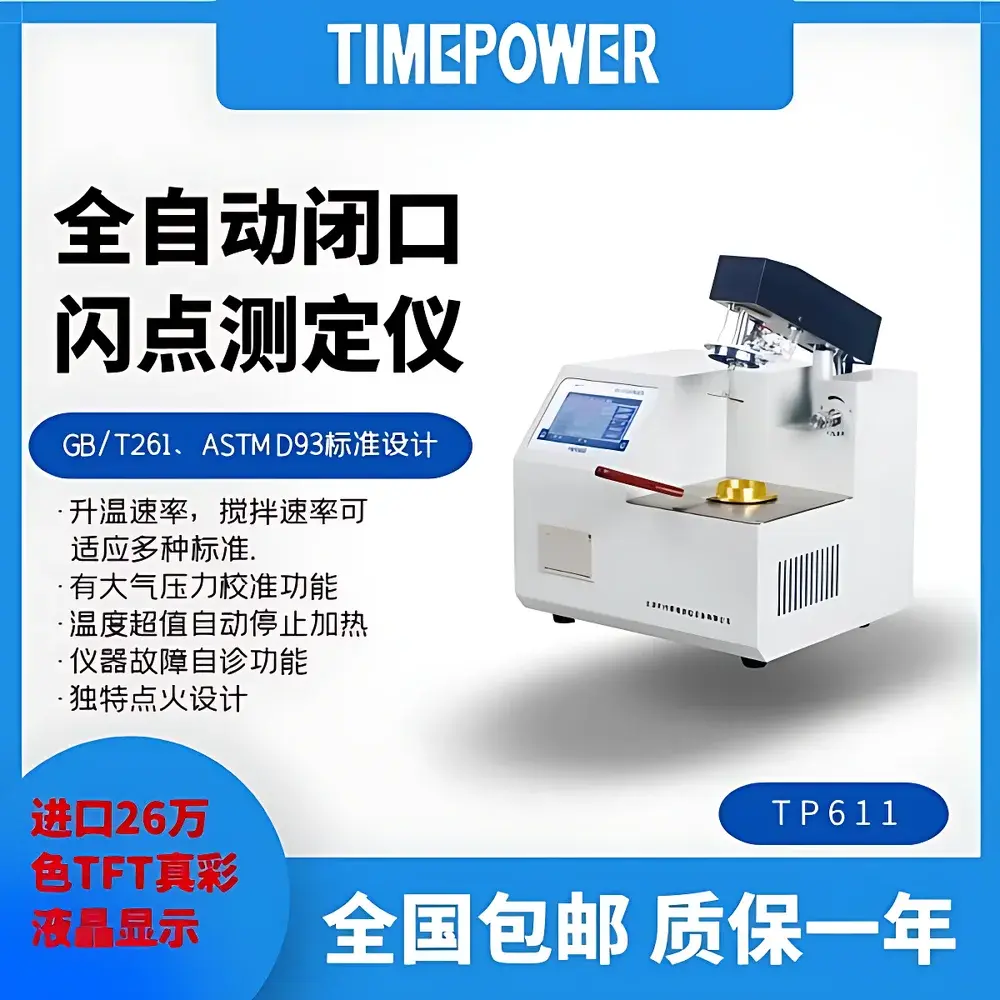
Timepower TP-611 Automated Closed-Cup Flash Point Tester
| Brand | Timepower |
|---|---|
| Origin | Beijing, China |
| Manufacturer Type | Manufacturer |
| Country of Origin | Domestic (China) |
| Model | TP-611 |
| Detection Method | Closed-Cup Method |
| Operation Mode | Fully Automatic |
| Applicable Standards | GB/T 261, GB/T 3536, ASTM D92, ASTM D93 |
| Repeatability | ≤4 °C |
| Ignition Methods | Fully automatic electronic arc, gas flame, electric spark, and pilot flame ignition (user-selectable) |
| Temperature Range | −25 °C to 400 °C |
| Measurement Range | 40 °C to 370 °C |
| Accuracy | ±1 °C for flash point <110 °C |
| Resolution | 0.1 °C |
| Ambient Operating Conditions | 5–40 °C, ≤85% RH |
| Power Supply | AC 220 V ±10%, 50 Hz ±10% |
| Power Consumption | <500 W |
| Display | 260K-color TFT LCD (480 × 272 pixels) |
| Cooling Method | Integrated forced-air cooling |
| Printer | Thermal printer, 36-character line, Chinese character support |
Overview
The Timepower TP-611 Automated Closed-Cup Flash Point Tester is a precision-engineered instrument designed for the reliable and repeatable determination of the closed-cup flash point of petroleum products, lubricants, solvents, and other flammable liquids. It operates on the principle of controlled heating under sealed conditions, followed by sequential introduction of an ignition source—either electronic arc or adjustable gas flame—while continuously monitoring vapor concentration and thermal dynamics. Compliant with internationally recognized test protocols including ASTM D93 (Pensky-Martens Closed Cup), ASTM D92 (Cleveland Open Cup), GB/T 261, and GB/T 3536, the TP-611 supports regulatory conformance in quality control laboratories, refinery QC departments, third-party testing facilities, and R&D centers engaged in hydrocarbon formulation and safety assessment.
Key Features
- Fully automated operation sequence: sample loading, lid sealing, temperature ramping, stirring, ignition triggering, flash detection, cooling, and result reporting—all executed without manual intervention.
- Dual ignition modality: user-selectable switching between high-reliability electronic arc ignition and calibrated gas-flame scanning, ensuring compatibility across diverse sample volatility profiles and laboratory gas infrastructure.
- Integrated environmental compensation: real-time atmospheric pressure correction applied to raw flash point values per ASTM D93 Annex A1 and ISO 2719:2016, improving inter-laboratory reproducibility.
- Precision temperature control architecture: PID-regulated heating system with dual-stage thermal sensors and adaptive ramp rate adjustment to meet standard-specified heating gradients (e.g., 5–6 °C/min for ASTM D93).
- Self-diagnostic firmware: continuous hardware status monitoring—including cup seal integrity, stirrer rotation verification, ignition circuit continuity, and thermal sensor drift detection—with on-screen fault codes and actionable guidance.
- High-contrast 260K-color TFT display (480 × 272 resolution): intuitive graphical interface supporting multilingual menu navigation (English/Chinese), real-time thermogram visualization, and step-by-step procedural prompts.
Sample Compatibility & Compliance
The TP-611 accommodates samples ranging from low-volatility base oils to mid-range distillates and high-boiling residuals, provided they remain fluid at ambient conditions and do not decompose below 40 °C. Its sealed test chamber design minimizes vapor loss and eliminates operator exposure during testing. All operational logic and calibration traceability align with GLP documentation requirements. Data integrity safeguards—including audit-trail-enabled result logging, time-stamped event records, and non-erasable measurement history—support compliance with FDA 21 CFR Part 11 when paired with validated software configurations. The instrument satisfies essential safety and metrological criteria defined in ISO/IEC 17025:2017 for accredited testing laboratories.
Software & Data Management
While the TP-611 operates as a standalone unit with embedded firmware, optional PC connectivity via RS-232 or USB enables bidirectional data exchange with Timepower’s proprietary LabLink™ desktop application. This software facilitates batch report generation (PDF/CSV), trend analysis across multiple test runs, calibration certificate management, and electronic signature integration for QA sign-off workflows. All stored results include metadata: operator ID, sample ID, ambient pressure, ambient temperature, standard selected, ignition mode, final flash point, repeatability delta, and pass/fail status against specification limits. Exported datasets retain full traceability for internal audits or external regulatory review.
Applications
- Refinery QC: routine flash point verification of naphthas, kerosenes, diesel fuels, and residual fuel oils per ASTM D93 and GB/T 261.
- Lubricant manufacturing: stability assessment of hydraulic fluids, turbine oils, and gear oils during formulation and aging studies.
- Chemical distribution: incoming inspection of industrial solvents (e.g., xylene, acetone, MEK) to verify transport and storage classification per UN TDG and GHS criteria.
- Academic research: kinetic modeling of vapor-phase ignition thresholds under variable pressure and heating rate conditions.
- Regulatory submission: generation of compliant flash point data for SDS authoring, customs declarations, and hazardous materials transportation permits.
FAQ
What standards does the TP-611 fully support for closed-cup flash point testing?
ASTM D93 (Pensky-Martens), GB/T 261, and ISO 2719:2016. It also provides configurable modes for open-cup testing per ASTM D92 and GB/T 3536.
Is atmospheric pressure correction applied automatically during testing?
Yes—the instrument integrates a built-in barometric sensor and applies real-time correction per ASTM D93 Annex A1, eliminating manual post-processing.
Can the TP-611 be integrated into a LIMS environment?
Via optional serial or USB communication and LabLink™ software, raw data and metadata can be exported in CSV or XML format for LIMS ingestion.
What maintenance routines are recommended for long-term accuracy?
Monthly cleaning of the test cup, ignition electrode, and vapor sensor; annual verification of temperature sensor calibration using NIST-traceable reference standards.
Does the TP-611 meet requirements for ISO/IEC 17025 accreditation?
Yes—when operated within specified environmental conditions and maintained per Timepower’s documented procedures, it fulfills the technical competence and traceability requirements outlined in Clause 6.4 and Annex A of ISO/IEC 17025:2017.




