
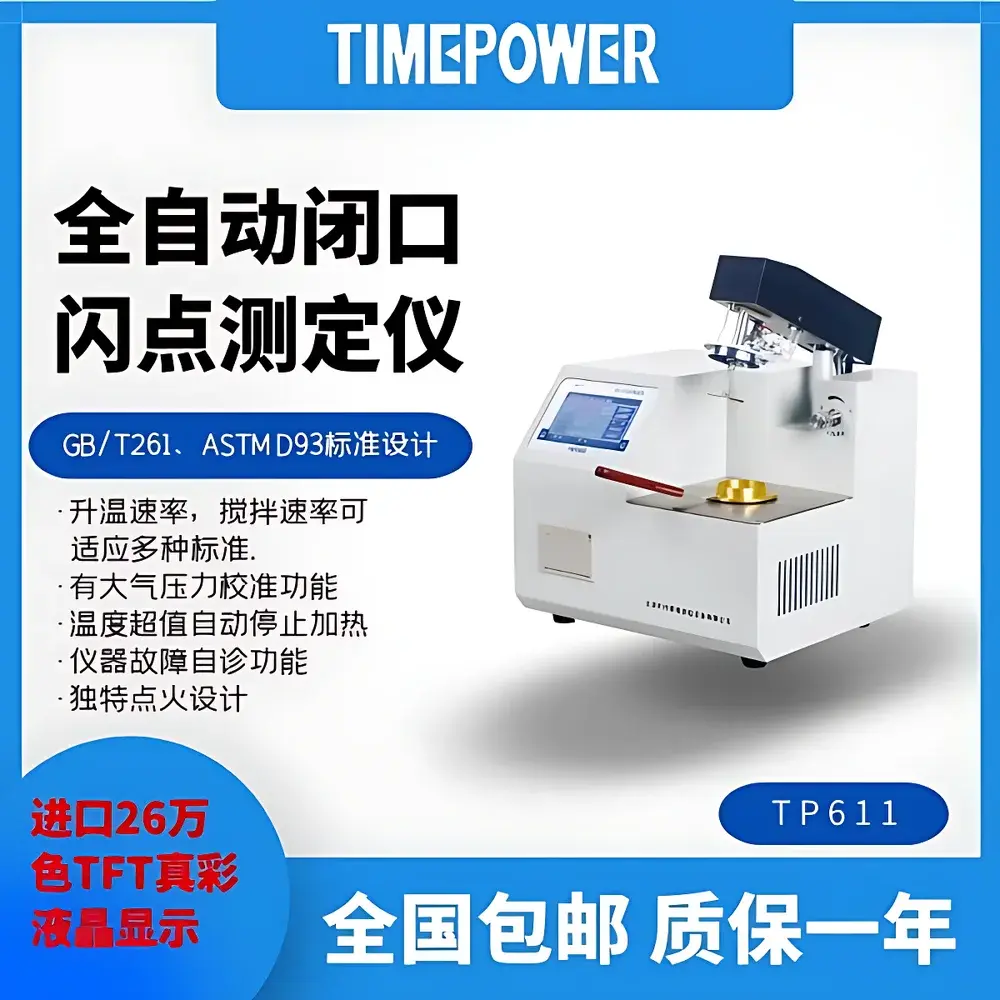
Timepower TP611 Automatic Closed-Cup Flash Point Tester
| Brand | Timepower |
|---|---|
| Origin | Beijing, China |
| Manufacturer Type | Direct Manufacturer |
| Country of Origin | China |
| Model | TP611 |
| Detection Method | Closed-Cup (Pensky-Martens / Tag Closed Cup) |
| Operation Mode | Fully Automatic |
| Applicable Standards | GB/T 261, GB/T 3536, ASTM D92, ASTM D93 |
| Repeatability | ≤4 °C |
| Ignition Methods | Fully automatic electronic arc ignition, manual gas flame ignition, electric spark ignition, pilot gas flame ignition, and user-selectable scanning modes |
| Temperature Range | Ambient to 400 °C (standard configuration) |
Overview
The Timepower TP611 Automatic Closed-Cup Flash Point Tester is a precision-engineered analytical instrument designed for the accurate and reproducible determination of flash point temperatures in petroleum products, lubricants, solvents, and other flammable liquids. It operates on the fundamental principle of closed-cup equilibrium flash point measurement—specifically aligned with the Pensky-Martens (ASTM D93, GB/T 261) and Tag Closed Cup (ASTM D92) test methodologies. In this technique, a sample is heated under controlled conditions inside a sealed test cup; vapors accumulate above the liquid surface until reaching the lower flammability limit. A precisely timed ignition source is introduced at defined temperature intervals, and the lowest temperature at which sustained vapor ignition occurs is recorded as the flash point. The TP611 integrates thermodynamic control, vapor-phase kinetics modeling, and real-time atmospheric pressure compensation to ensure metrological traceability and compliance with international regulatory frameworks governing flammability safety assessment.
Key Features
- Fully automated sequence execution—including sample cup lifting, precise PID-controlled heating ramp, continuous magnetic stirring (adjustable speed per standard requirements), programmable ignition timing, vapor detection via optical flame sensor, thermal shutdown upon threshold exceedance, and integrated cooling cycle.
- Dual-mode ignition system supporting both electronic arc and adjustable gas flame scanning, configurable via on-device TFT interface to match method-specific requirements (e.g., ASTM D93 mandates electric arc; ASTM D92 permits pilot flame).
- 260,000-color 7-inch TFT true-color LCD touchscreen with intuitive icon-driven navigation, multilingual UI support (English default), and real-time graphical display of temperature profile, ignition events, and system status.
- Atmospheric pressure correction algorithm compliant with ASTM E180 and ISO 4619, dynamically adjusting flash point results based on local barometric readings to maintain inter-laboratory comparability.
- Self-diagnostic firmware architecture that monitors heater integrity, stirrer motor function, ignition circuit continuity, sensor calibration drift, and cup positioning accuracy—logging fault codes for GLP-compliant troubleshooting.
- Robust mechanical design featuring corrosion-resistant stainless-steel cup assembly, ceramic-insulated heating element, and sealed optical detection chamber to minimize contamination and extend service life under routine QC lab conditions.
Sample Compatibility & Compliance
The TP611 accommodates standard 70–100 mL sample volumes in accordance with ASTM D93 and GB/T 261 geometry specifications. It supports viscous liquids (up to 10,000 cSt at 40 °C) when used with optional preheating or viscosity-adjusted stirring protocols. Instrument validation follows IQ/OQ protocols traceable to NIST-certified reference materials (e.g., n-decane, xylene blends). Regulatory alignment includes full technical conformance with GB/T 261–2021, GB/T 3536–2022, ASTM D92–22, ASTM D93–23, and ISO 2719:2016. Data integrity safeguards meet FDA 21 CFR Part 11 requirements for electronic records and signatures when paired with validated LIMS integration.
Software & Data Management
Embedded firmware enables standalone operation without PC dependency. All test parameters, raw temperature/time data, ignition event timestamps, and final flash point values are stored internally with timestamped audit trails (user ID, method ID, environmental metadata). USB export supports CSV and PDF report generation with embedded digital signatures. Optional Ethernet/Wi-Fi connectivity allows secure remote monitoring, centralized method deployment, and seamless integration into enterprise QA/QC workflows governed by ISO/IEC 17025 or GMP Annex 11 environments.
Applications
- Refinery quality control: verification of distillate fractions (naphtha, kerosene, diesel) against specification limits.
- Lubricant formulation labs: screening base oil volatility and additive thermal stability.
- Chemical manufacturing: classification of solvent blends for transportation (UN TDG Class 3) and storage hazard labeling (GHS Category 2/3).
- Regulatory submission testing: generating GLP-compliant reports for EPA, REACH, and CNCA certification dossiers.
- Research & development: kinetic studies of vapor-phase ignition thresholds under variable pressure and heating rate conditions.
FAQ
Does the TP611 comply with ASTM D93 Method A and Method B?
Yes—the instrument supports both electric arc ignition (Method A) and pressurized gas flame ignition (Method B) through configurable hardware settings and firmware logic.
Can it be calibrated using certified reference standards?
Absolutely. Calibration is performed using NIST-traceable flash point standards (e.g., SRM 2723a, SRM 2724), with built-in calibration verification routines and certificate-of-conformance reporting.
Is atmospheric pressure compensation mandatory for valid results?
Per ASTM D93 Section 7.2.3 and GB/T 261 Clause 8.2, pressure correction is required for all reported flash point values; the TP611 applies this automatically using its integrated barometric sensor.
What maintenance intervals are recommended for long-term reliability?
Quarterly inspection of ignition electrodes, annual verification of temperature sensor linearity (±0.5 °C), and biannual cleaning of vapor path optics and cup sealing surfaces—documented in the included GLP maintenance log template.
How does the “unique flame-scan design” improve measurement robustness?
The dual-path scanning mechanism ensures consistent spatial coverage across the vapor headspace, minimizing false negatives from localized quenching or incomplete mixing—particularly critical for high-viscosity or low-volatility samples.





