
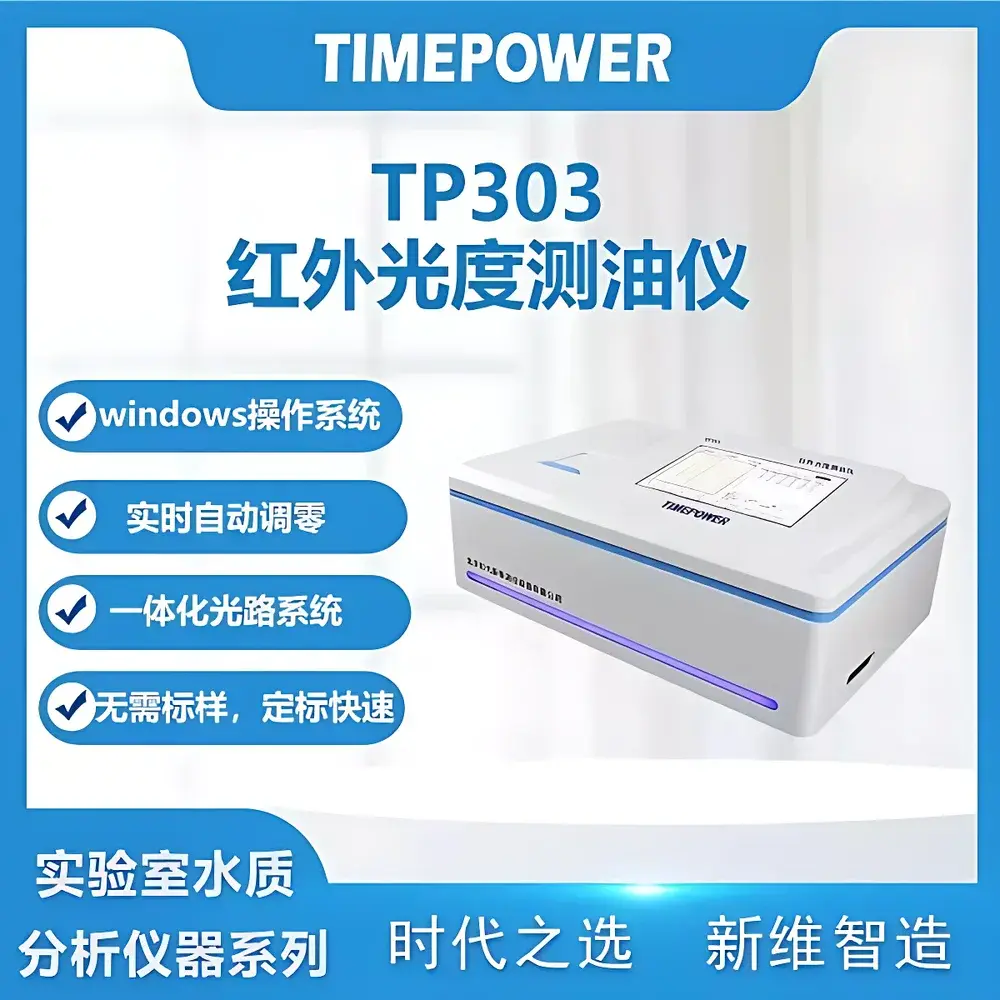
Timepower TP3301 Fully Automated Infrared Oil-in-Water Analyzer
| Brand | Timepower |
|---|---|
| Model | TP3301 |
| Origin | Hebei, China |
| Manufacturer Type | Direct Manufacturer |
| Compliance | HJ 637–2018 |
| Measurement Principle | Infrared Spectrophotometry (Triple-Wavenumber Absorption at 2930 cm⁻¹, 2960 cm⁻¹, and 3030 cm⁻¹) |
| Sample Preparation | Tetrachloroethylene Extraction + Magnesium Silicate Adsorption |
| Output | Total Extractable Hydrocarbons, Petroleum Hydrocarbons, and Animal/Vegetable Oils (by difference) |
| Operational Mode | Standalone with Onboard Data Processing |
| Calibration | Reference Coefficient-Based (No Calibration Curve Required) |
| Wavenumber Accuracy | < 1 cm⁻¹ (Secant-Mode Scanning) |
| Optical System | Integrated Beam Path with Pulsed IR Source, Active Narrowband Filtering, and Digital Lock-in Amplification |
| Zero Adjustment | Real-time Auto-zero During Source Off-Cycle |
| Display & Interface | Chinese GUI, Touchscreen or Keypad Navigation |
| Data Handling | Onboard Storage, Statistical Analysis, Spectrum Visualization, Thermal Printing |
Overview
The Timepower TP3301 Fully Automated Infrared Oil-in-Water Analyzer is an EPA-aligned, regulatory-grade instrument engineered for precise quantification of hydrocarbon contaminants in aqueous and semi-solid matrices using standardized infrared spectrophotometry. It implements the measurement protocol defined in China’s national standard HJ 637–2018 — “Determination of Petroleum and Animal/Vegetable Oils in Water by Infrared Spectrophotometry” — and is equally applicable to油烟 (cooking fume) analysis per GB 18483. The system operates on the fundamental principle of differential absorption spectroscopy: oil-bearing extracts are prepared via tetrachloroethylene (C₂Cl₄) liquid–liquid extraction, followed by selective adsorption of polar compounds (e.g., triglycerides, fatty acids) on magnesium silicate. The resulting spectra are evaluated at three critical wavenumbers — 2930 cm⁻¹ (CH₂ asymmetric stretch), 2960 cm⁻¹ (CH₃ asymmetric stretch), and 3030 cm⁻¹ (aromatic C–H stretch) — enabling independent calculation of total extractable material (TEM), petroleum hydrocarbons (PHC), and animal/vegetable oils (AVO) as the residual difference. This triple-band algorithm eliminates reliance on multi-point calibration curves, reducing operator dependency and inter-laboratory variability.
Key Features
- Regulatory-compliant optical architecture optimized for HJ 637–2018 compliance, including integrated sample/reference cell auto-switching mechanism for repeatable zero referencing and minimized path-length drift.
- Secant-mode wavenumber scanning ensures spectral registration accuracy better than ±1 cm⁻¹ — critical for reproducible band-intensity quantitation across instruments and time.
- Pulsed infrared source design minimizes thermal load on optical components, enhancing long-term photometric stability and extending lamp service life beyond 5,000 hours.
- Dual-stage signal conditioning:前置 active narrowband filtering suppresses out-of-band radiation, while digital lock-in amplification recovers weak absorbance signals from high-noise backgrounds — achieving signal-to-noise ratios > 10⁴:1 at 2930 cm⁻¹.
- Real-time auto-zero functionality triggered during source off-cycles eliminates baseline drift without manual intervention, supporting unattended operation over extended batch runs.
- Standalone operation mode with embedded ARM-based controller; no external PC required for routine analysis, data reduction, or report generation.
Sample Compatibility & Compliance
The TP3301 accommodates liquid samples (wastewater, leachate, cooling water), homogenized sludge/sediment suspensions, and cooking fume condensates following standardized pretreatment protocols. All measurements conform to the method-defined extraction efficiency, solvent purity, and matrix interference controls outlined in HJ 637–2018. While not certified to ISO/IEC 17025 under third-party accreditation, the instrument’s documented traceability chain (including factory-certified reference coefficients, wavelength verification standards, and repeatability validation reports) supports GLP-compliant data generation. It meets functional equivalency requirements for US EPA Method 1664A (when adapted with C₂Cl₄ extraction) and aligns with ISO 9377-2:2000 principles for hydrocarbon speciation in environmental waters.
Software & Data Management
The onboard firmware provides full-cycle data lifecycle management: spectrum acquisition, peak integration, coefficient-based concentration calculation (mg/L), statistical summary (mean, SD, RSD%), and graphical overlay of raw/processed spectra. Up to 1,000 test records — including metadata (date/time, operator ID, sample ID, extraction batch number) — are retained in non-volatile memory. Export options include USB-stick transfer of CSV-formatted results and direct thermal printing of audit-ready reports with embedded spectral plots. The system logs all critical events (lamp ignition cycles, zero-check timestamps, error flags) for internal QA review. Though not Part 11 compliant out-of-the-box, its immutable audit trail structure facilitates integration into validated LIMS environments when deployed behind controlled access and electronic signature workflows.
Applications
- Environmental monitoring stations performing routine discharge compliance testing for petroleum refineries, petrochemical plants, and metal finishing facilities.
- Municipal wastewater treatment plants assessing influent oil loading and effluent compliance prior to release.
- Food service emission monitoring per GB 18483, including kitchen hood capture efficiency evaluation and stack concentration reporting.
- Railway and thermal power generation sites conducting coolant and lubricant leakage surveillance in closed-loop systems.
- Metallurgical and mining operations quantifying emulsified oil content in process rinse waters and tailings pond supernatants.
- Soil and sediment laboratories executing TCLP-extractable oil screening using modified HJ 637–2018 solid-phase protocols.
FAQ
Does the TP3301 require daily calibration with standard oil solutions?
No. Per HJ 637–2018, it uses pre-determined instrument-specific absorption coefficients (k2930, k2960, k3030) rather than empirical calibration curves. A single reference coefficient set — verified during factory commissioning — remains valid unless optical alignment or detector response is altered.
Can the instrument analyze solid or semi-solid samples directly?
Not natively. Samples must first undergo standardized solvent extraction (HJ 637–2018 Section 7.1–7.3) to yield a C₂Cl₄-soluble phase compatible with the flow cell geometry and path length.
What maintenance intervals are recommended for sustained accuracy?
Lamp replacement every 5,000 operating hours; magnesium silicate cartridge replacement after 50 extractions; optical window cleaning with spectroscopic-grade methanol every 200 analyses or when visible residue accumulates.
Is spectral raw data export supported?
Yes. Full-resolution transmittance/absorbance spectra (wavenumber vs. intensity) can be exported in ASCII format via USB interface for secondary processing in MATLAB, Origin, or ASTM E1421-compliant chemometric software.
How does the auto-zero function mitigate thermal drift?
By acquiring dark-current references synchronously with each lamp pulse cycle — i.e., during the microsecond-scale off-period — the system decouples electronic offset drift from photodetector temperature rise, ensuring baseline fidelity independent of ambient fluctuations.




