
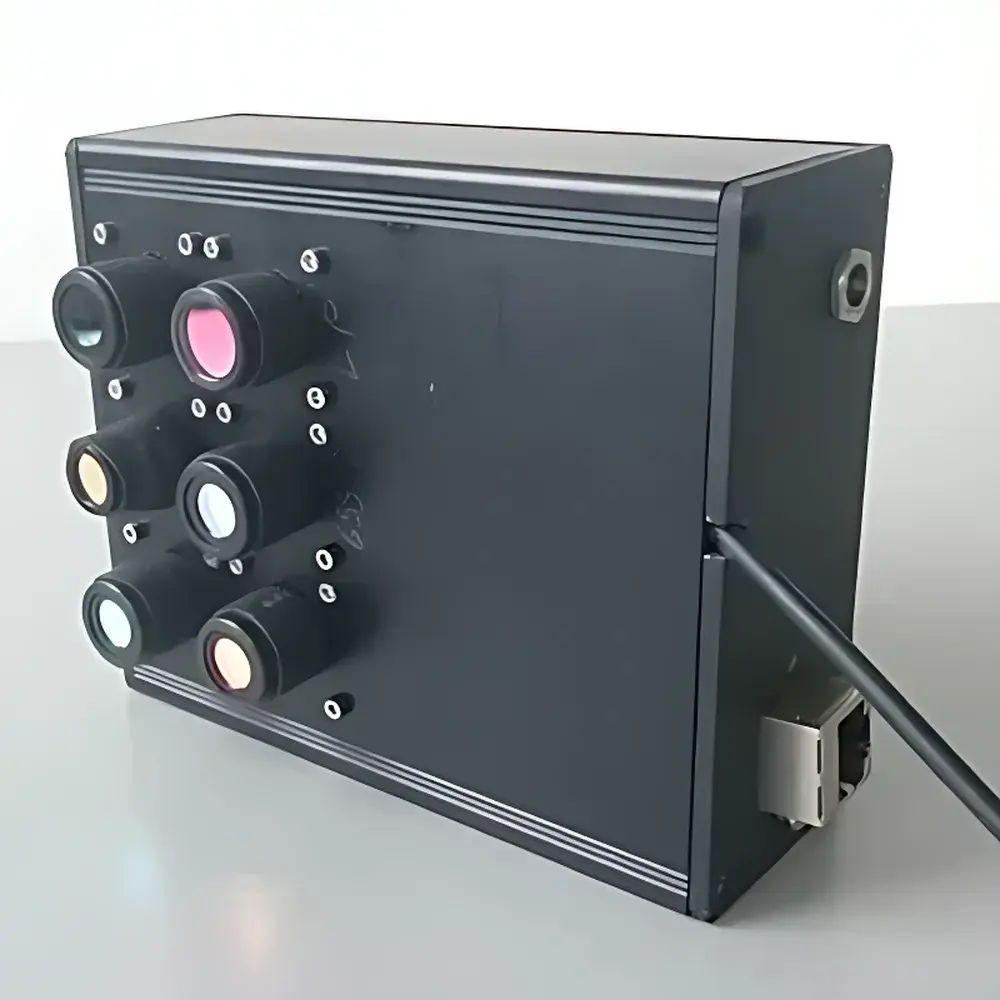
Cubert S119 Snapshot Hyperspectral Imaging Camera
| Brand | Cubert |
|---|---|
| Origin | Germany |
| Model | S119 |
| Spectral Range | 380–1100 nm |
| Spectral Resolution | 20 nm |
| Spatial Resolution | 6 × 1.25 MP (per spectral cube) |
| Frame Rate | 4 cubes/s |
| Detector | Si-based CCD |
| Shutter Type | Global Shutter |
| Interface | USB 3.0, GigE, Hardware Trigger |
| Onboard CPU | ARM7 |
| Weight | 600 g |
| Power Supply | DC 5 V, 15 W |
| Data Output Format | 1296 × 966 per spectral band |
| Storage | Internal SSD + microSD slot |
| Lens Mount | F-Mount |
| Imaging Modality | Snapshot (single-exposure spatial-spectral mapping) |
| Platform Compatibility | Ground-based & UAV-mounted |
| Spectral Sampling Interval | 10 nm |
| Total Spectral Bands | 6 |
| Spectral Data Volume per Capture | ~1.25 million spectra |
Overview
The Cubert S119 is a snapshot-based hyperspectral imaging camera engineered for high-fidelity spectral-spatial data acquisition in resource-constrained environments. Unlike push-broom or scanning systems requiring motion synchronization, the S119 captures full 3D hypercubes (x, y, λ) in a single exposure using a patented prism-based image slicer and mosaic filter array integrated directly onto a high-quantum-efficiency silicon CCD sensor. This architecture eliminates motion artifacts and enables robust operation on moving platforms—including unmanned aerial vehicles (UAVs), handheld rigs, and laboratory translation stages—without reliance on precise external triggering or stabilization hardware. Its 380–1100 nm spectral coverage spans the visible to near-infrared (VNIR) region, supporting detection of key absorption features associated with chlorophyll-a/b, carotenoids, water content, cellulose, and nitrogenous compounds. Designed for field-deployable quantitative analysis, the S119 delivers calibrated radiometric output traceable to NIST-traceable reference sources and supports integration into ISO/IEC 17025-compliant calibration workflows.
Key Features
- Snapshot acquisition architecture: Captures complete hyperspectral cubes (6 spectral bands × 1296 × 966 pixels) at up to 4 cubes per second—no scanning, no slit, no moving parts.
- VNIR-optimized optical design: Broad 380–1100 nm spectral response with 20 nm effective resolution and 10 nm sampling interval across six discrete, factory-aligned spectral channels.
- Global shutter CMOS/CCD hybrid imaging: Ensures temporal synchronization across all spatial and spectral dimensions; critical for dynamic scene capture and vibration-prone mounting.
- Embedded ARM7 processing unit: Enables real-time metadata tagging, onboard dark/current frame correction, and lossless compression (LZ4) prior to storage.
- Modular interface suite: Dual high-throughput interfaces—USB 3.0 for lab integration and Gigabit Ethernet for remote telemetry—plus TTL-compatible hardware trigger input for synchronized multi-sensor deployments.
- F-mount mechanical compatibility: Supports industry-standard Cine and photography lenses (with appropriate focus calibration); optional telecentric and macro adapters available for microscopy-grade IFOV control.
Sample Compatibility & Compliance
The S119 is platform-agnostic and validated for use in both ground-based stationary setups (e.g., conveyor-belt inspection, plant phenotyping goniometers) and airborne configurations (UAV payloads ≤ 1.2 kg including gimbal and power). Its low mass (600 g), passive thermal design, and 5 V DC input simplify integration into battery-operated systems compliant with DO-160 Section 21 environmental stress profiles. Data output adheres to ENVI-compatible BIL/BIP formats with embedded radiometric calibration coefficients and geometric metadata (GPS time stamp, IMU quaternion if externally fused). The system meets CE marking requirements for electromagnetic compatibility (2014/30/EU) and low-voltage directive (2014/35/EU); firmware implements audit-ready logging per GLP principles, with timestamped configuration changes and sensor health diagnostics stored alongside raw data.
Software & Data Management
Cubert’s proprietary UHD-Analyzer software (Windows/Linux/macOS) provides non-destructive preprocessing—including flat-field correction, spectral band registration, and reflectance conversion using panel-based or irradiance-calibrated references. Export modules support HDF5, GeoTIFF (with GDAL-compliant georeferencing), and MATLAB .mat structures for downstream modeling in Python (scikit-learn, PyTorch) or R (hyperSpec). All firmware updates and configuration files are digitally signed; the embedded bootloader enforces cryptographic verification before installation. For regulated environments, optional FDA 21 CFR Part 11-compliant audit trail extension logs user actions, parameter modifications, and data export events with immutable timestamps and operator identifiers.
Applications
- Agricultural remote sensing: Crop health assessment via NDVI, PRI, and red-edge slope indices; early stress detection (water deficit, nutrient deficiency, pathogen presence).
- Food quality inspection: Detection of surface contaminants, bruising, mold, and compositional heterogeneity in fruits, grains, and processed meats.
- Recycling & material sorting: Discrimination of polymer types (PET, HDPE, PP), painted metals, and composite laminates based on spectral fingerprinting.
- Forensic document analysis: Differentiation of ink formulations, erased annotations, and substrate aging without destructive sampling.
- Biomedical research: Label-free tissue characterization in ex vivo histopathology and dermatological imaging studies under controlled illumination.
FAQ
What does “Snapshot” mean in the context of the S119?
It denotes single-exposure acquisition of all spatial and spectral information simultaneously—no scanning motion or temporal multiplexing is required.
Can the S119 be used with third-party lenses?
Yes, via its standard F-mount interface; however, optimal spectral fidelity requires lenses with 30% at Nyquist frequency.
Is radiometric calibration included out-of-the-box?
Each unit ships with factory-measured relative spectral response (RSR) and dark current profiles; absolute calibration requires user-provided NIST-traceable reflectance standards.
How is spatial resolution defined for this sensor?
The native detector resolution is 1296 × 966 pixels per spectral band; effective ground sampling distance (GSD) depends on lens focal length, working distance, and platform altitude.
Does the S119 support real-time streaming over GigE?
Yes—raw cube streams (uncompressed or LZ4-compressed) can be transmitted at full frame rate (4 cubes/s) with sub-10 ms latency when paired with a PCIe-based GigE Vision host adapter.




