
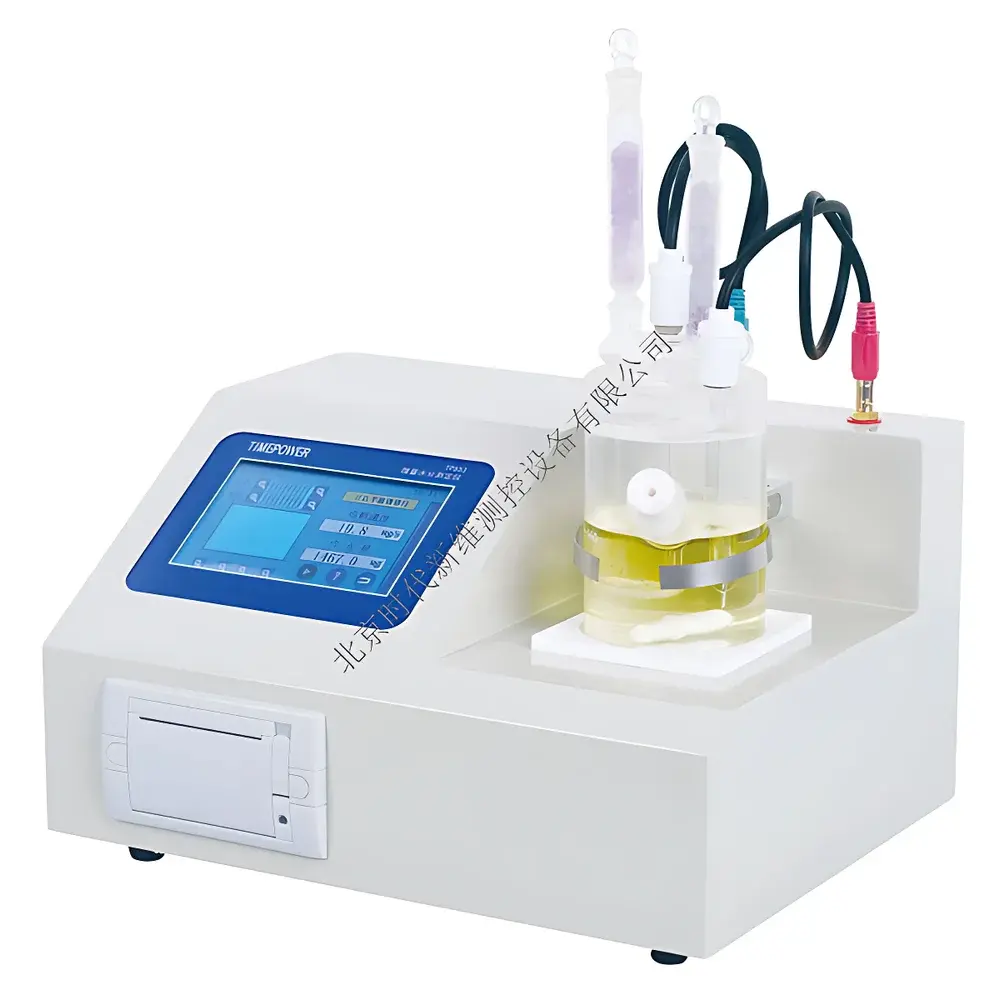
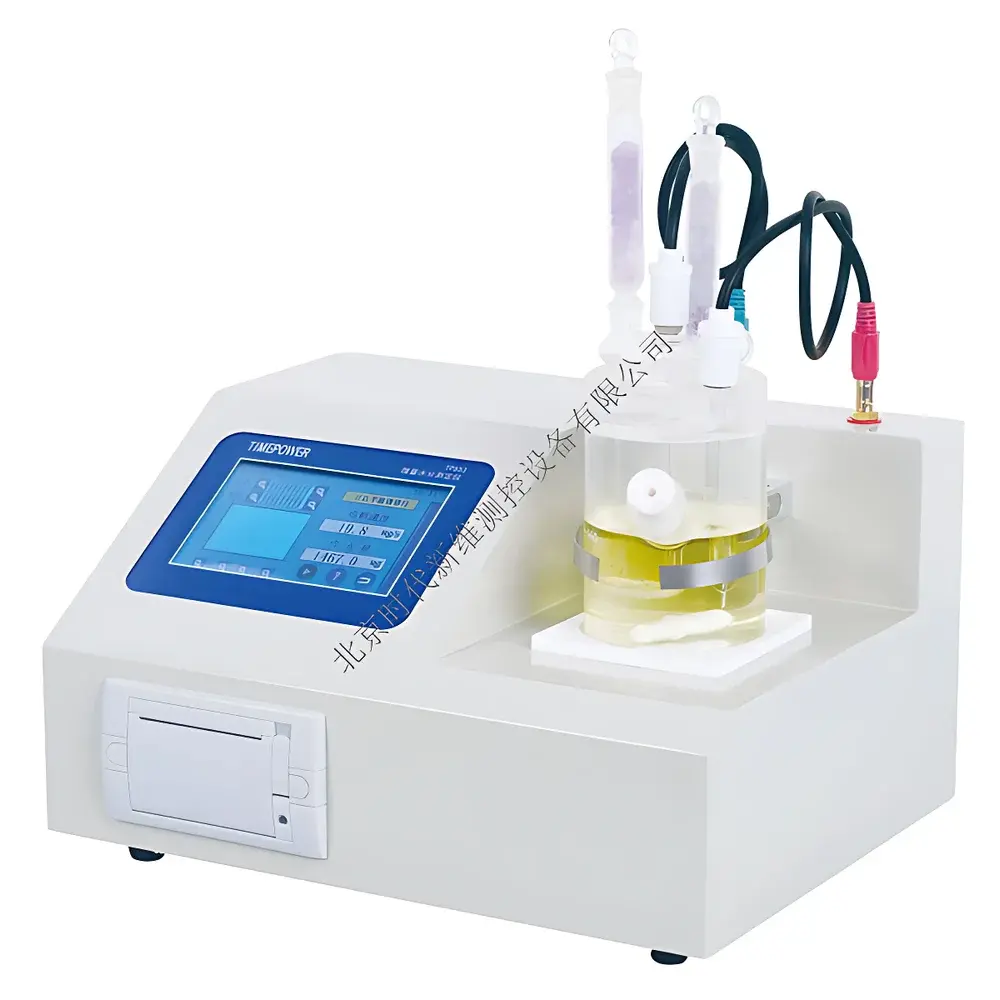
Timepower TP653 Automatic Coulometric Karl Fischer Moisture Analyzer
| Brand | Timepower |
|---|---|
| Origin | Beijing, China |
| Manufacturer Type | Direct Manufacturer |
| Country of Origin | China |
| Model | TP653 |
| Pricing | Upon Request |
Overview
The Timepower TP653 Automatic Coulometric Karl Fischer Moisture Analyzer is a precision laboratory instrument engineered for trace moisture quantification in liquid, solid, and gaseous samples using the coulometric Karl Fischer titration principle. Unlike volumetric KF methods, the TP653 generates iodine electrochemically at the anode via controlled constant-current electrolysis—ensuring stoichiometric 1:1 molar equivalence between generated iodine and water molecules (H₂O + I₂ + SO₂ + 3RN + CH₃OH → 2RN·HI + RN·HSO₄CH₃). This fundamental electrochemical relationship, governed by Faraday’s law, enables absolute quantitation without calibration standards. The system is designed for high reproducibility (<3 µg repeatability for sub-milligram measurements) and minimal reagent consumption, making it ideal for quality control laboratories in power generation, petrochemical refining, pharmaceutical manufacturing, agrochemical R&D, and food safety testing where regulatory compliance and method traceability are critical.
Key Features
- 32-bit embedded microprocessor with real-time mini-OS for deterministic control and low-latency response
- Coulometric titration mode with auto-ranging current control (0–400 mA), ensuring optimal electrolysis efficiency across wide moisture concentration ranges
- Dynamic electrolysis curve visualization on 5.6-inch color LCD touchscreen—enabling real-time monitoring of reagent activity, endpoint stability, and drift behavior
- Twelve pre-programmable analysis methods; six user-defined methods storable with independent parameters (current setpoint, endpoint threshold, delay time, blank correction)
- Dual-input interface: capacitive touchscreen + tactile mechanical keys—designed for glove-compatible operation and long-term reliability in regulated environments
- Integrated fluid handling module supporting automated reagent dispensing and waste evacuation, reducing operator exposure to toxic KF reagents (pyridine/methanol-based)
- Hermetically sealed, waterproof electrolytic cell with optimized electrode geometry—reducing equilibration time (200 tests per 100 mL)
- Full data logging with timestamped records (date, time, sample ID, moisture result, cumulative charge, method ID) compliant with ALCOA+ data integrity principles
Sample Compatibility & Compliance
The TP653 accommodates diverse matrices including hydrocarbons (transformer oils, lubricants, jet fuels), polar solvents (methanol, ethanol, acetone), viscous substances (resins, polymers, waxes), powdered solids (APIs, excipients, catalysts), and compressed gases (SF₆, natural gas)—all within the 3 µg–100 mg absolute water measurement range. It fully supports standardized test procedures mandated across global industries: ASTM D6304 (coulometric KF for petroleum products), ISO 10337 (crude oil and petroleum products), GB/T 7600 and GB/T 6283 (Chinese national standards for electricity and chemical sectors), SH/T 0246 and SH/T 0255 (petrochemical industry specifications), and USP (pharmaceutical moisture determination). Its hardware architecture and firmware logic are structured to support audit-ready documentation under GLP and GMP frameworks, including secure user access levels and electronic signature readiness.
Software & Data Management
Data acquisition and reporting are managed through an embedded application layer that supports bidirectional communication via RS-232 and USB interfaces. The analyzer natively integrates with analytical balances (Sartorius, Mettler Toledo) for automatic sample weight import and with LIMS or ELN systems via ASCII/CSV export. All measurement events—including raw coulombic charge integration, endpoint detection logic, drift compensation, and method execution logs—are stored in non-volatile memory with tamper-evident timestamps. Audit trail functionality meets FDA 21 CFR Part 11 requirements when deployed with validated external software platforms. Optional PC-based desktop software provides advanced statistical analysis (RSD%, trend charts, method validation reports) and batch export for regulatory submissions.
Applications
- Power industry: moisture monitoring in insulating oils (IEC 60814 compliance), SF₆ gas purity verification
- Petrochemical QA/QC: water content in crude fractions, gasoline additives, biodiesel (EN 14103), and lube base stocks
- Pharmaceutical manufacturing: residual solvent analysis in APIs, lyophilized product qualification, excipient certification per ICH Q5C
- Agrochemical development: water determination in pesticide formulations, technical-grade active ingredients, and emulsifiable concentrates
- Food & flavor chemistry: moisture profiling in essential oils, glycerin, propylene glycol carriers, and hygroscopic powders
- Research laboratories: kinetic studies of hydrolysis reactions, catalyst hydration state analysis, and polymerization inhibitor stability testing
FAQ
What is the minimum detectable water mass and associated uncertainty?
The instrument achieves a resolution of 0.1 µg and a repeatability of ±3 µg for measurements below 1 mg. For results ≥1 mg, relative standard deviation is ≤0.3% (excluding sample introduction variability).
Is the electrolyte compatible with non-pyridine reagents?
Yes—the cell design supports modern imidazole- or diethanolamine-based coulometric reagents; however, method validation is required per reagent manufacturer specifications.
Can the TP653 be operated in uncontrolled ambient environments?
No. Optimal performance requires ambient temperature between 20–30 °C and relative humidity ≤85%. Operation outside this range may compromise reagent stability and endpoint detection accuracy.
How often must the electrolyte be replaced?
Replacement is triggered when the cumulative charge approaches the preset reagent capacity threshold—typically after 150–200 analyses per 100 mL, depending on sample water load and matrix interference.
Does the system support 21 CFR Part 11-compliant electronic records?
The embedded firmware provides foundational audit trail elements; full Part 11 compliance requires deployment with validated third-party data management software and administrative controls.





