
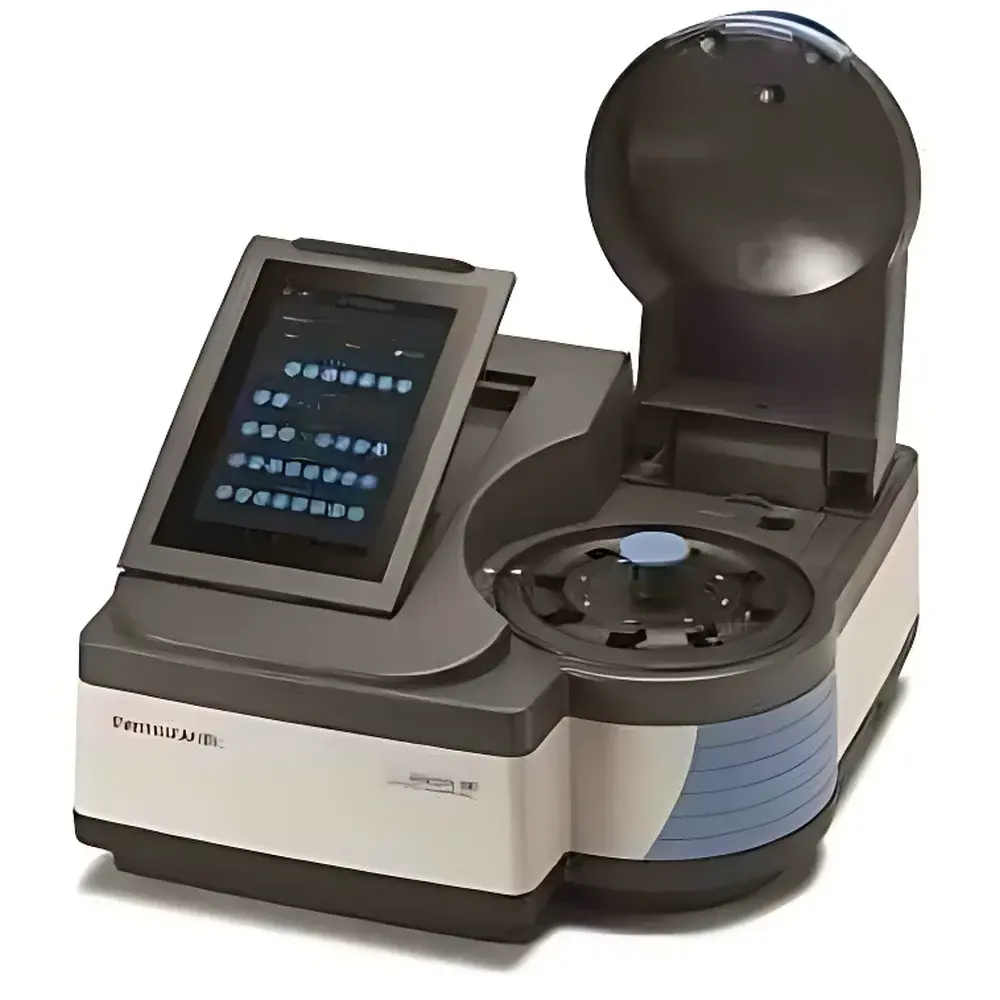
Thermo Fisher BioMate 160 UV-Vis Spectrophotometer
| Brand | Thermo Fisher |
|---|---|
| Origin | USA |
| Distributor Type | Authorized Distributor |
| Origin Category | Imported |
| Model | BioMate 160 |
| Instrument Architecture | Pseudo-Double-Beam |
| Detector Type | Photodiode Array (PDA) |
| Wavelength Range | 190–1100 nm |
| Wavelength Scanning | Automated |
| Spectral Bandwidth | 2 nm |
| Wavelength Accuracy | ±0.5 nm |
| Stray Light | <1.0%T at 198 nm (KCl), <0.05%T at 220 nm (NaI), <0.03%T at 340 nm (NaNO₂) |
Overview
The Thermo Fisher BioMate 160 UV-Vis Spectrophotometer is a dedicated, benchtop absorption spectrometer engineered for routine quantitative and qualitative analysis in life science laboratories. It operates on the principle of Beer–Lambert law-based absorbance measurement across the ultraviolet and visible spectrum (190–1100 nm), utilizing a pseudo-double-beam optical design to compensate for source intensity drift and detector response variation during scanning. Its core hardware platform derives from the GENESYS 150 series—optimized for stability, reproducibility, and low-maintenance operation—while integrating purpose-built life science firmware and an embedded 7-inch high-resolution tilting touchscreen interface. The xenon flash lamp eliminates warm-up delays and enables rapid, single-shot spectral acquisition with minimal photodegradation risk to light-sensitive biological samples.
Key Features
- Pseudo-double-beam architecture with real-time reference beam correction for enhanced baseline stability and long-term measurement repeatability
- Photodiode array (PDA) detector enabling full-spectrum acquisition in under 1 second, supporting kinetic and time-resolved measurements
- Fixed 2 nm spectral bandwidth—optimized for resolution/sensitivity balance in nucleic acid and protein quantification
- Wavelength accuracy of ±0.5 nm certified per NIST-traceable calibration protocols; validated across the full operational range using standard reference materials (e.g., holmium oxide, didymium filters)
- Stray light performance compliant with ISO 9001 and ASTM E275-22 specifications: <1.0%T at 198 nm (KCl), <0.05%T at 220 nm (NaI), <0.03%T at 340 nm (NaNO₂)
- Integrated 7-inch capacitive touchscreen with anti-glare coating and adjustable tilt mechanism for ergonomic operation under varied lighting conditions
- Onboard Wi-Fi connectivity (802.11 b/g/n) supporting secure transfer of methods, spectra, and reports to networked storage or LIMS environments
- Xenon flash lamp with >10⁹ shot lifetime—no warm-up required, zero lamp alignment maintenance, and consistent spectral output over instrument lifetime
Sample Compatibility & Compliance
The BioMate 160 accommodates standard 10 mm pathlength cuvettes (glass, quartz, or plastic), as well as optional accessories including microvolume stands (e.g., 0.5–2 µL capillary-based measurement), Peltier-controlled temperature-regulated holders (±0.1 °C stability), and multi-cell changers for unattended batch analysis. All preconfigured life science applications—including A260/A280, A260/A230, A280, A205, OD600, and enzyme kinetics—are aligned with widely accepted protocols referenced in USP , ISO/IEC 17025, and CLSI EP10-A3 guidelines. The system supports audit trail generation and electronic signature capability when deployed in GLP- or GMP-regulated environments, meeting foundational requirements for data integrity under FDA 21 CFR Part 11 (when used with validated network infrastructure and user access controls).
Software & Data Management
The instrument runs Thermo Scientific™ BioMate™ Software v3.x—a standalone, Windows-compatible application with embedded method templates and customizable reporting. Raw absorbance, transmittance, and concentration data are stored in vendor-neutral .csv and .jdx formats. Method files include metadata such as operator ID, timestamp, instrument serial number, and calibration history. Wi-Fi-enabled synchronization allows direct export to shared drives, cloud repositories (via configured SFTP or HTTPS endpoints), or local printers without requiring intermediate PC connection. Data encryption (AES-256) and role-based user permissions (administrator, analyst, viewer) are configurable to support laboratory information governance frameworks.
Applications
- Nucleic acid quantification and purity assessment (DNA, RNA, oligonucleotides) via A260, A260/A280, and A260/A230 ratios
- Protein concentration determination using A280 (tryptophan/tyrosine) and A205 (peptide bond) absorbance
- Microbial growth monitoring through OD600 turbidity measurements in suspension cultures
- Enzyme kinetics (e.g., NADH/NADPH oxidation, p-nitrophenyl phosphate hydrolysis) with programmable time-point sampling
- Colorimetric assay validation (e.g., BCA, Bradford, Lowry) with built-in standard curve fitting (linear, quadratic, log-log, 4PL)
- UV-Vis characterization of synthetic dyes, nanoparticles, and small-molecule pharmaceuticals
FAQ
Is the BioMate 160 compliant with FDA 21 CFR Part 11?
Yes—when deployed with appropriate IT infrastructure (e.g., domain-authenticated network, encrypted storage, and documented SOPs), the system supports electronic records and signatures per Part 11 Annex A requirements, including audit trail review and user authentication.
Can I use disposable plastic cuvettes for microvolume measurements?
Yes—the optional microvolume adapter supports 0.5–2 µL sample volumes in standard disposable plastic cuvettes, eliminating the need for expensive quartz capillaries while maintaining measurement fidelity for dilute biomolecular solutions.
Does the instrument require routine wavelength recalibration?
No—factory-performed wavelength calibration is traceable to NIST standards and remains stable for ≥12 months under normal operating conditions; verification checks using holmium oxide solution are recommended quarterly.
What is the maximum scan speed for full-spectrum acquisition?
Full 190–1100 nm scans are completed in ≤1.2 seconds with 1 nm data interval, enabling high-throughput screening of multiwell plate-derived samples when paired with compatible autosamplers.
Is remote instrument control supported?
Remote monitoring and method execution are possible via Wi-Fi-connected devices running the BioMate Software client; however, direct browser-based or mobile app control is not natively supported.





