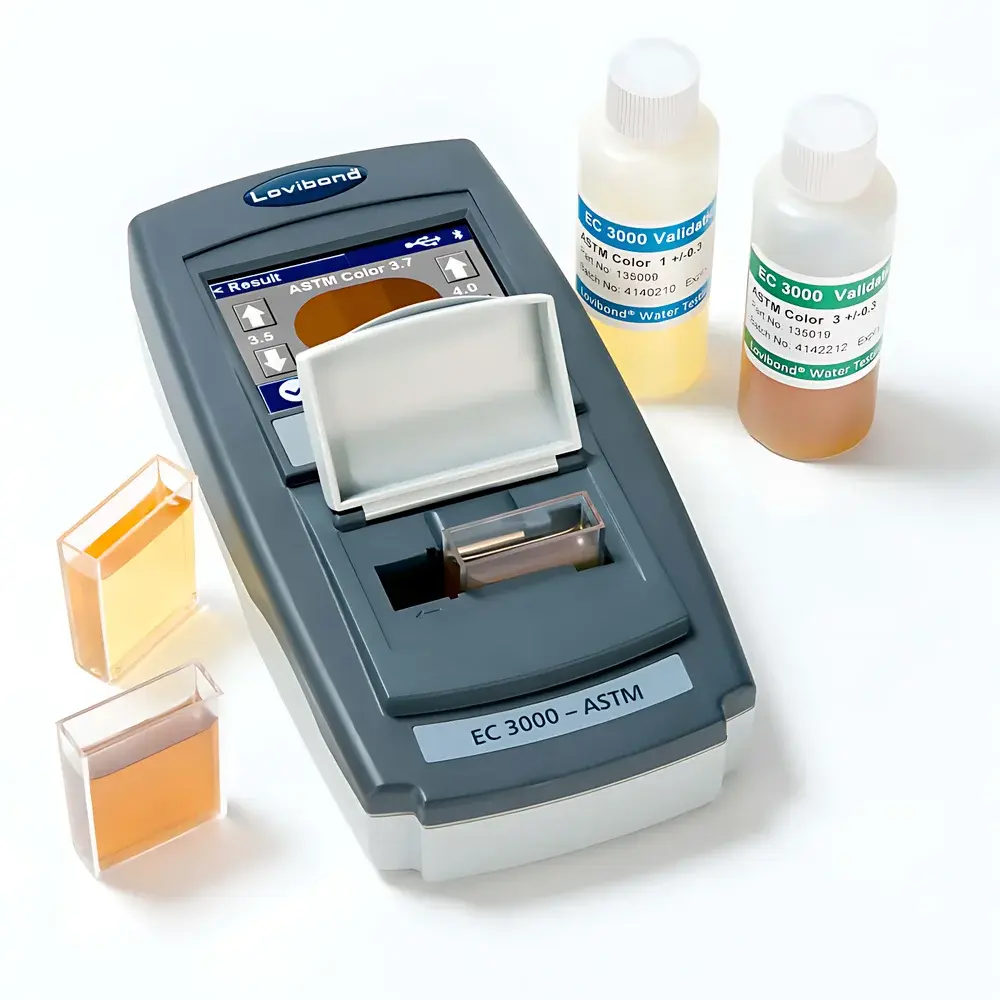
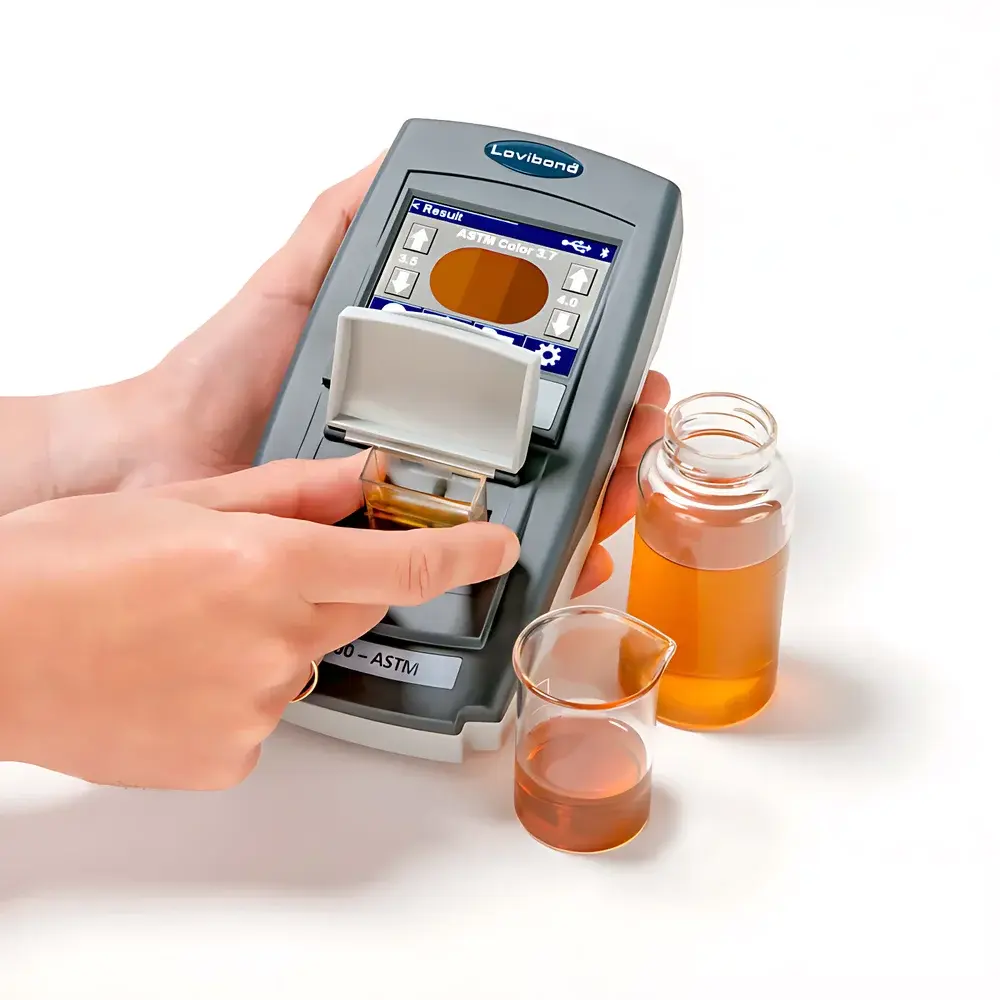
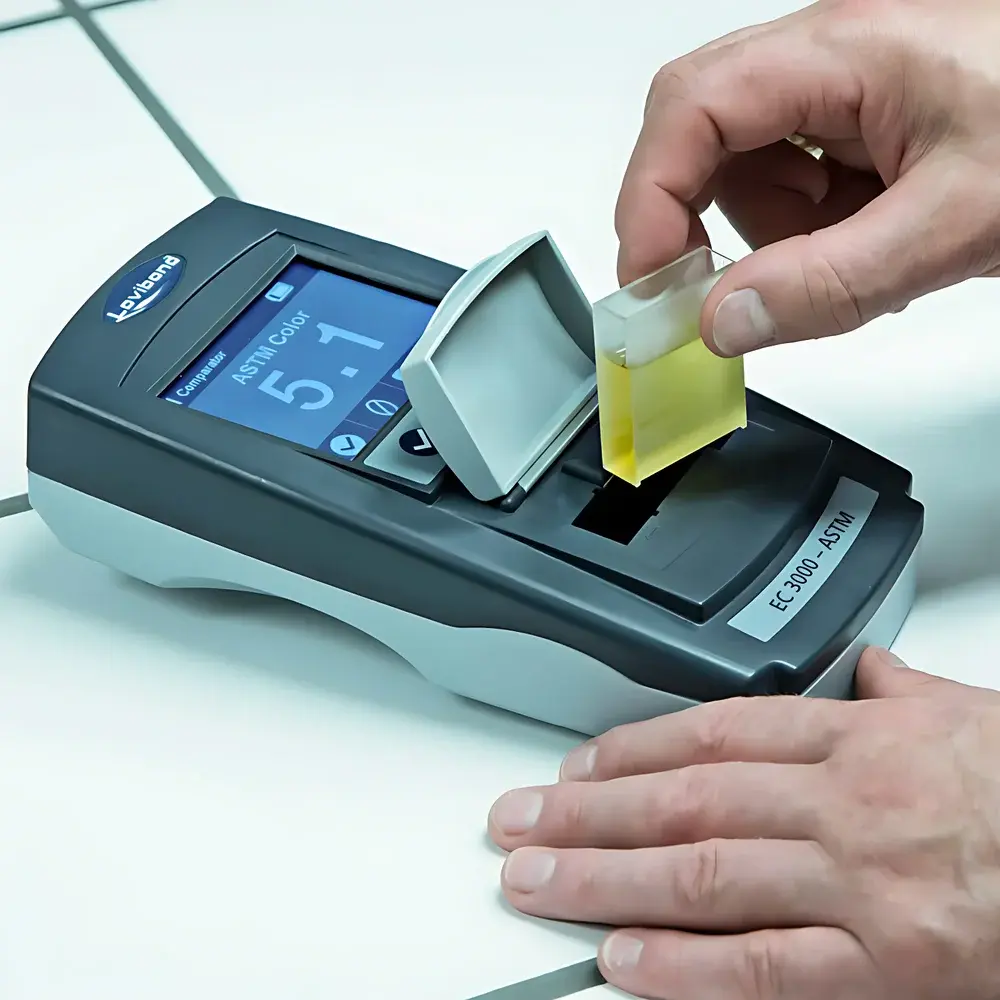
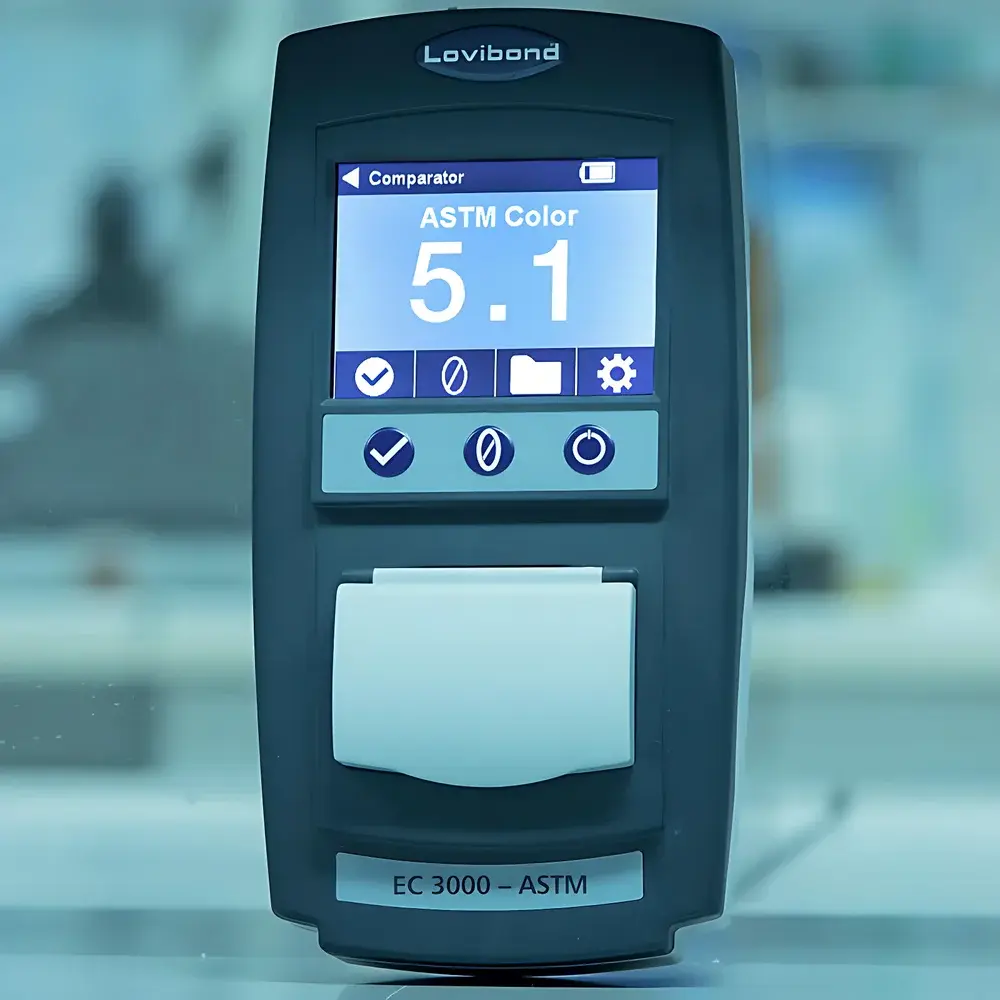
Lovibond EC3000 ASTM Digital Colorimeter
| Brand | Lovibond (Tintometer) |
|---|---|
| Origin | United Kingdom |
| Model | EC3000 ASTM |
| Measurement Range | 0–8 ASTM units |
| Resolution | 0.1 unit |
| Repeatability | ±0.1 unit |
| Path Length | 33 mm |
| Standard Compliance | ASTM D1500, ASTM D6045 |
| Field of View | 3-field |
| Cuvette Types | Two 33 mm plastic cuvettes (W100), Two 33 mm glass cuvettes (W100) |
| Calibration Standards | Two 60 mL reference liquid standards |
| Filter Set | Two certified interference filters |
Overview
The Lovibond EC3000 ASTM Digital Colorimeter is a precision optical instrument engineered for objective, repeatable quantification of color in petroleum-based liquids according to the internationally recognized ASTM D1500 standard. Unlike subjective visual comparison methods, this instrument employs a stable tungsten-halogen light source and a calibrated photometric detection system to measure spectral transmittance at defined wavelengths—primarily within the visible range optimized for hydrocarbon color assessment. The EC3000 operates on the principle of single-wavelength photometry, where absorbance is converted into an ASTM color unit via a factory-established calibration curve traceable to NIST-traceable reference materials. Its design bridges the transition from legacy visual comparators to modern digital metrology without requiring operators to abandon familiar ASTM scale interpretation. The instrument delivers a single scalar output—ASTM color number—spanning 0.5 to 8.0 in 0.5-unit increments, mapping directly to the standardized 16-step scale used for grading lubricating oils, heating oils, diesel fuels, and other refined petroleum distillates.
Key Features
- Compliance-certified measurement engine fully aligned with ASTM D1500 and ASTM D6045 test methodologies
- Dual-cuvette 3-field viewing system enabling simultaneous sample, blank, and reference comparison for rapid visual verification
- High-stability tungsten-halogen illumination with thermal regulation to minimize drift during extended operation
- Integrated optical path length of 33 mm—optimized for standard ASTM sample thickness and consistent with historical comparator geometry
- Resolution of 0.1 ASTM unit and repeatability of ±0.1 unit under controlled laboratory conditions (23 °C ±2 °C, RH <70 %)
- Dedicated firmware with direct ASTM unit display—no manual conversion or lookup tables required
- Robust mechanical architecture with scratch-resistant optical windows and corrosion-resistant housing suitable for QC lab environments
Sample Compatibility & Compliance
The EC3000 ASTM is validated for use with clear to moderately hazy liquid hydrocarbons that meet ASTM D1500 sample preparation requirements—including filtration through 0.8 µm membrane filters and degassing where necessary. It accommodates both W100-format plastic and glass cuvettes (33 mm path length), allowing laboratories to select based on chemical compatibility, cost-per-test, or regulatory preference. All optical components are certified against ISO/IEC 17025-accredited reference filters, and the instrument’s performance verification protocol includes daily zeroing with air or solvent blank and periodic validation using supplied 60 mL traceable liquid standards. The device supports GLP-compliant operation through documented calibration logs, user-accessible firmware versioning, and physical seal integrity checks on filter compartments.
Software & Data Management
While the EC3000 ASTM operates as a standalone benchtop instrument with no embedded data logging or USB connectivity, its measurement workflow integrates seamlessly into regulated quality systems. Each reading is displayed numerically and may be manually recorded into LIMS or electronic lab notebooks. For laboratories requiring audit trails, the instrument’s calibration history—including date, operator ID, reference standard lot number, and deviation values—must be maintained per internal SOPs aligned with FDA 21 CFR Part 11 principles. Optional external barcode scanners or dedicated data capture terminals can be deployed to reduce transcription errors when paired with structured reporting templates compliant with ISO 9001 and API RP 2000 documentation frameworks.
Applications
- Quality control of base oils and finished lubricants during refining and blending operations
- Batch release testing of heating oil and marine diesel fuel per EN 590 and ASTM D975 specifications
- Stability monitoring of transformer oils and insulating fluids over time
- Supplier qualification and incoming inspection of petrochemical feedstocks
- Technical support for ASTM method validation studies and interlaboratory round-robin trials
- Training platform for analysts transitioning from visual comparator techniques to instrumental color analysis
FAQ
What ASTM standards does the EC3000 specifically support?
It is designed and verified for ASTM D1500 (Standard Test Method for Color of Petroleum Products [ASTM Color Scale]) and ASTM D6045 (Standard Practice for Instrumental Determination of ASTM Color of Petroleum Products).
Can the EC3000 measure non-petroleum samples such as food oils or solvents?
No—it is calibrated exclusively for the ASTM D1500 scale and should not be used for samples outside the defined hydrocarbon matrix; alternative color scales (e.g., Gardner, Saybolt) require dedicated instruments.
Is the instrument supplied with calibration documentation?
Yes—each unit ships with a manufacturer-issued Certificate of Conformance referencing ASTM D1500, along with individual calibration records for included liquid standards and interference filters.
How often must the EC3000 be recalibrated?
Annual recalibration by an accredited service provider is recommended; however, daily verification with blank and reference standards is mandatory prior to sample analysis per ASTM D1500 Section 8.3.
Does the EC3000 comply with FDA 21 CFR Part 11 requirements?
As a standalone analog-output device without electronic record generation, it does not fall under Part 11 scope—but its use within a validated process meets ALCOA+ data integrity expectations when supported by procedural controls.