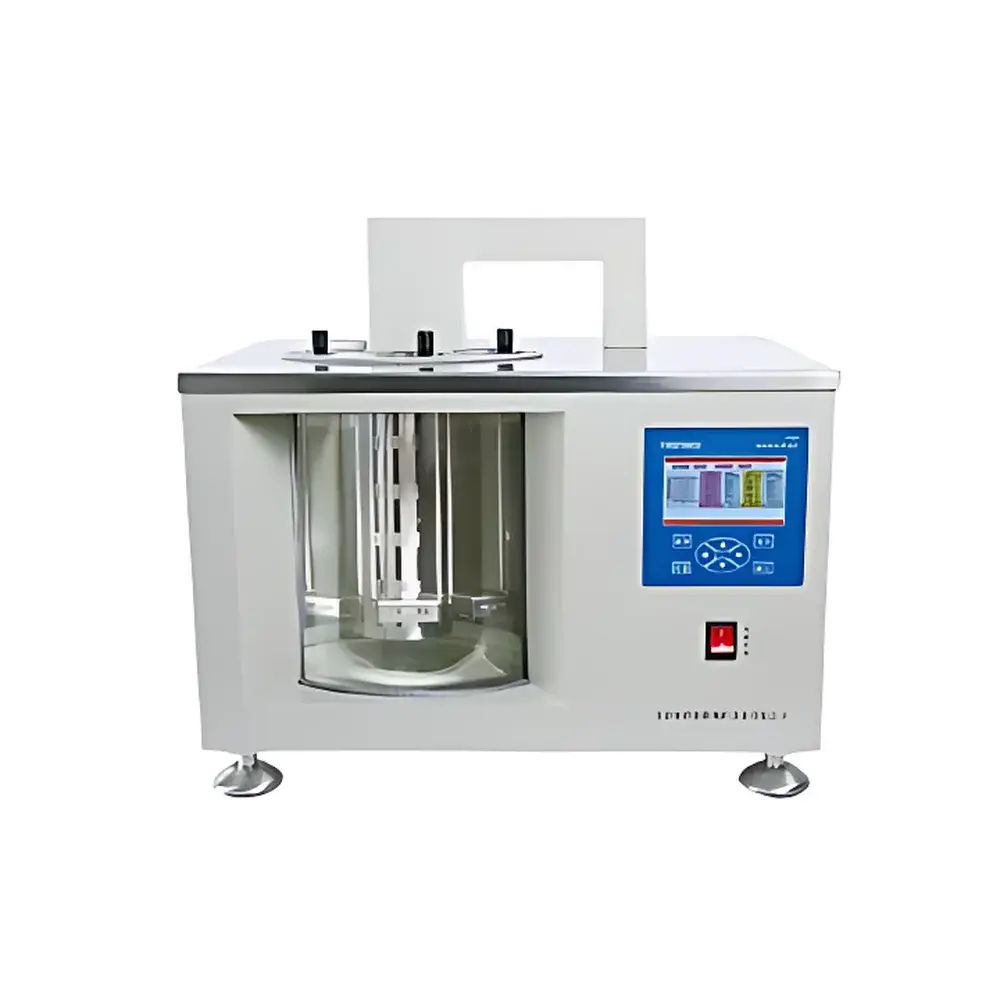
Timepower TP625 Kinematic Viscosity Tester
| Brand | Timepower |
|---|---|
| Origin | Beijing, China |
| Manufacturer Type | Manufacturer |
| Origin Category | Domestic |
| Model | TP625 |
| Pricing | Upon Request |
| Temperature Control Range | 0–120 °C (0 °C to ambient requires optional chiller) |
| Temperature Stability | ±0.05 °C |
| Temperature Resolution | 0.01 °C |
| Bath Capacity | 4 test positions |
| Display | True-color LCD with real-time clock (year/month/day/hour/minute, battery-backed) |
| Power Supply | AC 220 V ±10%, 50 Hz ±10% |
| Heating Power | ≤1500 W |
| Dimensions | 510 × 360 × 470 mm |
| Weight | 20 kg |
| Ambient Operating Conditions | 5–40 °C, ≤85% RH |
| Compliance | GB/T 265–1988 |
| Sensor | Imported high-precision platinum RTD |
| Control Algorithm | PID-based digital temperature regulation |
| Optional Accessories | Ubbelohde (standard), Reverse-flow capillary viscometers (optional) |
| Cooling | External refrigeration unit available for sub-ambient measurements |
Overview
The Timepower TP625 Kinematic Viscosity Tester is a precision-engineered laboratory instrument designed for the accurate and repeatable determination of kinematic viscosity in petroleum products and related hydrocarbon-based fluids. It operates on the principle of capillary flow under gravity—measuring the time required for a fixed volume of liquid to flow through a calibrated glass capillary tube under standardized thermal conditions, as defined by GB/T 265–1988 (equivalent to ASTM D445 and ISO 3104). The instrument maintains strict thermal equilibrium via a digitally regulated constant-temperature water bath, ensuring compliance with international test methodology requirements for reproducibility and traceability. Its architecture integrates microprocessor-based control, high-fidelity temperature sensing, and automated timing logic to eliminate operator-dependent variability in efflux time measurement—a critical factor in viscosity reporting per ISO/IEC 17025-accredited laboratories.
Key Features
- Digital PID temperature control system with ±0.05 °C stability across the full 0–120 °C operating range—achieving thermal uniformity essential for viscosity accuracy.
- True-color LCD interface with embedded real-time clock (battery-backed), supporting date/time stamping of all test records for audit readiness.
- Four independent bath positions enabling parallel analysis of multiple samples or replicate determinations within a single thermal cycle.
- Imported platinum resistance temperature detector (RTD) with <0.01 °C resolution and fast thermal response, minimizing temperature drift during extended testing sessions.
- Integrated LED illumination system for enhanced visual clarity when observing meniscus movement in capillary tubes—critical for precise start/stop timing in manual or semi-automated modes.
- Modular design supports optional external refrigeration units for low-temperature kinematic viscosity testing down to 0 °C, extending applicability to waxy distillates and low-pour lubricants.
- Comprehensive safety logic: automatic power cutoff upon abnormal temperature rise, fuse-protected main supply, and interlocked heater activation sequence requiring bath fill verification prior to energization.
Sample Compatibility & Compliance
The TP625 is validated for use with transparent and opaque petroleum liquids—including base oils, transformer oils, hydraulic fluids, diesel fuels, and residual fuel oils—provided they meet the flow criteria specified in GB/T 265–1988. It accommodates standard Ubbelohde-type capillary viscometers (supplied) and optionally supports reverse-flow capillaries for high-viscosity or volatile samples. All operational parameters—including bath temperature setpoint, dwell time, and efflux timing—can be logged and exported to support GLP/GMP documentation requirements. The instrument’s firmware and calibration protocols are structured to align with ISO/IEC 17025 clause 6.4 (equipment verification) and FDA 21 CFR Part 11 principles where electronic records are generated (e.g., timestamped results, user ID tagging, and immutable audit trails).
Software & Data Management
While the TP625 operates as a standalone benchtop instrument with embedded firmware, its result output includes ASCII-formatted data packets compatible with laboratory information management systems (LIMS) via RS-232 or optional USB-to-serial interface. Each test record contains sample ID, bath temperature, efflux time(s), calculated kinematic viscosity (in mm²/s), and metadata (date, time, operator code). Internal memory retains up to 1,000 test entries with cyclic overwrite protection. Calibration constants for individual capillaries are stored per viscometer ID, allowing multi-instrument traceability. For regulated environments, optional software modules provide electronic signature capture, deviation logging, and export to CSV or PDF formats compliant with internal QA review workflows.
Applications
- Quality control of insulating oils in power generation and transmission facilities—verifying conformance to IEC 60296 specifications.
- Routine monitoring of lubricant degradation in refinery and petrochemical process streams.
- Specification testing of aviation turbine fuels (Jet A-1, JP-8) per ASTM D3612 and DEF STAN 91-91.
- Research-grade characterization of biofuel blends (FAME, HVO) where temperature-dependent viscosity profiles influence injection and atomization behavior.
- Contract testing laboratories performing third-party certification against GB/T, ASTM, ISO, or EN standards.
- Academic and industrial R&D labs studying structure–viscosity relationships in polymer-modified bitumens and synthetic ester lubricants.
FAQ
What capillary viscometers are supported?
The TP625 ships with calibrated Ubbelohde-type capillaries meeting GB/T 265–1988 dimensional tolerances; reverse-flow viscometers are available as optional accessories for viscous or volatile samples.
Is the instrument suitable for ASTM D445 testing?
Yes—the thermal control performance, timing resolution, and procedural logic fully satisfy ASTM D445 requirements when operated with certified capillaries and validated calibration standards.
How is temperature calibration verified?
Users must periodically verify displayed bath temperature against a NIST-traceable reference thermometer; the instrument provides a dedicated calibration offset adjustment function for correction.
Can test data be exported to LIMS?
Yes—via serial communication using configurable ASCII protocol; integration with common LIMS platforms (e.g., LabWare, Thermo SampleManager) has been validated in multiple client installations.
What maintenance is required?
Routine tasks include periodic cleaning of the water bath, inspection of capillary integrity, validation of temperature sensor drift (<0.1 °C/year typical), and annual verification of timing circuit accuracy using certified quartz timers.